Cultural myths….Buried treasure

treasure pic

Once upon a time, there was a flojo (lazy boy) whose mother told him to go out and gather leña (wood) for the fire. So out he went, hither and yon, picking up sticks at a leisurely pace. Spotting a mesquite tree, he decided he would rest from his labors. Drawing close, he came across a wooden chest in the shade. Curious, he lifted the lid and found it brimming with gold coins. The chest was too heavy for him to carry he did have all that leña (wood) to carry, so he decided he would leave the treasure there. He gathered his sticks and headed home.

He told his mother about the treasure he had found under the mesquite tree and she scolded him for not bringing even one coin back with him. He replied that if the treasure were meant for him, it would come to him. The mother threw up her hands in exasperation.

An ambitious neighbor happened to be passing when the boy was telling this story to his mother and heard everything. He dropped what he was doing and went in search of the treasure.

Just as the boy had said, the neighbor found the chest under the mesquite tree. He chortled in glee and threw open the lid only to discover that it was full of horse manure. Furious, he hauled the chest and manure to the boy’s house and threw it all on the roof.

Now, the house was old and rickety and the roof had several places where the laminas (roofing sheets) had rotted through. Some of the manure fell through those holes in the roof and landed on the boy’s bed. Imagine his surprise when the he woke the next morning covered in gold coins. Because the treasure was meant for him it had come to him just as he said.

This is just one example of local legends concerning treasures. No wonder my son has difficulty with Mexican moral values. I’m not sure what lesson this story is supposed to teach–that one should wait passively for good fortune, that one should accept his or her lot in life and not make efforts to better it–or what?

digging treasure

My husband’s mother once had a dream where a woman appeared to her and told her that there was a treasure buried in the back room of their house in Cerano. The woman said that this treasure would be my mother-in-law’s if she followed her instructions exactly. If not, she would take one of her children. She was not to leave the house at midnight when she heard dogs bark that night or both her child and the treasure would be taken from her.

My mother-in-law woke very excited. She bullied her husband into digging up the floor in the back room in search of the treasure. As she was pregnant, my mother-in-law couldn’t do much digging herself. My father-in-law dug and dug, from early morning until midnight, but did not find a thing. At midnight, they heard dogs barking outside and in her concern for the livestock, my mother-in-law ran out to scare the dogs away, but there were no dogs.

Remembering what the woman had told her, my mother-in-law ran back into the house, but it was too late. She began to have labor pains. All the next day she labored to give birth, but when she finally was able to push, there was no baby, only fluid and blood. The woman had taken her 12th child right from her womb and the treasure was never found.

This story is repeated as fact in my husband’s family. Here there is a strong tendency to believe in the messages given in dreams. A curandera (healer) is a respected position in the community and has the ability to not only treat with herbs but interpret tarot cards and dreams. I admit there are things in México that defy other rational explanation.

treasure map

Another local legend has it that one late afternoon, a campesino (farmer) was walking home after he had collected leña (wood) for the evening meal. Out of the blue, a stone flew through the air and hit the farmer in the head. He carried on a bit, running back and forth, looking for the person who had thrown that rock. A second came and hit the campesino (farmer) in the back. Try as he might, he could not locate the source of the stones. As he stood confused in the road, a hole opened at his feet. That was too much for him and he scrambled off the road towards home.

His wife, after hearing the story, scolded him. Everyone knows after all, that a treasure comes to the person it was meant for, but he had lost his opportunity for wealth because of his fear. Second chances are never given.

So my husband and his buddy Bigotes (mustache) were talking one day and the conversation turned to treasures. According to Bigotes, there is an area rumored to be the spot of a hidden treasure near the base of La Yacata. So the two of them made plans to go poking about and see if they could find the treasure. Bigotes claimed to have a magic ring that when spun at the treasure site, will tell the seekers the method to obtain that treasure. For example, the seeker must demonstrate valiente (bravery) in some way if that is what the ring spells out. Of course, reading the small print clause for treasure seeking you will find that someone must “comer tierra” (eat dirt) or in other words die for the treasure to be found. But remember the treasure can only be found by those that are intended to find it.

Bigotes had other things to do that afternoon, so my husband went on his own, although I discouraged him since I didn’t really want him to “comer tierra.” But when has he ever listened to me? He went exploring and didn’t find the treasure per se, but came back whistling with a feed bag full of clanking things. He had found a pile of trash and rummaged about in it, pulling out wires and metal things. Delighted with his find, he took them the next day to where they buy fierro viejo (old metal) and received nearly $500 pesos–truly a treasure–at least for us!

My husband and his "treasure"

My husband and his “treasure”

***********

disclosure

2 Comments

Filed under Mexican Cultural Stories

Forcibly Green–Obligatory Organic

Welcome to the April edition of the Simply Living Blog Carnival – Going Green cohosted by Mandy at Living Peacefully with Children, Laura at Authentic Parenting, Jennifer at True Confessions of a Real Mommy, and Joella at Fine and Fair. This month, we write about going green and environmentally friendly living. Please check out the links to posts by our other participants at the end of this post.

***

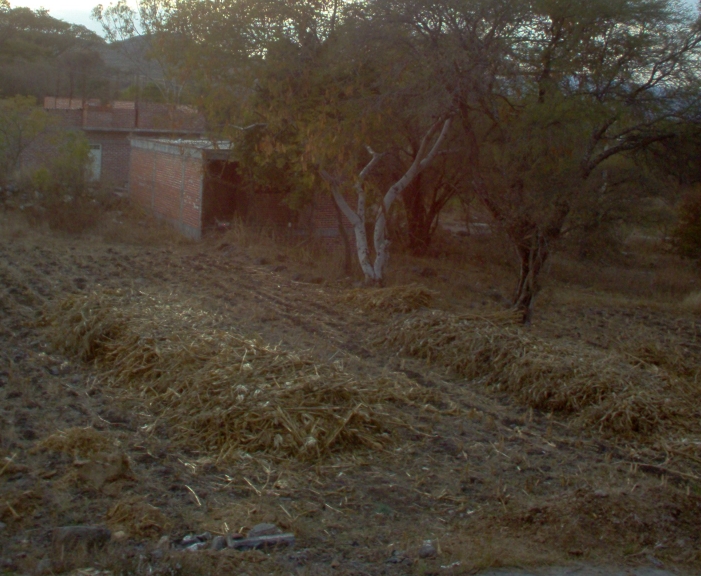
rastrojo

After the corn is harvested, it is laid out to dry completely then milled to make feed for our animals.

It’s easy in a modern world, to discount the effect one person has on the environment. The trash truck comes and hauls away the trash. The sewer flushes away excrement. The wind blows away car exhaust. The immediate surroundings remain clean. Now suppose all those conveniences are taken away. There is no trash truck, no sewer, no filter to clean the water, no running water for that matter. Would a person reexamine how he or she lives and make an effort to be more mindful in green living? Well, it depends on the person I guess.

Once upon a time, in a previous life, I thought I was more or less living “green.” I would go to the grocery store, pick up organic produce, buy organic canned and packaged food, use a filter for my water tap, use organic clothing when it was on sale, separate recycling and drop it off at the local bins, piddle with plants, use cloth bags and pat myself on the back for being concerned with the environment. Silly girl!

Now I live in an alternative life, where there is no choice but to be green.

When I go to the fruteria (fruit and vegetable store), I have only one option–local in-season produce or nothing at all. While not necessarily by choice, I am reducing greenhouse gasses since the food travels a relatively short distance to reach the market. I also do not contribute to pollution and waste caused by packaging and processing. All the fruits and vegetables are in their natural, ripened state, ready for purchase by the kilo, not can. I use a canvas bag for shopping whenever possible, not because it reduces the plastic bag waste residue (although I’m all for that) but because I am charged 50 centavos more for the bag, and these days every peso counts.

Corn and beans are a staple in the diet here, both for animals and people. Corn tortillas are a part of every meal. The Mexican government controls the corn prices. Of course, that means that inflation is unchecked. Since we arrived, the price of a kilo of tortillas has gone from 6 pesos to 13. Bodega Aurrera (a branch of Wal-mart) is mysteriously allowed to sell tortillas at a price below the federal mandate and offers a kilo for 8 to 10 pesos, but their tortillas have the consistency of cardboard.

With the prices of seed corn rising every season, it is now cheaper for the tortillerias (tortilla makers) to buy corn flour imported from the U.S. where Monsanto rules. As of 2005, Monsanto has garnered permission to sell their GMO seeds in México, overriding farmers’ protests. It really is only a matter of time before economics destroy the legacy of corn in the land where it was first cultivated.

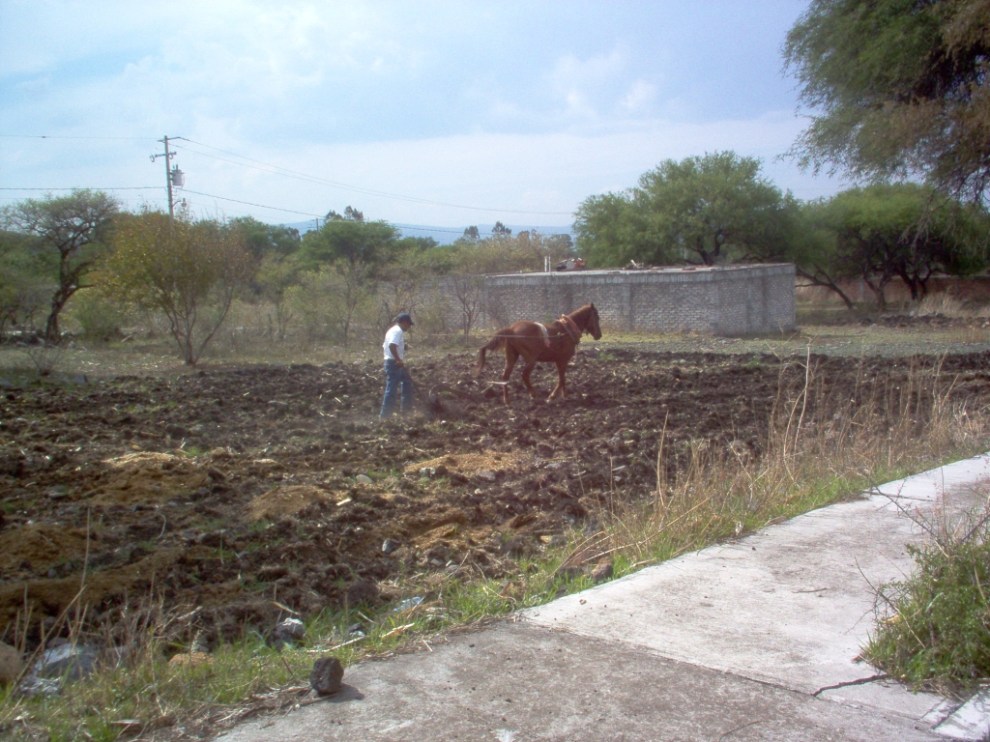
farming

My husband with Red preparing the field for planting.

So in order to maintain ourselves, we’ve had to expand our own cultivation. The growing season for this part of México is from June until November when the rainy season starts. So in June, we plant corn, beans, and squash on lotes prestados (borrowed lots) with a sort of sharecropping deal in the traditional way. The beans grow up and are supported by the corn stalks, and the squash plants fill in the ground between the stalks. We grow organically because every bit of the plant is used as food for ourselves (squash flower tacos are super awesome) or our animals (rastrojo is ground dried corn stalk and feeds our goats and horses through the dry season).

A liter of milk now costs 11 pesos, and a kilo of eggs (about 8 or 9 eggs) costs 30 pesos. There was a recent outbreak of avian flu among the commercially raised Mexican chicken population. Beef and pork products are “eat at your own risk.”  It’s only common sense that for our own health and pocketbook, we look for alternatives. We drink raw organic goat’s milk and are provided with organic eggs and meat from our own mini-ranch.

The Mexican government has a full-scale advertising campaign aimed at the conservation of water. Mexicans are advised to turn off the shower while they soap up. Bathtubs are a luxury nearly unheard of. Washing cars or watering lawns are simply not done. Millions of Mexicans still live without running water. Our own community of La Yacata is one of those areas. So water conservation is not merely of a matter of turning off the faucet while brushing your teeth. We take it seriously.

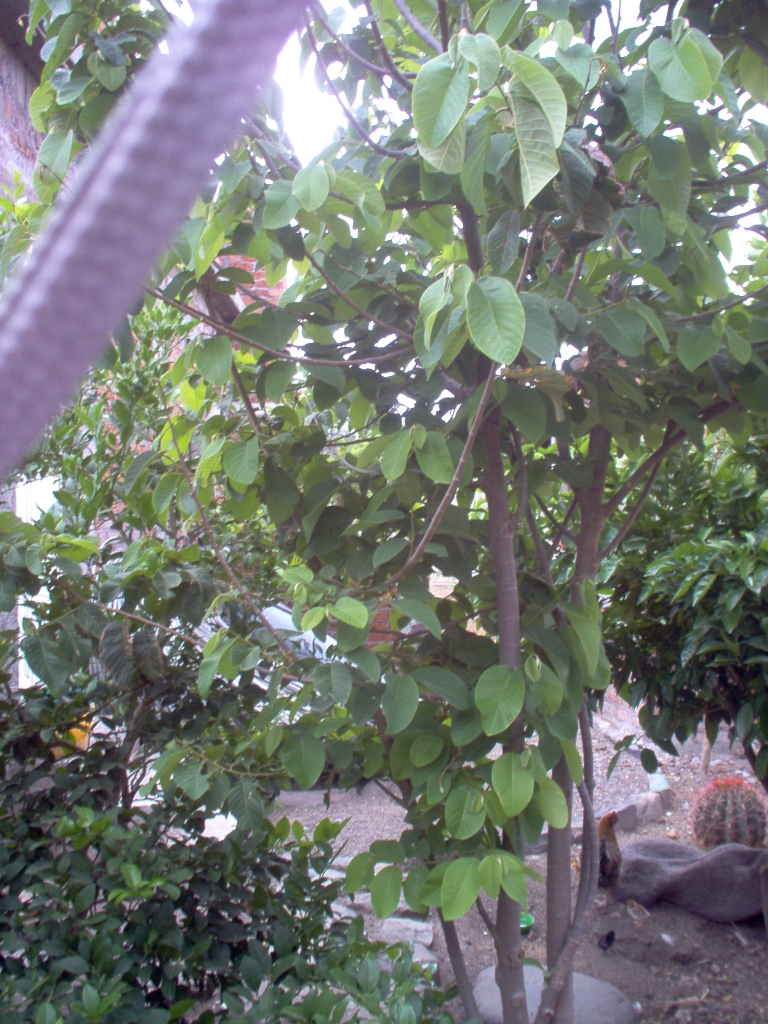
backyard

Our cherimoya tree in the back yard is watered by a pipe that brings wash water from the second floor to the tree roots.

El agua es bendito. (Water is Holy). We reuse nearly all of our gray water to water the fruit trees and plants in the backyard. We have orange, lime, lemon, cherimoya, mora (blackberry), peach, and granada (pomegranate), chayote and guayaba. Our animals do not have standing troughs but are given portioned servings of water. We do these things, not necessarily because they are good for the planet, although that is a great reason, but because the cost and effort of replenishing our water supply are extreme.

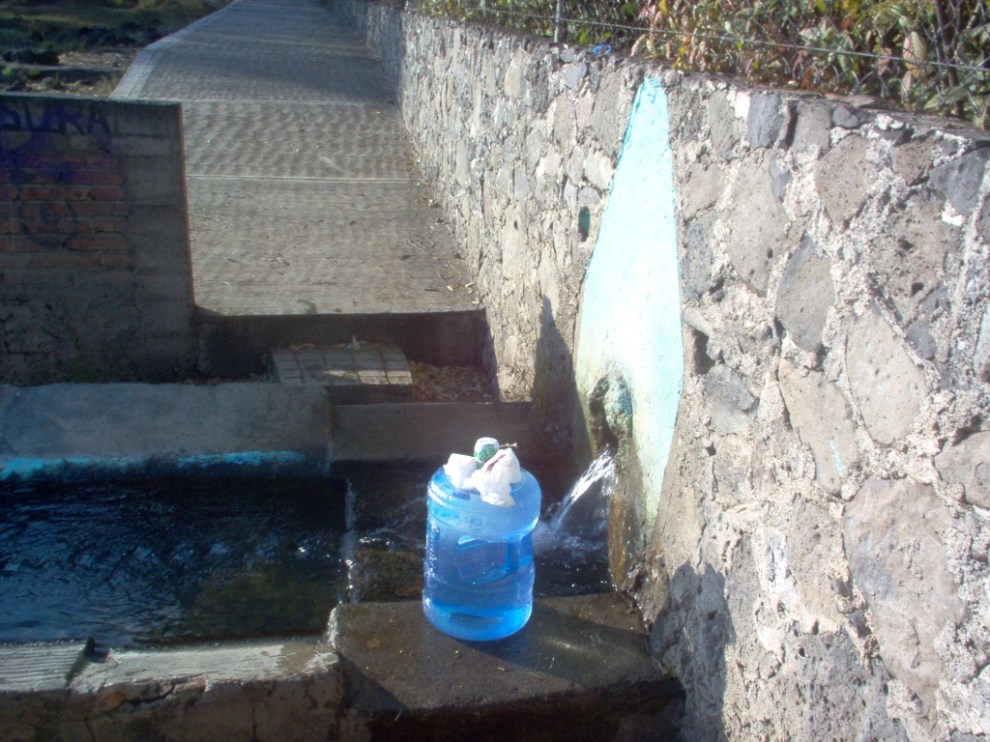
garafon

Filling our drinking water container from the natural springs in a nearby community.

At the same time, the government is encouraging water conservation, it reiterates that the water from the tap is not drinkable and everyone has to use bottled watered (sold by the Pepsi and Coke companies). A garafon (container) of water costs between 17 and 21 pesos. Sometimes, that’s out of our budget. So we go to presas (springs) in nearby communities and fill our garafon (container) from there. Until you have survived your first bout of churro (diarrhea) from drinking dirty water, you will never understand the importance of keeping the water supply clean.

How clean is your water? 

bottle recycle

Plastic can be sold to recycling centers here in Mexico however it pays so little per kilo that you have to gather a lot to make it worthwhile.

The trash tractor does not come to La Yacata for daily pickup. So what do we do with the garbage? Organic trash is given to our animals, no waste there. Anything metal can be resold for a few pesos as fierro viejo (old metal) to places that reuse and resell it. We have even gone hunting for scrap metal to resell when times are tough. Plastic trash is a problem, though. Although there are now places that will buy plastic to recycle, it pays so very little that only the most desperate junta botellas (collect bottles). We try not buy plastic in the first place, to reuse bottles when we can, or we are forced to burn them. Yes, this causes air pollution, but we haven’t come up with a viable solution to this yet.

Our neighbor, who has only lived there about a year, has contaminated his immediate environment (and ours) with his plastic trash. This is a problem for us, for it is always possible that one of our curious goats may ingest a plastic bag which will kill it. The trash heaps also attract coyotes and wild dogs and rats. I guess he’s just not too concerned with green living.

side car

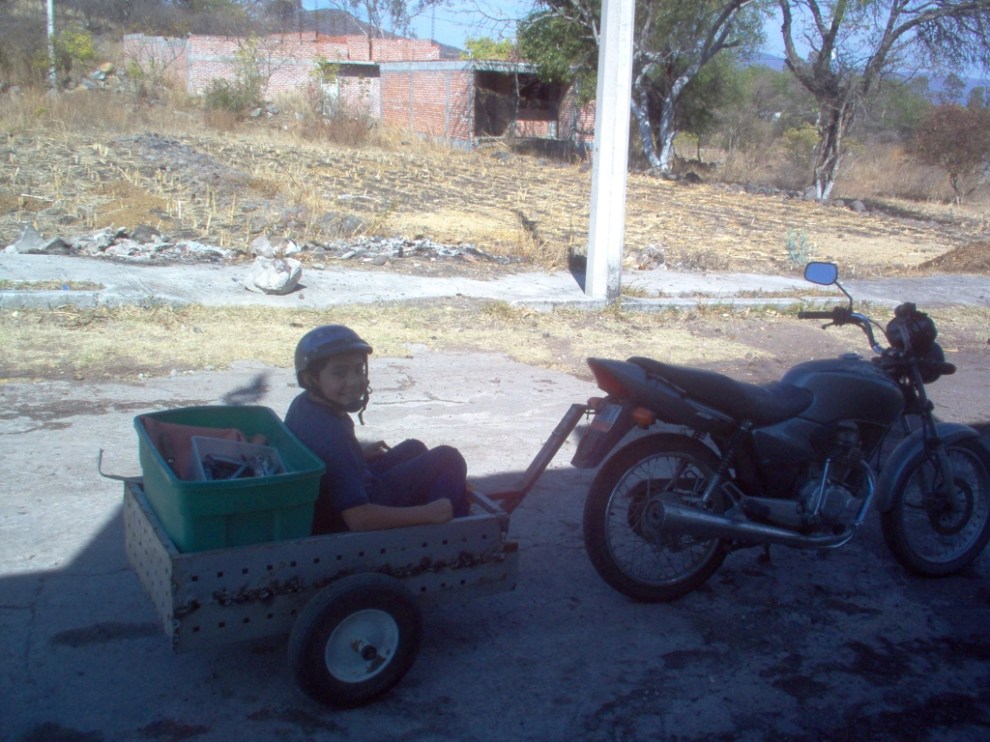
Moto-cart. Just the thing for transporting!

The Mexican government also regulates the prices for petroleum and gas prices have steadily been increasing. We have a truck, however, more often than not, we do not have enough pesos on hand to fill the tank, so it just sits there. Our everyday transportation consists of motos (motorcycles), my husband and I each have one. Using a moto cuts down on emissions, which is great, and provides other benefits like more money in the pocket and easy parking. I love my moto.

It seems to me that in general, people do not get excited until a dump is opened in their neighborhood or a factory that contaminates the water supply is built down the road. Then the “not in my backyard” motto unites the community into looking for different options with active protests. I admit to having been one of those people in my previous life. I did the least bothersome and let someone else worry about the rest. However, it’s been made clear to me that my “backyard” is larger than I imagined. In La Yacata, living green is an economic necessity. The price for contaminating the environment is too steep for us to pay. How about you?

***************************************

disclosure
**********************************************************

Thank you for visiting the Simply Living Blog Carnival cohosted by Mandy at Living Peacefully with Children, Laura at Authentic Parenting, Jennifer at True Confessions of a Real Mommy, and Joella at Fine and Fair. Read about how others are incorporating eco-friendly living solutions into their everyday lives. We hope you will join us next month, as the Simply Living Blog Carnival focuses on Daily Lives!

  • Green Renovating: A Lot, A Little, Not So Much – Laura at Authentic Parenting ponders about the many things that have an impact on eco-friendly renovating
  • Growing Native in My Flower Beds – Destany at They Are All of Me takes the guilt out of her flower habit by switching from high maintenance flowers to native plants which not only lessens her gardening load, but also benefits the local wild life.
  • Baby Steps – Kellie at Our Mindful Life shares how her family became more sustainable, one step at a time.
  • A Greener Holiday – Sara from Family Organic discusses the overwhelming amount of “stuff” that comes with every holiday and talks about how to simplify instead.
  • Forcibly Green–Obligatory Organic – Survivor at Surviving Mexico talks about her family’s evolution from passive to active green and sustainable living.
  • Giving It Away – Juliet Kemp of Twisting Vines writes about the role of Freecycle, the giant karmic lending library, in her simple and green living.
  • Simply Sustainable – Mandy at Living Peacefully with Children discusses her family’s attempts to live in harmony with the earth by living simply and more sustainably.
  • How Does Your Yarden Grow – Alisha at Cinnamon&Sassafras writes about an ongoing permaculture project, converting her grass lawn into a mower-free paradise.
  • Green? – Is it about ticking the boxes? sustainablemum shares her thoughts on what being green means in her life.
  • Using Cloth Products To Reduce Household Waste – Angela from Earth Mama’s World shares how her family replaced many disposable household products with cloth to reduce their household waste.
  • Going Green in Baby Steps – Joella of Fine and Fair shares some small, easy steps to gradually reduce your environmental impact.
  • Are You Ready To Play Outside?! – Alex from AN Portraits writes about gardening, and playing in the dirt, and how it’s O.K. to get dirty, play in the dirt, play with worms, for both adults and kids.
  • Lavender and Tea Tree Oil Laundry Booster – At Natural Parents Network, Megan from The Boho Mama shares an all-natural way to freshen laundry.

21 Comments

Filed under Animal Husbandry, Carnival posts, Economics, Homesteading, Water issues

The Working Man

working men

So with the closure of Taco Express, I told my husband that I would no longer be party to any more of his money-making schemes. I continued with my own schemes of course, but I will not invest in his.

Therefore, he started job hunting in earnest. It isn’t as easy as you might imagine. Unemployment rates are high, wages are low. In order to just apply for a job you typically must have a voter registration card, a driver’s license, a national registration number, proof of residency (like a utility bill), a high school diploma and your own application, purchased at a papelería (paper store). Each and every one of these documents is a hassle to obtain. You also should have someone already employed with the company who can vouch for you. It’s not what you know, but who you know.

So armed with these documents, my husband began his search. The most difficult type of employment to obtain is regular old construction work. There are too many workers for too few jobs. Then come in the men from outside Moroleón, from the ranchos, who are willing to work for even less than the standard $250 per day. Depending the current value of the pesos that averages out to be about $20 for an 8-10 workday.

This affected us directly as this was the type of job my husband had been looking for. He had not found regular employment in 4 years, then he had that operation and recovery time, so it limited the type of work he felt he could do without re-injuring himself. For instance, he didn’t think that he should be a water delivery boy carrying garafones (water cooler bottles) up and down stairs.

So anyway, he had been going to different job sites asking for employment. He came home each day discouraged. Those with jobs just laughed at his efforts. Literally. To them, it seemed humorous that they had jobs and he didn’t. It didn’t matter what he could do. Definitely not the land of opportunity here.

He found employment for one person, who would swear at the workers, have them do things outside their job, and basically make life miserable. He put up for it for two days, until due to the overseer’s error, he had his finger squished (lost his nail eventually, but no lasting nerve damage). He never got paid for his work, nor received anything in compensation for injuries.

Then another job my husband found was working for the state constructing overpass bridges. He liked his boss there, however, one day he was told to climb the bridge and work at the top. Traffic was not diverted around the construction site, nor was there any sort of scaffolding or safety equipment. The workers straddled two boards set over a yawning gap, over the traffic. He refused to go up and quit that instant. As my mom says, “It shows he has his priorities straight at least. His family comes first.” Seriously, what was I going to do, here in México, a widow, with a young son and no money to return to the US?

Recently, he was fortunate enough to find steady employment. He works for a family and the family of the family, in remodeling their houses. They have a plethora of properties in the area and always are looking for more to buy and redo, so he’s had work 6 days a week. They love his work.

However, he has had a problem with keeping a peon (assistant). Most of the work requires two people, either to carry things or to mix the cement while the other lays brick. So at first, he worked with his younger brother C. C is the youngest of the family of 11, and nothing much was ever expected of him. And he has lived up to that expectation of nothing. He and my husband had a falling out when C took off in our truck and crashed into a telephone pole. So then my husband was short one peon. I keep telling him to not work with his brothers.

Then he had another peon, a middle-aged man who owns lots in La Yacata. But my husband is demanding to work for, he expects quality work and his tools well cared for, and that was too much for the guy and he quit.

Then, my husband had his older brother J working with him, but again, there were problems. During this time, J fell off the wagon and was drinking excessively again and missed work. Then he decided that he preferred to return to Tamaulipas and left my husband in the lurch. Didn’t I just tell him not to work with his brothers?

So then he went in search of another peon, but as this was to be regular work, most guys felt it was too much commitment for them and said no.

But there are always men looking for work, so I’m sure that one will show up. In the meantime, he does the work for 2 people but gets only paid for one. It’s enough to make one think longingly of the States, where there was always enough work for anyone willing to work.

**************************************


disclosure

3 Comments

Filed under Employment