
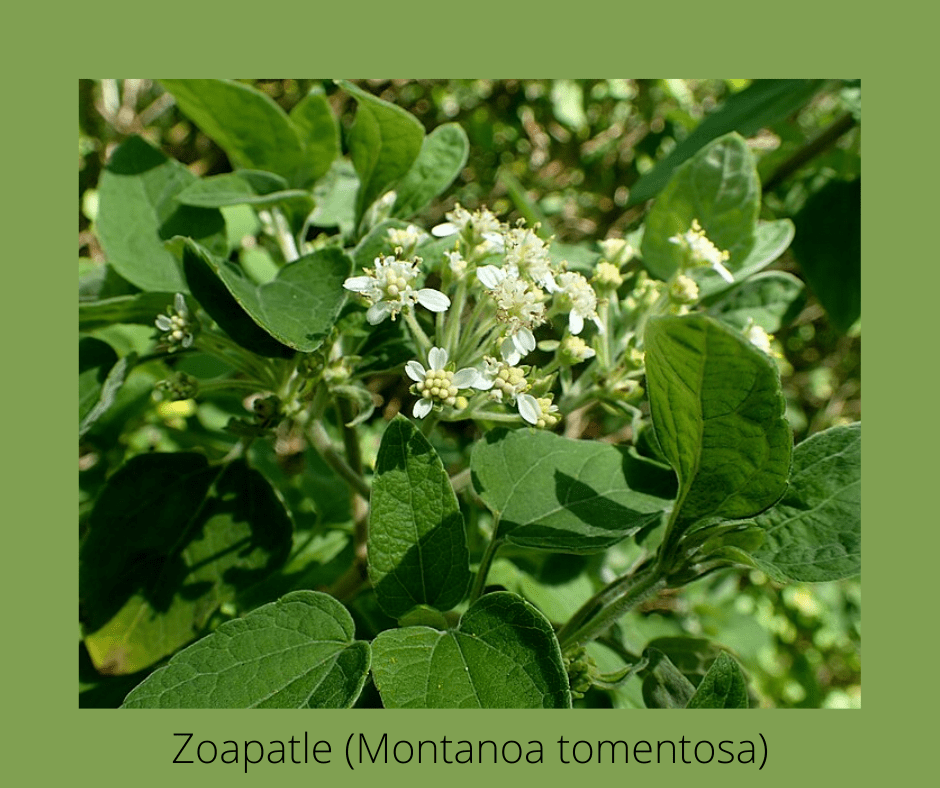
Zoapatle (Montanoa tomentosa), with spelling variants soapatle, zoapatli in Morelos, zihuatapli, zoapacle, zoapaxtle, zuhuapatli in Puebla, and zoapatl in Tlaxcala is also known as cihuapatli in Nahuatl which means “woman’s medicine.” Other names include roö and toó (Otomi) in Mexico state, Cacopacle in Hidalgo, and Cacachpa, Cacahpachtle, Chapus in Puebla. Other areas use the terms pirimo blanco or perimo (Purépecha), aclinán, yucuyahui, nocuana-titete-xini-ni or yaga-zeche (Zapotec), cuana-xana, ciguapactli, Homah-ak (Maya), and talacao (Guarijío).
This Mexican native bush has fragrant leaves and yellow or white flowers. Traditionally, it has been used to facilitate a difficult delivery and other “women’s issues.” The Florentine Codex records its use in delivery and for bloody diarrhea. Francisco Hernández documents that the plant is considered “hot” and useful in “cold” infirmities. He continued with the information that in addition to inducing labor, it was prescribed for post-partum infections and to bring on menstruation. Francisco Ximénez wrote that it was also useful in alleviating menstrual pain and anxiety. According to Martín de la Cruz, zoapatle root was added to stews and used as a flavoring in pulque.
A zoapatle leaf and root decoction is prepared with canela (Cinnamomum zeylanicum) and chocolate (Theobroma cacao) and given to the laboring mother to speed up delivery. Since the uterine contractions it provokes are extremely strong, zoapatle infusions should only be administered in extreme instances and never when there is something irregular about the baby’s placement, such as a breech birth. Additionally, the infusion can cause fatigue, thirst, and cardio-respiratory depression in the newborn if not taken in proper dosages. Bernardino de Sahagún recorded that this concoction was given right before the baby crowns. A second cup could be given if needed.
Zoaptle leaves combined with maiz root (Zea mays) sweetened with piloncillo (brown sugar cone) taken on an empty stomach is a simple abortifacient. Uterine contractions triggering miscarriage can begin as fast as five to twenty minutes after ingestion.
An after-birth tea is made with zoapatle leaves, bretónica (Lepechinia caulescens), and epazote (Dysphania ambrosioides), sweetened with chocolate (Theobroma cacao) or piloncillo (brown sugar cone) is served to help expel the placenta and reduce hemorrhaging. The plant and root are chopped and boiled to make a poultice to stop hemorrhaging after birth.
In the event that contractions are not strong enough to bring on cervical dilation, or the contractions are strong, but the cervix has not dilated, the laboring woman may be given a steam bath in the temazcal with zoapatle leaves. Studies have proven that zoapatle infusions will indeed cause cervical dilation.
To regulate menstruation, a decoction of zoapatle leaves is drunk in place of water while the woman fasts for three days. For menstrual cramps, the infusion is made with flower buds. Studies have shown that Montanoa tomentosa has an anti-anxiety effect during low-hormonal conditions, such as the premenstrual period. Thus, evidence supports its use as a mood stabilizer and natural antidepressant.
Zoapatle leaves possess a unique antifertility activity in that it inhibits a fertilized egg’s implantation by affecting uterine motility during ovulation. It does not function as a spermicide.
Post-delivery, women are encouraged to continue to bath with zoapatle infusion and drink it as an infusion to promote milk production. It may be that the anti-fertility and anti-depressive components of the plant are what most benefit the new mother at this point since there is no scientific evidence of zoapatle either being a galactagogue or an anti-inflammatory agent. If the woman doesn’t become pregnant right away, her milk production won’t drop off as the new fetus develops. Furthermore, the condition necaxantle, generally understood as “woman’s weakness” caused by the loss of menstrual blood, pregnancy, childbirth, and childcare through breastfeeding, evidenced by fatigue, mood swings, and depression, is regulated through the continued use of zoaptle infusions post-partum.
***
Interested in natural remedies? Uncover herbal remedies from traditional Mexican sources for healing and wellness in the Exploring Traditional Herbal Remedies in Mexico series.


 Surviving Mexico