Tag Archives: Moroleón

Driving Hazards–Towns and cities

donkey in the grass

Give me country driving anytime! As you can see, country lanes are clearly marked and after the burro is done with lunch, the road will be as well.

In towns and cities, arrows are posted on the side of buildings to indicate which direction traffic is to flow, whether it is one way and which direction, or whether it is two-way traffic. Just because the road is two-way traffic for awhile, doesn’t mean it continues to be 2 way, so check the sides of the buildings often. Don’t base your assumption of traffic flow of motos, they have their own set of driving rules. And be aware that many roads have no street signs.

glorieta

This is the glorieta (traffic circle) between Moroleón and Uriangato. The conos (cones) represent spools of thread. The area is known for its textiles.

The newest fad in road construction is la glorieta (traffic circle). Technically the right of way goes to those vehicles traveling around the glorieta (traffic circle) but proceed with caution because apparently not everyone knows about that particular traffic law.

The hours to avoid driving near schools are 8 a.m. and 12:30 p.m. and again at 2 p.m. and 6:30 for the vespertino (afternoon) session. Cars are double and triple parked in no parking zones and traffic lanes to drop off students. Drivers are not in their cars since they have accompanied their particular set of students to the door to give them their bendicación (blessing) before classes begin. There are supposed to be transitos (traffic police) during these hours, but that’s not always true. There’s nothing to do but be patient.

Stopping in town is risky business. Public parking can be found, but may seem hardly worth the effort if you are just going to be a minute. It is tempting to park in those wide open areas that are designated as bus stops, but try to refrain from that. Buses have no qualms about taking your side mirrors with them as they pass. Good luck trying to collect on damages! Transitos (traffic police) also get testy if you are parked where you shouldn’t be for any length of time. They carry screwdrivers and will take your license plates right off your vehicle. You will need to go to the transit office and pay a fine to get them back. (See Driving Hazards–Police and traffic stops)

On our trip back from San Miguel de Allende, we missed our turn in Celaya and we asked for directions, which did us no good whatsoever since we couldn’t find the street we needed because it had no sign. We finally made our way back to the main boulevard and followed that to the end of the city, where lo and behold, there was our exit. So although preguntando llega a Roma, (Asking will get you to Rome) apparently preguntando (asking) won’t get you out of Celaya no matter how many people you ask.

Nine harrowing hours after we started out from Moroleón to San Miguel de Allende and back, we made it safely home. I understand completely now the custom my husband has of crossing himself and muttering a prayer before heading out on the road. I offer a prayer up myself nowadays because it really is a dangerous thing setting out your front door in México.

************************


disclosure

3 Comments

Filed under Driving Hazards

Failing at your own business–Tianguis Flea Market

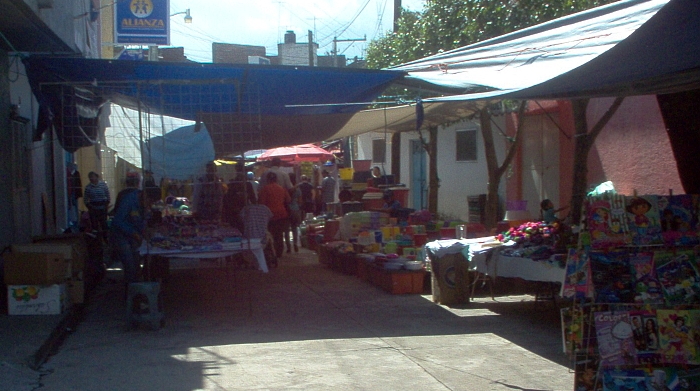
tiangus cerano

The tianguis in Cerano.

My son has a birthday coming up and we thought to rework his room to reflect his almost-a-man age. So he and I went through his things and took out the younger stuff–like the Bob the Builder suitcase, the Spidey posters, the itty bitty reclining chair and the like, to make room for other more manly decor. But, as funds are tight, we needed to sell the rejected items to buy other items. This meant a trip to Cerano for the Sunday tianguis (flea market).

So we loaded up the truck and headed out early Sunday morning. My husband secured us a puesto (spot). It was a pretty good spot, right next to the ice cream store at the corner of the callejon (alley) that goes to the church. We were up on the bridge that crosses the arroyo (open sewer drain), so by 2 pm the smell was a bit strong, but by then we had done all the business we had hoped to and more, so we left.

The first to greet us after we had our puesto assigned was Cowboy. He hangs about the tianguis asking for handouts and helping merchants unload for a few pesos. Although I hadn’t been to Cerano in over a year, he remembered my name and rushed over to help us unload. My husband gave him 10 pesos for his efforts.

Business was slow but steady in the morning. I let my husband do all the negotiating and just kept an eye on the merchandise. It isn’t like a yard sale, where the prices are ticketed and you pay the price on the ticket. An interested person asks the cost of the item. My husband responds with a price. The potential buyer thinks it over. My husband asks what price would be acceptable. The potential buyer names a price substantially lower than the proposed price. My husband responds with a negative and then points out the special features of the object of interest. Then he names a price 10 pesos lower than the original price. The potential buyer may name another price. My husband may say ‘ni para mi ni para ti’ and offer a different price. This continues until they agree on a price or my husband says the price they want to pay is too low and the deal ends. Occasionally someone walking by will hear the price my husband names and snatch the object at that price, stealing it away from the negotiating buyer. It’s all the same to us.

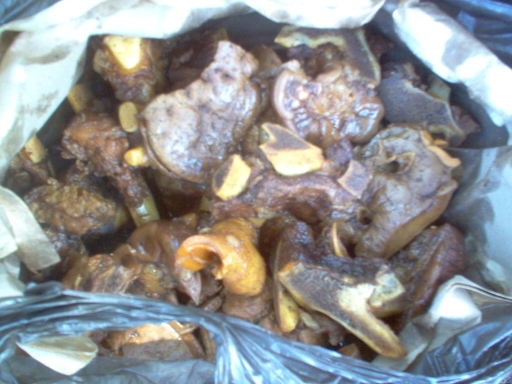
carnitas de res

Carnitas de res, a speciality from Cerano.

After misa, (mass) things started to get busy. While my husband did his salesman thing, my son and I went to the carniceria (butcher shop) that sells carnitas de res (fried cow pieces). Carnitas are typically made from pig and are not on my list of favorite things to eat, but these carnitas de res make going to Cerano something to look forward to. My husband bought tortillas from the 13-year old son of his cousin who died last year from inhaling light bulb filaments (I’m still not sure I understand that) and we chowed down.

Oh, did I mention that my husband is from Cerano? Cerano is a small town about 30 minutes from Moroleón and as different as being on Venus. The population is said to be about 4,000 and most of them I swear are relatives of his. Well, look that the logistics. My mother-in-law came from a family of 9 children, children of Mama Vira and Papa Rique. Her father Papa Rique also had a lady on the side who had 9 children. My mother-in-law had 11 children, although none live in Cerano at the moment. Her sister Lucia had 9 children, all of which live in Cerano. Her daughters all have 3 children each, some of which live in Cerano. My mother-in-law’s other sister, Tía Lena, the dwarf who owns the bar, has 4 daughters who have a variety of children. Another sister, Tía Jesus (yes, Jesus) has 3 girls. Basically, a good portion of the town reflects my husband’s features, some so closely that at a distance I have mistaken identity. One day, one of his cousins was at the house of the relatives that we were visiting, but without a shirt. I went to scold my husband for taking his shirt off, when I realized, just in time that this person was quite a bit younger than my husband, and wait, wasn’t him at all.

My husband, having lived there until he was 13, can identify and tell the stories of nearly all the residents. One man came along and wanted to buy a palo (shovel) because it would be useful if he were attacked. I thought this was a bit strange until my husband explained that this man was the uncle of Cowboy. OK. All in the family right?

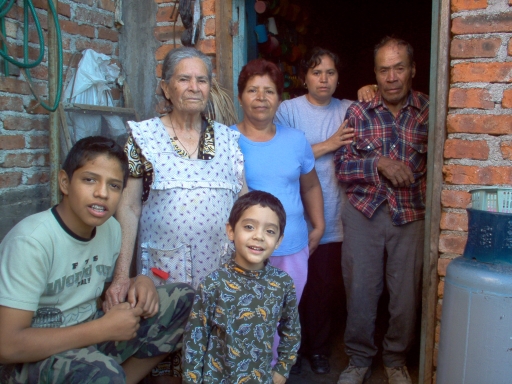
cerano gang

From left to right– A, Mama Vira, my mother-in-law, Tia Jesus, Papa Rique and my son in the front

Mama Vira, Papa Rique and Tia Jesus stopped at our puesto to visit with us. We shook hands all around–our customary greeting. They looked over our things. My husband gave Mama Vira $20 for tortillas and I gave Tia Jesus a flowered comforter that we had out to sell. They shook hands all around again and left, happy with the day’s acquisitions.

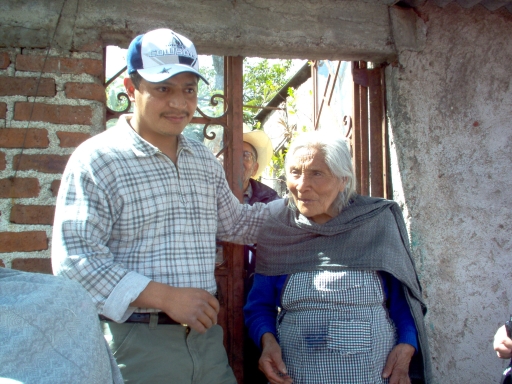
cerano gang 2

My husband and Mama Sofia with Tío Felipe lurking in the background

Mama Sofia, the mother of my husband’s father, also passed by. She greeted me amiably enough on her way to buy meat for lunch, but wouldn’t look our way on the way back. Seems she hasn’t forgiven my husband for nearly choking the lights out of her husband, Tio Felipe (not the father of my father-in-law Porfirio who died after being kicked by a burro some 50 years ago) after Felipe had given her a beating. Felipe has tried various times over the years to murder Mama Sofia. I think she recovers out of spite.

Well, sales went well overall. We had $600 take home after paying for the puesto, cleaning fees, ice cream, carnitas, the family handouts and gas for the truck, which is more than I earn in 2 days teaching. It doesn’t pay to go every week, but once every few months is a nice afternoon’s work. Now on to remodeling.

*********************

disclosure

9 Comments

Filed under Employment

Driving Hazards–Police and Military stops

Transitos are the traffic cops in México and are not armed.

Transitos are the traffic cops in México and are not armed.

Then there are police checkpoints to contend with. Arriving in Celaya, on our trip from Moroleón to San Miguel de Allende (See Getting Legal–Trip 1) we were stopped by the transito (traffic police) because our truck didn’t have a current verficación (inspection) sticker. I put my head down and pretended to be invisible while my husband negotiated the mordida (bribe). On the way back, we were stopped yet again by the same group of transitos (traffic police). Being tired and cranky, my husband made the mistake of complaining that we had already paid our dues in the morning. The transit cop had him get out of the vehicle and then gave him a dressing down for being chismoso (a tattletale) before sending us on our way with his mordida (bribe) of course.

Bribery is called mordida (bite) as in a bite of an apple.

Bribery is called mordida (bite) as in a bite of an apple.

To bribe or not to bribe, that is the question to consider.

Transitos are open to bribery. However, whether you offer a bribe or not depends on who you are. If you are female, typically no bribe is offered and no ticket is given, you may not even be stopped. Unless, of course, you are an aggressive female, then you are treated like any male in this machismo power play. (See Driving Hazards–Crossing the Border) If you are a non-Mexican male, you must understand this an alpha male thing and if the phrase “se puede reglar esto” (this can be resolved) is used by the transito (traffic police), discretely hand over $200 pesos. Transitos (traffic police) will stop you for missing inspection stickers, missing or out of state plates, for the driver not wearing a seatbelt, for anything that might be not working on your vehicle, like a tail light or just because. They will ask you for your license and tarjeta de circular (permission to use the vehicle in the country), so it pays to have both current. A transito (traffic police) can take either card or your placas (license plates) and hold them for ransom until you go and pay the fine.

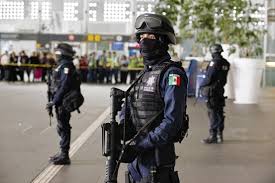
Los estados are the state police in México and are always armed.

Los estados are the state police in México and are always armed.

The next level up is the random inspection typically done by the state police. These officers wear large pistols, and are sometimes masked, so are not to be confused with the transitos (traffic police), who do not wear guns and never wear masks. Los del estado (state police) may stop you for having out of state plates, for vehicle identification number (VIN) verification to see if you are driving a stolen vehicle, for a license or tarjeta de circular (permission to drive in the country) check, for driving a nice vehicle, or whatever other reason occurs to them. The mordida (bribe) is much higher and trickier to negotiate. They may take your vehicle or any other items that aren’t permanently attached as part of the “inspection.” It doesn’t to any good to go and file a complaint. (See On Safety and Security).

Los federales are national guard in México and are always armed.

Los federales are the national guard in México and are always armed.

Los federales (federal police) cruise around looking for vehicles to confiscate. High risk vehicles are newer cars and chocolates (vehicles that have U.S. plates because they were never legalized at the aduana (customs)) We had more problems when we had a newer truck, but now that we drive a Mexican national that we like to call Butch (Chevy circa 1980) they stop us less. When stopped, the feds ask for the paperwork for the vehicle issued by the aduana (customs). Know that only the registered owner or direct relative may drive a vehicle that has been imported into México. We have had to show our marriage certificate along with the other paperwork to prove that my husband is permitted to drive the truck since it was registered in my name to facilitate border crossing.

Los militares are the miltary police in México and are always armed.

Los militares are the military police in México and are always armed.

Then there are los militares (military police). This is a complete barrier stop for all vehicles. All motorists are subject to search and all vehicles are inspected, for guns or drugs. Civilians do not have the right to bear arms in México, but many have guns. It just isn’t prudent to carry them in your vehicle, even for personal safety. We carry a machete in our vehicle, which is not illegal, and can also be used to cut grass along the side of the road for our animals when the occasion presents itself.

The guns these guys tote are eye-popping big. You can determine whether it is a legitimate inspection or not by whether the police are wearing their cappuchis (masks) or not. A legitimate inspection is done by unmasked military and nothing is removed from your vehicle. Well, the other type, it’s best to just grin and bear it and not give too much information about yourself or risk being marked as a prospective kidnapping target. (See On Safety and Security).

Fortunately, only the transitos (traffic police) stopped us on that first trip. (See Getting Legal-Trip 1)

*************************


disclosure

6 Comments

Filed under Driving Hazards, Safety and Security