After dinner, last week, my husband began by saying I should hear him out about this plan he has and I immediately perked up and took notice. What new plan was this??? So he started with “There is this group of women and they would pay $100 each. . .” I thought perhaps he was talking about a tanda, which is a sort of chain savings plan where a number of women contribute a portion of their weekly earnings, paying it to the designated hostess and receiving it the week of her own hosting. I tuned out of the conversation for a bit while I tried to think of the word tanda and came back to full attention when my husband started making hugging and kissing pantomimes. What was he talking about?
His sister L, he continued, wanted to visit her young boyfriend (see Parenting challenge–Independence vs. safety) who is currently serving a five-year stint in the bote (jail) near Valle de Santiago on Sunday for a visit. She asked if my husband would drive her there in the truck. She had a group of 9 ladies or so that also wanted to go to visit their significant others and they would pay $100 pesos each for the ride. My husband pressed me to agree by saying we could drop them off at the jail, then go to the tianguis (flea market) in Valle and spend the day leisurely enjoying the shopping and refreshments with the profits of the trip.
I reminded him that every single one of his sister’s plans has caused problems for us. Her last move gave my husband a hernia, her involvement in some of our money making schemes has cost us money and so on. As recent as a week previously, she and the strapping Cornhusker-grown wife of M were brawling in the streets while my husband was trying to close a deal on the burra (donkey) and he pretended he didn’t know either of them. How could any idea of hers be a good idea?
What if she was planning on breaking her man out of jail? I could just picture them, 9 cholos climbing out of the wrenched jailhouse bars that had been tied to the hitch of the truck, holding their pants in one hand and hopping in the back of the get-away vehicle (driven by my husband) with police and their Uzis firing after us.
As it appeared I wasn’t going to agree, my husband played his trump card. Well, if that did happen, he said, it would be something interesting for me to write about on my blog. OK. I’m in.
This was one time that the reality didn’t live up to my imagination. We got up at the unearthly hour of 4 a.m. Sunday morning so that we could take care of the animals before we left. We began the pickup round for inmate wives and families at 5 a.m.
I have privileged status, being the wife of the driver, so I sat in the front seat. My son, however, was ousted to the back of the truck so that a wife and baby could be in the front. I also was given a baby, a little tike about 3 months old, to hold. Although the driver is required to wear a seatbelt, no one else in the vehicle is subject to that law. Therefore, we held the babies in our laps. Fortunately, neither baby was fussy, so it wasn’t as difficult as it might have been.

The State Penitentiary outside Valle de Santiago
We arrived at the Ceresa (State Penitentiary) about 7 a.m. The ladies hurried to the gate, leaving their children behind in my care, to get their ficha (number). They came back 20 minutes later or so, happy. All of them had scored numbers between 30 and 40, so they would be towards the head of the line. Then they scattered again to hunt down pan (bread) sold by local vendors. They came back with 2 to 3 bags each. These sweetbreads were to leave with their incarcerated significant other for breakfast for the week. There seems to be a concern that the inmates aren’t fed, but I think that’s just not true. I’ve seen some recently released men and they are in no way starving–in fact they were some of the fattest men I came across in Mexico. But then again, maybe their wives and mothers are very conscientious about their weekly visit.
After the bread rush, the ladies rushed to the gate for a second time to claim their credenciales (visitor’s passes). Each lady has her own laminated card, complete with her name and picture, the name of the inmate she is visiting, and the relationship to the inmate. My husband’s sister is not married to her young cholo, so I asked to see her card. She is listed as being G’s concubina (concubine). I had no idea that being a concubine was a legal status here in México. Well, I expect that makes it easier for her to request conjugal rights.
So by then the sun had come up, so the ladies began to primp and preen as any girl might before a hot date. Gel and blush, combing hair and brushing teeth, even a quick change of shirt, something more feminine. I shamelessly eavesdropped while they worked on themselves and each other.
So I learned about the trip last week to see the hombres encuarados (nearly naked men) and some mean gossip about two other ladies that didn’t travel with us. I was especially interested in what their men had done to be in the carcel (jail) in the first place, but I didn’t know them well enough to ask. However, my husband’s sister was free with her own gossip. The one girl with the 2 kids that sat next to me was the daughter-in-law of the lady who gave us donuts. They were here to visit a man who was in for 7 years for beating another man to death with a stone in La Yacata. (Hmm, must have been before we moved there.) The mother of the baby I held during the trip was there to visit her man who had been arrested for selling drugs, like G. The older lady was there to visit her husband who was in year 7 of a 12-year sentence, but my husband’s sister didn’t know for what. And the last lady was there to visit her husband who was in for 30 years for kidnapping an elderly man and holding him for ransom.
Enough gossip, it was time to line up. They left their jackets, cell phones and purses in my care. My husband helped them carry their babies and bags of food to the line. They were called in by groups of 10. We waited until we were pretty certain they had all been admitted and then went to look for breakfast.
Even by rural standards, there was nothing nearby that even resembled a store or restaurant. We stopped at a place that had a few tables set up in the yard desperate to eat. The only thing on the menu was carnitas (fried pork) which is not what I really wanted for breakfast, but the pico de gallo and salsa were very good.
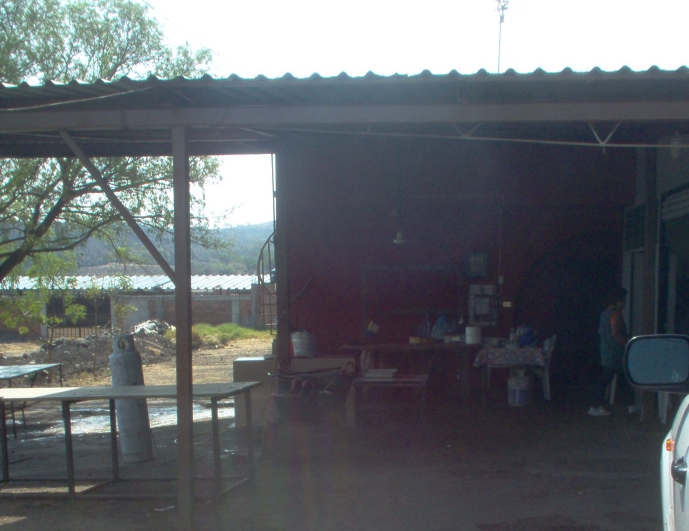
Breakfast of champions in Puebla Nueva
So then we went in search of a gas station. We didn’t have to wait in line and they had free and clean bathrooms.

Waiting in line at the gas station in Villa Nueva
We couldn’t afford to drive around and waste gas, so we went back to jail and parked under a mesquite tree outside the compound to wait for our passengers. With the heat and the owls hooting in the palm trees, I soon fell asleep.
Patience is a virtue that we have learned to perfect in México. My husband has taken up smoking to help him to wile away these long waiting periods and keep him calm. My son has learned to bring his rechargeable games (DS or PSP) when we expect something like this to happen. I bring my notebook to record everything for posterity. So went the afternoon. No shopping, no escaping cholos, nothing but the heat and an occasional passing vehicle.

My siesta was disturbed by the passing traffic.
So at 3 p.m. we entered the prison compound again. My husband went to wait by the door when he saw ladies beginning to trickle out. I was approached by some other lady, not one that had traveled with us who said that she was the friend of Mari (I still don’t know which one was Mari) and that she was going to leave these 2 benches with us to take back to Moroleón. I said, sure. Then she went back for 2 more. About 30 minutes later, our passenger ladies came out loaded with things. My husband moved the truck closer to the door. The ladies were peeved that there were already furniture items in the back because that meant less room for their own things.
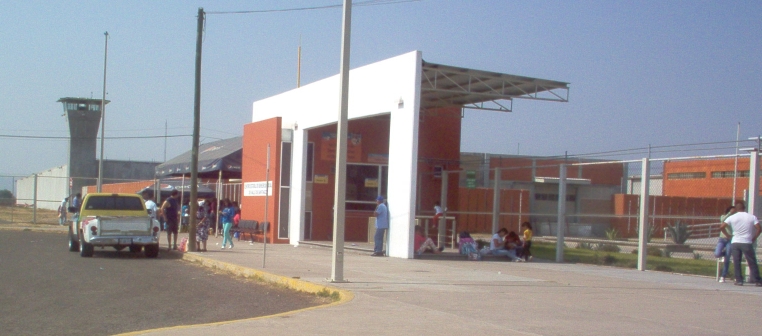
Front door at the Ceresa
They had large wooden framed paintings of the Virgen of Guadalupe, several more benches, a large TV stand, a child’s desk, two children’s hat stands and some little end tables. My husband’s sister had a centerpiece sized paper swan that she was all paranoid about having damage. (I guess her man isn’t as talented as some and that was the best he could come up with.) After a bit of maneuvering of babies, women and furniture bits, we were finally loaded and left the compound at 5 p.m.
The significant other ladies all sported nice collections of hickeys that they did not have in the morning. I suppose it makes sense that since their men can’t be there to make sure the ladies aren’t stepping out during the week, that they mark their territories with hickeys during visiting hours.
One under way, I asked that lady in the front about the furniture. It seems there is quite a prison industry going on. The inmates that wish to work are given materials and a weekly wage (about $700 pesos per week) and make these items. Their wives and mothers then come and pick up the items and sell them in their hometowns. The inmates also make shoes that can be ordered through by catalog.
I was amazed. $700 pesos a week! I expect that the families of many of these inmate workers are earning more now that their men are behind bars than they were before. Work is scarce in this area. Crime does pay after all.
So we made it back to Moroleón before it began to rain, made the drop offs and arrived home about 7 p.m. After we fed and watered the animals, I asked my husband how much money he had made with this venture. He ruefully admitted that he only had $300 pesos free and clear, after gas and tolls. It hadn’t been a good money-making plan after all but it did make a good story.
***********************


0.000000
0.000000

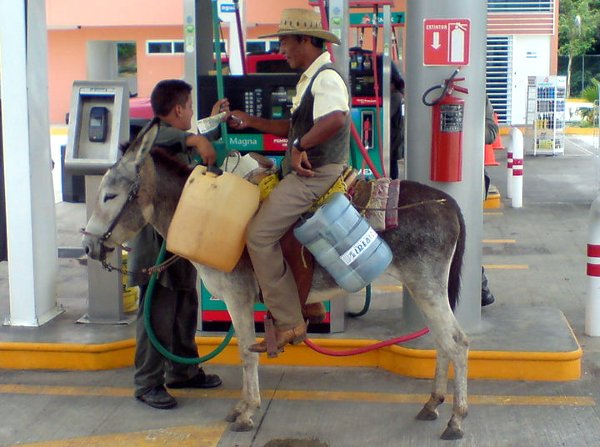 We started out in the morning with a full tank of gas in the truck just in case. Gasolinera (gas stations) are not always where you think they should be. Residents in smaller towns sometimes have to go quite a distance to get gas. It’s not uncommon to send a representative to the gasolinera for several families. Various types of plastic containers are often reused as gas receptacles. I admit, one of our garafones (water jugs) has been converted to a gas container and we keep a second plastic jug (I believe it had windshield wiper fluid in it once upon a time) with a bit a gas behind the seat, just in case.




 Surviving Mexico