
Category Archives: Teaching

Failing at your own business–Private ESL classes

mototeacher

An artist’s rendition of me–Teacher on the go!

I’ve written about teaching English before (See Saturday classes) but I thought I’d expand this topic a bit today. Teaching English as a Second Language isn’t easy. It requires an incredible amount of on-the-spot invention, an excellent command of English grammar and lots of patience. It also helps if the teacher is able to explain some things in the student’s native language.

I use my moto to travel to most of my private classes. I’ve found that parents like that they can leave their kids at home with a “babysitter” and I’m not stuck babysitting after the class hour is up. I can just leave the kids there. Some adults prefer to have class in their home, others would rather meet at the school saying they have too many distractions at home. In the less formal home environment, there’s also a better chance of tea and crumpets (or fruit and juice) during class.

Cancellations tend to be a problem, though. I count on the money from private classes for our day to day living expenses. When a student cancels, that’s less money for tortillas the next day. I’ve made it my policy if a students is a no-show or cancels 3 times, I offer the time slot to someone else.

To reduce the probability of cancellations, it’s important to keep the classes interesting. With that in mind, I thought I’d share some of my tricks of the trade.

Beginners

Nearly every class I have taught at the adult level has been what I would call beginner level. I have found that even if the student claims to know some English, it’s usually a lot less than they think. There have been a few exceptions, like students who have lived in the U.S. for a lengthy period of time, but they are easy to identify in the first few minutes of class. The text I recommend for adult beginners is Ingles para Latinos (Spanish Edition). Not only is the text in Spanish but it has Spanish-language pronunciation guides for the English vocabulary. I also really like the introductory section in the level 1 book. It addresses the number 1 obstacle to language learning–fear. The text is designed with the idea that the ESL student is already living or planning to live in the US, thus the vocabulary and short grammar lessons are practical rather than theoretical. I’m not as crazy about Ingles Para Latinos Level 2 , but it does go more in-depth with English grammar structures.

As any language teacher can tell you, mastering the four components of language fluency is essential to be truly fluent in the language. The four aspects of language domination are reading, writing (which includes grammar), speaking and listening.

Once my students have finished the beginner books, I ask them which component they would like to work on next. Here are my recommendations for texts in each aspect.

Reading

I have found the Chicken Soup for the Soul series to be a good intermediate level reading book. The stories are short, the vocabulary common and the topics are interesting. I have used the Chicken Soup For The Woman’s Soul successfully in a small group setting. The readings worked well as an introduction for speaking topics.

I have also used Chicken Soup for the Teenage Soul: Stories of Life, Love and Learning (Chicken Soup for the Soul) in a small group setting for younger students.

Another excellent resource is The Scholastic Read-Aloud Anthology: 35 Short, Riveting Read-Alouds That Build Comprehension, Listening, and Higher-Level Thinking Skills—and Keep Kids on the Edge of Their Seats. The topics are varied and the stories short. There are a few discussion questions at the end of each story that encourage student reactions and further discussion of the topics.

I have also used children’s books with pre-teens. These classes are usually one-on-one with an emphasis on pronunciation and comprehension. The most successful series I’ve used are The Boxcar ChildrenCaptain Underpants Series and Judy Blume’s Fudge Box Set

Writing

Sometimes a student wishes to work on their grammar skills, usually as preparation for some sort of standardized test. My favorite text to use in these classes is Gramatica De La Lengua Inglesa : A Complete English Grammar Workbook for Spanish Speakers. Again the text is in Spanish and the book concentrates on the most problematic grammar points for Spanish speakers, things that just don’t translate well.

Listening

Listening skills are the hardest to practice in the area where I live. There aren’t many native English speakers in the area. And although I always recommend watching English language movies without subtitles and listening to music to improve auditory understanding, sometimes students want a class to improve their listening comprehension. Learning to Listen: International Version (No.1) is a good choice for those who are preparing for the TOEIC exam. It has actual conversations about everyday sort of activities with a variety of accented English speakers. My second recommendation is Where the Sidewalk Ends: The Poems and Drawings of Shel Silverstein (25th Anniversary Edition Book & CD). I’ve designed a cloze procedure text to accompany the readings. Students find these activities more challenging, but highly entertaining.

Speaking/Idiomatic expressions                                                                                                                          
As I am an American, my accent is American as well. Although that’s not quite good enough for some people, I do teach American English to those who wish it. Speak English Like an American is an interesting text set up in a sort of telenovela (soap opera) style using common idiomatic American expressions as the drama of Bob and his family unfolds. It’s funny and engaging. There is an audio CD to go with the readings. The idiomatic expressions are defined in Spanish afterward and there are practice activities for the expressions. I’ve used this text both in small group and individual classes.

American culture is often confusing for the ESL student and thus I also teach an American Customs class using 101 American Customs : Understanding Language and Culture Through Common Practices and 101 American Superstitions : Understanding Language and Culture through Superstitions. The origin of each strange cultural phenomenon is briefly explained in these books and it’s easy to transition to a discussion comparing superstitions and customs between the US and the student’s native country.

Exam Preparation

On occasion I have students search me out for intensive exam preparation.

The most common exam given here is the TOEFL.  This is believed to be the ultimate exam for English Proficiency in Mexico, although that’s not its designed intent. Any TOEFL preparation guide will do, but that one I use is Barron’s Practice Exercises for the Toefl. Most students have difficulty with the grammar section and this book breaks it down into types of errors to look for. It also helps the students become more familiar with the test format, as it is NOT at all like Mexican school exams.

Gaining in popularity is the TOEIC exam.  I had my first experience with this when I completed the preparation course for a student (See Failing at your own business–University courses). It’s more of a business English exam, and the vocabulary used is often new to the average English student. Again, any preparation guide would help, but I use the Barron’s TOEIC Practice Exams . The Learning to Listen: International Version makes a nice complement for this.

The IELTS is the exam used by UNAM admissions and I have had students specifically request a preparation class designed with this exam in mind. The exam is British based, designed for the UK and other subjugated nations, like Australia and New Zealand, so it was a little bit of a learning process for me as well. I ordered the Barron’s IELTS as a guide to teach this class.

I have also been requested as a teacher for the U.S. Citizenship exam. Materials are easily downloadable from USCIS here. In order to be fully prepared for this exam, students must be fluent in English and be able to answer the questions about US history, government and culture. Sometimes this requires quite a bit of explanation on the part of the teacher, but it’s often a fun class to teach. All my students who have taken their exams after our preparation class have passed and gone on to become US citizens. Yeah me!

Children
I also teach ESL privately to children in addition to my job at the Kinder (See Kindergarten Event) and the Elementary school (See Elementary Event). I like to start with students who can already read in Spanish, so my students tend to at least 5 years old. I have compiled my own books for these classes and hope to soon have them available to download. It depends on when my illustrator, who is a bit of a free spirit, gets her part done. Right now I’ve done books about the alphabet, short vowels, beginning and ending consonant blends, homophones, homographs, and homonyms. I’m currently working on books for long vowels and kindergarten activities with a thematic approach.

Recommendations

Here are some recommendations from my treasure trove of teaching materials:

501 English Verbs: Fully Conjugated in All the Tenses in a New Easy-to-Learn Format, Alphabetically Arranged  This is an excellent writing resource for students.

An English/Spanish Dictionary. Not all dictionaries are created equal. The most common dictionary available in my area is the Larousse Pocket Spanish – English / Ingles – Espanol Dictionary , however, I recommend Vox Compact Spanish and English Dictionary. It’s just more complete, in my opinion. Then there’s that whole American English vs. British English thing.

Oxford Picture Dictionary English-Spanish: Bilingual Dictionary for Spanish speaking teenage and adult students of English . This is a nice way to work with vocabulary organized by themes.

Scholastic Children’s Dictionary This is sort of like a mini-encyclopedia with full-color illustrations rather than a traditional dictionary.

Scholastic Children’s Thesaurus Using the same adjective over and over again gets WAY boring.

Manila folder games. These are great and can be found on any subject, not just language arts. Here’s one set I use. File Folder Games Book Reading & Math: Grade 1

Card Games.  I use these for kids a little bit older instead of the manila folder games.
10 Reading Comprehension Card Games: Easy-to-Play, Reproducible Card and Board Games That Boost Kids’ Reading Skills—and Help Them Succeed on Tests

Puzzles. Melissa and Doug have all sorts of durable wooden puzzles for preschool and up. It makes vocabulary practice dynamic and fun. Here’s one I have.Melissa & Doug Wooden USA Map Puzzle

Even with all these things at my fingertips, there’s no predicting which students will continue and which give up. I have some regular, long-term students, but I also have a high turn-over rate, especially at the end of the school year. I’m not too fussed over that though because I have a waiting list. As one of the very few native speakers in the area, and having a BS in education to boot, I’m in demand!

*****************************************************

disclosure

12 Comments

Filed under Education, Teaching

Teacher protests and Facebook

politcal views

Well, I’ve gone and done it. I’ve gotten into a public argument on Facebook with a complete stranger. About what? The civil unrest and protests in Oaxaca.

How did I get myself in such a predicament? It started innocently enough. Another group member posted Mexico: State Terror, Education Reform and the Stock Exchange. The article outlines the violent situation and proposes that The reasons why the Mexican government wants to impose the education reform—even if it means killing people, as with the massacre in Nochixtlan by repressive state forces on June 19—are rooted in economic objectives guided by international financial organizations.

Now, I’ve already discussed at Surviving Mexico the Education Reform package (See Political Wrangling), so I won’t get into why the teacher’s union opposes its implementation here. What struck me was the idea that this whole situation may have a distinct cause, not just teacher examinations. As I pondered this, I remember a seemingly unrelated post called Chinese look to invest in southern Mexico.

As I’m not much interested in economics, I almost didn’t read the article. But I did. In summary: Authorities from China’s Guangdong Province met with Mexican officials and discussed plans to invest in Mexico’s recently-established Special Economic Zones. These zones offer tax benefits and support services to investors in order to generate new sources of employment in southern Mexico (Guerrero, Oaxaca, Chiapas, Michoacán, Veracruz and Tabasco).

These states currently have the highest rate of disappearances.

Just looking at the recent headlines for these areas gives you a good idea who are behind the disappearances.

Guerrerolocal police kidnapped no less than 100 people over the last two years in Guerrero, including students, women, children, and an African priest

OaxacaOaxaca Residents Say Mexican Police Began Massacre – Now They Want Them Out

ChiapasFederal Police Repress Parents that Support Teachers with  Tear Gas in Chiapas

MichoacánNew Evidence Shows Police Did Massacre 42 in Michoacan, Mexico

Veracruz4 state police were arrested in connection with the disappearance in Veracruz of four men ages 24 to 27 and a 16-year-old girl

TabascoTeachers clashed with riot police

What if, just supposing, that some of these protests were staged in order to give the government an excuse to come in and militarize the area, paving the way for those Chinese investors? The connection seemed strong enough for me to comment in the Facebook group post. (See also Mexico’s enemy…on Claudio X. Gonzalez)

The poster responded with the following: if you have the time and inclination, I suggest a 55 minute documentary called “The Demarest Factor: US Military Mapping of Indigenous Communities in Oaxaca, Mexico” released in 2010:This film is part of an ongoing investigation which has exposed US military mapping of communally owned indigenous land in the Southern Sierra in the state of Oaxaca, Mexico. The mapping took place under the auspices of the department of geography from Kansas University in Lawrence, Kansas in collaboration with the Foreign Military Studies Office (FMSO) at Fort Leavenworth, in Leavenworth, Kansas. The FMSO senior analyst Lieutenant Colonel Geoffrey B. Demarest declares in several essays and texts that communal ownership of property leads to crime and insurgency. The film exposes an ongoing military strategy to criminalize indigenous land tenure and identity in order to secure political and economic interests in the region.

Wow! This was a real eye opener for me. But then someone else chimed in on the conversation. His contribution was: Put the crack pipe down for a couple days. You have lost touch with reality. One small group of terrorists, sucking the Federal money teat, and finding at some point they need to work and produce to survive in the world. The majority of the States of Mexico approve of children having a real education as opposed to walking barefoot. Deal with reality. What a bullsh*t stupid post.

Now I’ve had a run-in with this particular group member before during a discussion about the relative safety of Mexico. He insisted that Mexico was completely safe and that you should never believe anything posted on the internet. I made the comment that my husband had been kidnapped, my nephew tortured and my mother-in-law killed by police. In addition, I knew 3 people personally who had been kidnapped and ransomed and 3 more that were kidnapped and killed. He told me that he didn’t believe any of it and that I was full of crap. Instead of engaging, I left the conversation. Later, I found out that another member had defended my statement as true and carried on in my stead. To no avail.

Anyway, I replied to his post quoting Facebook’s commenting policy. People use Facebook to share their experiences and to raise awareness about issues that are important to them. This means that you may encounter opinions that are different from yours, which we believe can lead to important conversations about difficult topics. Implying that someone is high or insane is not respectful.

His histrionic comment was: So saying that the teachers burning and destroying the private property of their neighbors is a respectful way to argue a problem that HAS been resolved, to their misfortune? It Takes an uneducated person to not understand that laws were passed by 3/4 of Mexico’s states and still cry and extort money. When the teachers start to act like people who YOU would like to teach your children about right and wrong and 2 +2 and how to spell their name, let me know.

Actually, my son attends public school here in Mexico and his teachers oppose the educational reform, but not for the same reasons as the Teacher’s Union. The exam will not provide educational equality and is a tool being used by the government to cut the power of the Teacher’s Union. And I am certainly not uneducated and fully understand that the government railroaded the reforms through, which leaves little room for negotiation. The government does what it does and we see the results in the protests.

My public response was No one has made the claim that the actions of the teachers are correct in any of this conversation. Only that there are other reasons for the civil unrest. The entire situation is rooted in corruption–by the teacher union AND the Mexican government. So give it a rest bud!

Apparently, he didn’t like that and countered with The burning of public and private businesses and property, hijacking of private vehicles, firebombing, extortion, robbery and murder come from the so call “Teacher’s Union ” Mexico Government is being very nice so far. Look at the history of the world ( I mean entire world) in any other country. These criminals would have been put down years ago. Stop blaming the cause on the Federal Government, the Feds should today be acting with extreme force to allow food and fuel into these areas, but they are not. Yet.

From one of my online friends in another group living in Oaxaca, I know that most of what has been released by official sources is not accurate. She personally saw 4 police officers looting an electronics store, loading up the refrigerator on the back of their police vehicle. As for murder, well, the police are the only ones with guns in this conflict.

Additionally, thanks to a new law passed over Easter break, the government can use deadly force to “keep the peace.”

My response: Again, I have not said in any way that the teacher’s union has been correct in its actions. AND the government is also responsible for burning public and private businesses, firebombing, EXTORTION, ROBBERY, AND MURDER. Perhaps you are correct in saying that in other countries, the insurgents would have been massacred earlier before things got to this point. That doesn’t make it right. Interesting you should mention keeping fuel out of the area. Seems that’s exactly what the government is doing in Chihuahua.

From another online friend in Chihuahua, the whole gas crisis started when PRI didn’t win the local elections. Imagine that.

The conversation continued with another more respectful participant.

Undereducated teachers in fear of losing jobs. Unions in fear of losing members. Teachers who are dedicated to teaching shamed by unions for crossing the picket line. Their heads shaved and forced to walk holding signs.

The current private schools need to stop hiring foreigners with no teaching background or degree.

All Mexico teachers should be tested yearly. If they don’t meet requirements. They should be fired.This is for the better of Mexico’s future.

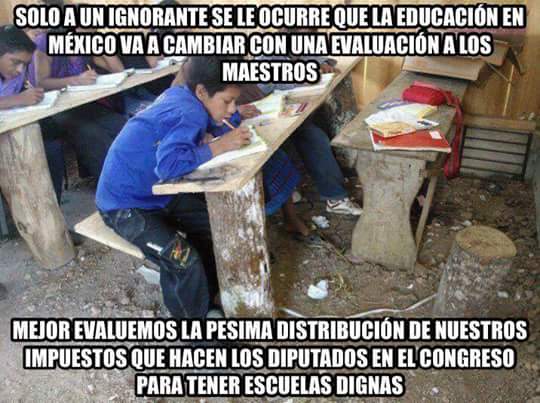
This comment takes me back to my post about Political Wrangling and Educational Reform.

ignorante

Only someone ignorant could believe that education in Mexico will change with teacher evaluations.  It would be better to examine the distribution of tax dollars that members of congress earn in order to have dignified schools.

After making the following comment: All of those things are true. Unfortunately, a yearly test won’t ensure that qualified teachers have teaching positions. It is SO easy to buy your teaching certificate here in Mexico, pay someone to take your exam, or pay the administrator to pass you–con mordida (bribes) o con cuerpo (giving sexual favors in exchange for something). There are multiple layers to the issue which need resolution.

I then bowed out of the debate and unfollowed the post. I have other things to do, like write this post.

like

*******************************************

disclosure

Leave a comment

Filed under Education, Politics, Teaching

Music Lessons

cam04288.jpg

My son got a bee in his bonnet in December about wanting a guitar. Finances have been less than stellar these days, but I promised we’d look into it. We found some mass produced guitars, but I didn’t think he’d be happy with that. I knew there were a few music shops around town and the odds are, we’d find one there, however, we ended up finding one where we least expected it, in a pawn shop. There were actually several to choose from. I had my son handle each one and strum the cords a bit to see if one felt right, kinda like Harry Potter choosing a wand.

The instrument that sounded the best to my ear was this handmade armadillo shell guitar. Well, I don’t know if it actually could be called a guitar. It was a stringed instrument to be sure. It had an honest to goodness armadillo shell and copper wires. It’s called a charango and believe it or not, quite a popular mariachi instrument even though it is most known in music from further south, Bolivia, Peru, and Argentina.My son refused it. He couldn’t see girls flocking around an armadillo player, you see. It gave us a good chuckle, though.

He did find one that he liked and that was that. Now comes the hard part, learning to play. We have a Learn How to Play the Guitar video Learn How To Play Guitar so that was the logical place to start. It was a complete failure. Maybe some can learn an instrument through video instruction, but it just wasn’t happening for my son.

The next logical action was to find a qualified teacher. The music teacher that teaches with me at the elementary school has his own music school, so I approached him first. He said he would be happy to teach my son, however, we ran into a scheduling problem. He taught evenings and weekends during the same hours that I have my private English classes. There wasn’t any way I could run my son to his school and get to my classes on time. Darn it!

guitar book.jpg

I wasn’t giving up so easily. I did find an old guitar book (The New Guitar Course, Bk 1: Here Is a Modern Guitar Course That Is Easy to Learn and Fun to Play!) among my piano books that showed him the basic finger positions, but he really needed a teacher. I could teach him how to read the music, but not how to play the guitar. Piano is my instrument.

If possible, let the children learn from the first under artists, lovers of their work: it is a serious mistake to let the child lay the foundation of whatever he may do in the future under ill-qualified mechanical teachers, who kindle in him none of the enthusiasm which is the life of art” (Vol. 1, p. 314).–Charlotte Mason

Every day on the way to work, I pass this cute little shop with a piano keyboard painted on the sidewalk in front. That’s where I tried next. The teacher was an elderly chap, a retired (or not so retired) musician.  Anyone with that sort of imagination for just the outside decoration was bound to be a true musical artist!

The registration was high–$400 pesos. Class prices were high–$100 pesos per hour. The book price was high –another $100 pesos. But I went ahead and confirmed my son’s attendance the following Saturday at 10 am.  It was close enough that he could walk from the school I work at so I wouldn’t miss any of my own classes.

Of course, then we had to get a carrying case and pick. I bought a soft carrying case at the mass produced guitar store for $200 pesos. It’d be just the thing to sling over his back on our moto trip to town. I didn’t find any picks though. The teacher also asked that he come with his pencil case, including scissors and glue, a lined notebook and a music notebook. That was no problem gathering together.

tuner.png

My son came back from his first music class over the moon. He said the teacher told him he was a visual learner (no surprise there) and that he had learned more in one class than most students learn in 2 weeks of classes. He said the teacher shook his hand and was impressed with the quality and design of the guitar that my son had picked, saying that it was the perfect size for the length of his fingers.  (My son has incredibly long fingers.) The teacher had him download n-Track Tuner Pro to his phone so he could tune his guitar.

There was no chiding him to practice either. He went over what he had learned and tuned his guitar every day. He started playing around and picked out a few simple tunes. Money worth spent I think in this case. The second class was just as good, about musical theory and the like. The teacher said that he would be ready to start the book the following week, something that usually took a month of lessons.

I told my son that he could go as long as he liked with the music lessons and quit any time after the 3 month period that I estimated would compensate for the $400 pesos inscription fee.  I don’t think it will be a problem after all!  He loves his classes, comes right in and shows me what he learned as soon as he gets back.

My husband has visions of putting my son on the street corner with a hat to earn a little income on the side. In a pinch, I think he’d be able to earn some tortilla money at least. He would probably earn more with the armadillo guitar, but hey, who can say!

*****************************************

 

disclosure

***************************************************
Have a Charlotte Mason themed blog post?  Link up here!

cm blog

5 Comments

Filed under Education, Teaching