Category Archives: Safety and Security

Prepping in Mexico–Give a Wide Berth to Cartel Violence

We live in the state of Guanajuato, which has the dubious honor of having the highest number of homicides to start the year in 2020. The current issues stem from the hostile takeover of areas controlled by Santa Rosa de Lima Cartel by the Jalisco New Generation Cartel. The shoot-outs are sometimes random, and civilians are sometimes caught in the cross-fire.

On the other hand, some instances of cartel violence are targeted attacks. Extortion, kidnapping, and murder are the three primary methods of control. While most of the time the focus is on someone from a rival cartel, sometimes innocent family members are involved.

A high-profile incident occurred in 2019 when nine women and children were murdered in Chihuahua, all members of the La Mora Mormon community that has been in the area for decades. The Mexican government claimed the murders were a case of mistaken identity, however, both local police officers and cartel members have been arrested leading to the speculation that it was a targeted hit.

Mexican saying which translates as “They wanted to bury us, but they had forgotten we were seeds.” Original artwork by Clau Guzes

It should surprise no one that the cartel and certain officials of the Mexican government are in cahoots. The 43 teaching students that disappeared in 2014 were arrested by the police then turned over to the Guerreros Unidos cartel by whom they were tortured and murdered. The mayor of the town Iguala and his wife were later arrested for their involvement along with several high-ranking police officers. The bodies of 42 of these young men have not yet been found.

From 2006 to 2012, the cartel have been responsible for between 60,000 to 100,000 deaths in Mexico. Between 2007 and 2014, the Mexican government has been linked to 23,272 reported disappearances. Not all disappearances are reported because of the fear of repercussions, therefore, the actual number could be significantly higher. Mass graves throughout Mexico are the final resting place for the bodies of thousands of those who have disappeared either by order of the government or the cartel.

Ties between Mexico’s political party PRI and illegal drug traders can be traced to the beginning of the 20th century during the US period of Prohibition. The political, police and military infrastructure that was subsequently designed in Mexico was intended to support the cultivation, manufacturing, and distribution of cocaine, heroin, and marijuana for export to the United States. The Dirección Federal de Seguridad (DFS) organization was formed to organize and control drug trafficking.

For decades, this system functioned without restriction. In the 1990’s PRI’s 70-year reign ended. The addition of new political players with no prior connection to the cartels upset the system. Sections of the Mexican government began to challenge the set-up. Thus began the government-sanctioned assassinations of drug-enforcement agents, governors, mayors, clergy, citizens, lawyers, judges, social activists and journalists. And there we have narcoterrorism in a nutshell. While cartels battle over territories, dissenters are silenced by the government.

Our family has been personally affected by cartel violence. My husband’s 25-year old nephew and a friend were taken from his home in our town after he was trespassing on a rival’s territory. His decomposing body was found outside a nearby village a month later. The other young man who was taken with him has not been found. Officially, the murder investigation is still open. However, we know that no one will be held accountable for his death.

Many young men and women that are recruited by the cartels are not willing participants. Cartels sometimes conduct raids on alcohol and drug rehab centers as a form of conscription. Other times the cartel itself is running a rehab center, making it that much easier to recruit vulnerable men and women.

Yet another way that the cartels add to their ranks is by kidnapping migrants from other Central and South American countries who are crossing Mexico with the hopes of claiming asylum in the United States. Approximately 20,000 migrants a year are kidnapped by the cartels in Mexico. Some are sold, some are murdered, and some are recruited.

If you find yourself in an area that is experiencing cartel violence, you may want to consider relocation. Mexico is a huge country and there are many areas, even those controlled by the cartel, where life is relatively peaceful. If you choose to remain in an area that has the potential for violence, you must develop your situational awareness.

Situational awareness is being aware of your surroundings. It involves identifying potentially dangerous situations. The first step in developing a situational awareness mindset is recognizing that there is a threat. These days, any activity you engage in, from grocery shopping to heading to a wedding, can become life-threatening if cartel violence breaks out in the area. Just because you yourself are not involved in drug distribution or trafficking does not mean that you are safe.

The second step in becoming situationally aware is to realize that you are responsible for your own security. The Mexican government is often involved with the cartel. Even if arrests are made, Mexico has an extremely high rate of impunity. Relying on the police is not a safe option.

Situational awareness does not mean you are hyperfocused to search out danger, every minute of every day. No one can maintain that level of vigilance. Rather, it refers to taking your surroundings into consideration as you go about your business. If you are in a restaurant, take note of the exits, for example. If you are walking, pay attention to sounds that indicate danger, like shooting or shouting, and take evasive action.

Practicing this state of relaxed awareness will help it to become second nature. The idea is to have a window of opportunity before a dangerous situation explores for you to take action to protect yourself. Being tired, under the influence of drugs or alcohol, or being distracted will reduce your overall situational awareness and should be avoided as much as possible when you are in a potentially dangerous situation.

If a violent situation develops, get as far away from it as possible, as quickly as possible. Then stay away from the area for as long as it takes to return to some form of normalcy.

Situational awareness is something that even children can learn to develop. Back to the LeBaron incident, a 13-year old boy helped six of his siblings to safety, hid them in bushes and walked 14 miles to get help from relatives. He understood that the situation was deadly. He did not freeze in panic but took steps to ensure the safety of his younger brothers and sisters, who are alive today because of his efforts.

¡Cuídate mucho!

Leave a comment

Filed under Safety and Security

Prepping in Mexico– Food Shortages and Famine

Mexico is one of the most megadiverse countries in the world. It is home to over 200,000 different plant and animal species. There are 707 known reptile species, 438 mammal species, 290 amphibian species and 26,000 different plant species. Mexico also has a great variety of ecosystems including desert, mountain, coastal, temperate and tropical climes. 

You would think that because of its extreme diversity, Mexico would not be at risk for crop failures, food shortages and famines. Unfortunately, that isn’t true. Governmental policies, climate change and dangerous internal conflicts have had detrimental effects on the crops produced in Mexico in the past and present. 

Historically, tree rings have indicated that severe droughts hit Mexico of the sixteenth century (1545-1600), 1752-1768,1801-1813, 1859-1868, and the 1950s causing food shortages in much of the country. Drought may have been the underlying cause of the political instability that destroyed pre-hispanic civilizations like those whose pyramids stand in Teotihuacan.  

The Codex Ramirez records a drought that lasted from 1450 to 1454 which caused a mass exodus from the center of Mexico. The Aztec Empire had a supply of maize to distribute however by 1454, the famine was so severe that the common people sold themselves or their children into slavery in record numbers of which many were sacrificed to elicit help from the rain dieties. 

The Spanish conquest did little to alleviate food shortages among the indigineous people of Mexico. Between 1521 and 1821, there were 88 drought periods. Although more advanced irrigations were set up by the Spanish, the crops were not evenly distributed among the inhabitants even as prices for meat and corn rose. In 1785, drought caused the starvation of more than 300,000 indigenous in Mexico. Historians have determined the colonial government was set up so that large landholders and merchants had the ability to price basic necessities out of the range of most of the population. 

This type of governmental setup remains alive and well in Mexico. Increasingly over the years, Mexico has become more dependent on imported goods from other countries. During periods of low food production, as happens when there is an extended drought, importation rates grow to make up the difference but at a higher price.

The shift in the focus of Mexican agriculture encouraged by the government, from drought resistant corn and bean varieties to forage and vegetable production, has placed a large demand on groundwater available. Additionally, the expansion of cities has redirected large amounts of water that previously had been used for crops to meet the needs of urban dwellers. 

Avocados are another crop that has periodic shortages, not because of drought, rather due to violence over control of the areas where this “oro verde” (green gold) grows. The state of Michoacan is the only one authorized to export this high-demand fruit. In 2018, the sale of avocados, mostly to the US, raked in more than $2.5 billion, which is more than the proceeds from petroleum. 

Many farmers have given up growing other produce to concentrate on the more lucrative low-hanging fruit trees. Large areas have been cleared to make room for even more trees. Crop diversity is at an all-time low in the area. Growers are dependent on the avocado crop and yet are forced to give a large portion of their profits to the cartel or risk not being able to sell any of it.

A different kind of event that caused food shortages in many areas was the restructuring of the gas distribution method in January 2019. The newly sworn in president AMLO closed the gas line pipes that run throughout Mexico in order to stop theft. However, there were not enough other ways to distribute the gas and areas in the interior of Mexico were without cooking and gas for vehicles for nearly two months until more vehicles were purchased to move the gas. The gas shortage meant that food delivery was intermittent or non-existent in some rural areas. 

Food shortages, whether they are short or long term, are difficult to manage if you haven’t prepared ahead of time. Here are a few suggestions on how best to get through.

Grow Your Own Food

Begin by growing some of your own food. If you have space, plant a garden. If our space is limited, try container gardening. Consider share-cropping to supplement your food supplies. Research which plants will provide food year-round or decide on two seperate planting sessions, one for the growing season, one for the dry.

In our area, corn is grown during the rainy season which begins in June. After the corn has been harvested, most areas are planted with garbanzo for a second crop instead of letting the field lay fallow until the following June. 

I grow a number of herbs which provide me with delightful teas and seasonings. They don’t take up much space and aren’t a lot of work. We also have several fruit trees and a blackberry bush for seasonal treats. 

Raise Animals

Chickens, ducks or quail can provide meat and eggs and don’t require a huge area. Rabbits can be raised for meat and again don’t need a lot of space. Goats are better than cows for milk production. They can forage their own food most of the year. Sheep and pigs are other smaller options but tend to be more labor intensive in my opinion. 

Forage, Barter, Hunt and Fish

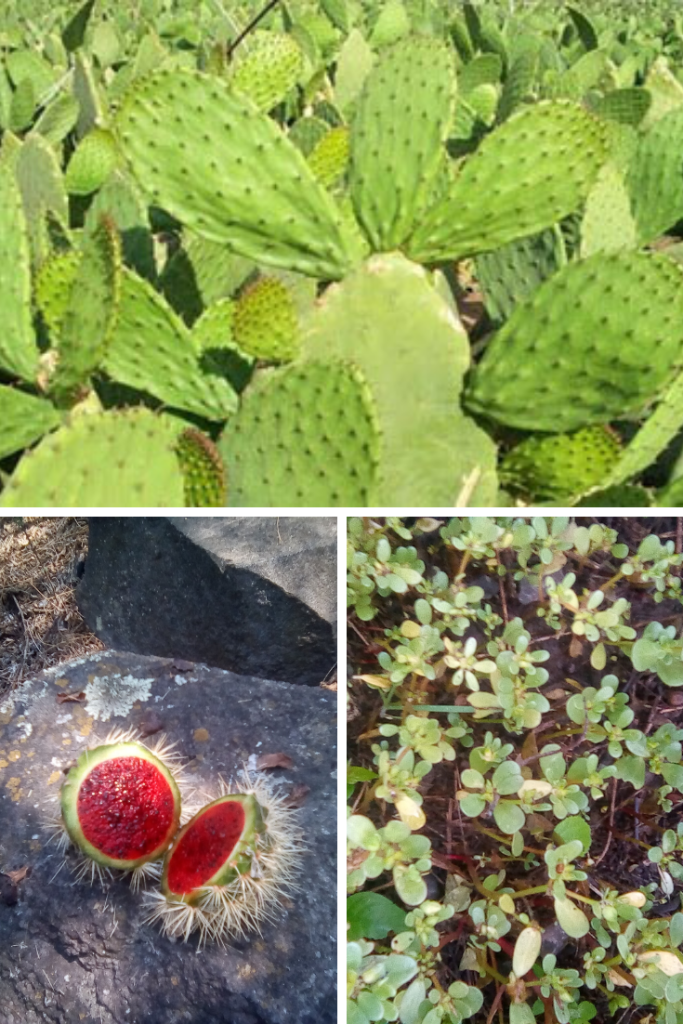
There are probably more food sources that you can forage locally than you realize. We can find nopales (cactus), tunas and pitayas (prickly pears), mesquite, verdolaga (purslane), mushrooms, and guayabas easily by just walking around our rural community. We can also trade for locally grown squash, tomatoes, corn, melons, and beans. We even have a neighbor who is an apiarist for fresh, organic honey. 

Our area does not have any deer or turkey populations that can be hunted for food. However, there are squirrels, opossum, rabbits and pigeons which can be brought down with a slingshot and roasted over the fire. While these might not be your first choice in cuisine, it’s good to know there are options. We are also close to several large freshwater lakes, so fishing is yet another local food source for us. 

Stock Up

During harvest season, stock up on the fruit and vegetables that are available. Because of the surplus, they are typically less expensive than other times of the year. Find a way to preserve these items either by canning, freezing or dehydrating. 

Stock up on staples such as corn, beans, sugar, salt, and rice which can be stored in a dry, cool area for quite a long time. Can goods are another good way to stock up. Canned peaches, soups and other items can be bought and rotated out so they won’t reach their expiration date.

Hopefully, famine isn’t a disaster you ever experience living in Mexico, although it is an unfortunate possibility. Food shortages have happened before and will happen again. What better reason to take some time to prepare for it.  

Leave a comment

Filed under Homesteading, Safety and Security

Prepping in Mexico–Mud and Land Slides

A rock landslide in Guerrero, Mexico August 1989. 

Several states in Mexico are considered high-risk areas for potential mud or landslides. Being classified as high risk means the rainfall patterns, steep terrain slopes, reduced vegetation cover, poor soil quality and earthquake, hurricane, or volcanic activity combine to make the area dangerous. 

Between 1925 and 2017, there were 1,967 recorded landslides throughout Mexico which resulted in at least 3,447 deaths. Most were caused by excessive rainfall in the areas. The majority were in central and southern Mexico, including the states of Hidalgo, Mexico, Puebla, Tlaxcala, and Veracruz. 

  • In 1920, a debris flow from the Rio Huitzilapan triggered by a 6.5 earthquake killed between 600 and 870 people in the village of Barranca Grande.
  • October 1, 1976, a landslide in La Paz, Baja California claimed at least 1,000 lives after Hurricane Liza hit the area. 
  • October 7, 1999, more than 210 people were killed and tens of thousands forced to evacuate after weeks of torrential rains.  In the town of Mixun which is about 100 miles northeast of Mexico City, as many as 40 people were buried in a landslide including 17 schoolchildren and their teacher. In the nearby town of Teziutlan, 26 people were killed after a hillside mudslide buried an entire neighborhood. More than 166 people were killed in the state of Puebla, 50 in Veracruz as well as numerous fatalities in Chiapas, Tabasco, and Hidalgo. 
  • In 2004, Hurricane Ivan caused underwater mudslides that destroyed an offshore oil rig in the Gulf of Mexico spilling 700 barrels of oil per day for 15 years. 
  • September 17, 2013, Hurricane Ingrid and Tropical Storm Manuel caused buildings to collapse in Veracruz killing at least 12 people and forcing more than 20,000 to evacuate.
  • August 8, 2016, Hurricane Earl caused mudslides that buried homes in Huauchinango, Puebla killing 25, while mudslides in Veracruz caused the death of 11 more.
  • July 10, 2019, a mudslide destroyed a home in Santo Tomas Chautla village, located near the city of Puebla. The family was celebrating a graduation. Three adults and four children were killed, while two other children were severely injured. 
  • September 28, 2019, Santa Maria de Tlahuitoltepec, Oaxaca 11 people went missing after a mudslide. 

Landslides occur when masses of earth, rock or debris move down a slope. Debris flows and mudslides are flowing rivers of earth, rock, and debris. They develop during periods of intense rainfall or runoff, flow more rapidly than a person can run, and strike with little or no warning. They grow in size as they accumulate boulders, trees, and buildings and can travel miles. They don’t always stream directly down but can flow sideways as well. 

Mudslides are more likely to happen in areas

  • That they have happened before
  • Where wildfires have destroyed vegetation
  • At the bottom of slopes or canyons
  • Where slopes have been altered by road and building construction
  • Along streams and rivers
  • Where there is a lot of surface runoff

There are a few things you can do to prevent being affected by mudslides. First, do not build your home near drainage ways, close to mountain edges, near steep slopes or in natural erosion valleys.

Be sure to learn about the history of your property. Have landslides happened there before? If they have, they are more likely to occur again. Huge boulders scattered randomly about can be leftover signs of past debris flows or landslides. Watch how the water runs off during storms, then make channels or deflection walls to redirect water run-off. Plant trees and plants on slopes to reduce soil erosion. Build retaining walls to restrain the soil along the slope.

Develop a family emergency response and evacuation plan that includes choosing a rendezvous location and a safety plan for any pets or livestock you may have.

If you live in an area that is considered at high risk for mudslides, pay special attention to the following warning signs indicating a land or mudslide is imminent:

  • Saturated ground
  • Unusual bulges in the pavement, sidewalk or ground
  • Soil moving away from building foundations
  • Cracking or concrete floors and foundations
  • Doors and windows that stick indicating the frames have shifted
  • Learning walls, trees or poles
  • Sunken roads
  • Rapidly increasing water levels that are full of sediment
  • A sudden decrease in water levels even though it is raining
  • Rumbling sounds
  • Trees cracking or boulders hitting the ground

If you were unable to evacuate, move to a second floor or roof if possible. Do not try to outrun a mudslide downhill. Instead move laterally, attempting to get to higher ground. If you are driving or walking, do not try to cross flooded streams. Watch out for rocks that may have already fallen, collapsed pavements and bridge damage. 

After a landslide, stay away from the area. Additional movement may occur. Be alert for flooding which often occurs after a mudslide or debris flow. Check for trapped or injured people near the slide location without entering the slide path. Be careful of downed electrical lines. 

Once the area has been declared safe, check your home’s foundation for damage. Replant the affected area as soon as possible. Seriously consider relocating since the chances of mudslides happening at the same location are very high. 

Mudslides are just on of the unpredictiable and deadly natural disasters that occur frequently in Mexico. Stay tuned for more preparedness posts during September, which is after all Preparedness Month.

Leave a comment

Filed under Safety and Security