Category Archives: Safety and Security

Events related to safety and security of central México

Ni Una Mas (Not One More) Femicide in Mexico

I’ve written how mothers are venerated here in Mexico. I’ve written about how the Virgen Maria de Guadalupe, the ultimate mother, has played a key part in the independence of Mexico. However I’ve also written about the hissing and booing of Malinche in Mexican history, and here is where the juxtaposition of femicide in Mexico begins. Femicide is defined as the killing of women by males because they are female. As opposed to homicide, femicide is linked closely with sexual violence enacted to punish, blame and control the actions, emotions and behavior of women. It is the most common crime in the world and has the highest level of impunity for perpetrators. It’s hard to even find reliable statistics for Mexico since murders are covered up, bodies are never identified, disappearances remain unreported, and justice is sorely lacking. It is estimated that an average of 6-7 women per day is murdered in Mexico. Perhaps that doesn’t sound like very many, but 6 per day is 42 per week, 180 per month, 2190 per year. That’s two thousand one hundred and ninety daughters, mothers, and sisters every year. In some Mexican states, femicide rates are 15 times higher than the global average. With the death rate so high, it comes as no surprise that 63 percent of Mexican women over the age of 15 have experienced some form of gender violence, although 95 percent of the aggressors have never been held accountable in the court of law.

femicide-pic

To understand these staggering figures, it’s necessary to look at the nature of femicide itself and the underlying cultural of machismo in Mexico. I’m not going to write a dissertation about it, but suffice it to say that femicide is considered acceptable in many segments of Mexican society. Women are considered expendable as demonstrated by the low number of murders actually brought to justice. During 2012-2013, 3,892 women were classified as victims of femicide. Of that number, only 24 percent of the crimes were investigated and only 1.6 percent led to sentencing.

This idea of expendability was further reinforced culturally with the implementation of NAFTA. The factories that have sprung up at the border (maquiladoras) hire mostly lower wage earning young women. These working women have left the relative safety of their hometowns and family circles in order to work at the border town sweat shops and have become easy prey for unprovoked violence by strangers. Men who have been denied work because of their higher-wage earning gender seek out to harm these women to prove their macho-ness.

Not only strangers but husbands and boyfriends have also been unmanned with the economic shift. This shift directly challenges the cultural idea of Marianismo (relating to the Virgin Maria) found in Mexico.  It comes as no surprise that domestic violence is on the rise when these traditional gender roles are challenged.

In one such border town, Ciudad Juarez, over it is estimated that 700 women have disappeared and more than 360 more killed. The majority of these victims are young women, many workers in the maquiladoras, and have been sexually assaulted before their death. The Inter-American Court of Human Rights found the state complicity guilty of these deaths in 2009 because so few were ever even investigated much less documented adequately. Ciudad Juarez was previously sanctioned by the National Human Rights Commission for gross irregularities and general negligence including the misidentification of corpses, lack of expert forensic evidence, failure to conduct autopsies or obtain semen samples, failure to file reports and incompetent record keeping when it came to female victims.

One important differentiation between femicide and homicide is that the murder is committed by someone who takes advantage of his elevated social of physical power over a woman. There are countless known examples of the authorities in Mexico abusing their social position and power. Some femicides are believed to be related to the powerful drug cartels, found in Ciudad Juarez and other areas of Mexico. Prostitution rings and human trafficking are real dangers for women in Mexico.

In the State of Mexico, while now President Peña Nieto was governor of the state, at least 1,997 women were murdered. One particularly horrifying incident of abuses done to women by those in power occurred in 2006 when Mexican troops were called in, by Governor Peña Nieto, to end the protestations of local flower sellers in a community near the capital. In San Salvador Atenco, at least 11 women were detained by police and transported to a holding facility. They were raped and beaten and denied medical treatment for days. The Inter-American Commission on Human Rights (IACHR) investigation of the matter found that the state government (under Peña Nieto) attempted to minimize the crimes. Instead of prosecuting the officers involved, the state arrested 5 of the women, having them serve more than a year in prison for blocking traffic during the initial flower seller protest. Within a culture where those in power can do as they wish to women with consequence, it is no wonder femicide is rampant in Mexico.

The Inter-American Commission on Human Rights (IACHR) investigation of the matter found that the state government (under Peña Nieto) attempted to minimize the crimes. Instead of prosecuting the officers involved, the state arrested 5 of the women, having them serve more than a year in prison for blocking traffic during the initial flower seller protest. Within a culture where those in power can do as they wish to women with consequence, it is no wonder femicide is rampant in Mexico.

Quintana Roo has one of the highest human trafficking rates in Mexico. In 2005, reporter Lydia Cacho pointed fingers and named names of high-profile businessmen in Cancun and their involvement in child pornography and prostitution rings. In yet another power play by authorities, she was subsequently arrested for defamation of character, tortured and threatened with rape in an attempt to silence her.

5 Latin American Feminist Groups You Should Know About

The Ni Una Mas (not one more) social movement in Mexico was originally organized to raise awareness for the violence against women in Ciudad Juarez. Since its initial formation, it has grown to include a variety of domestic and international organizations, all with the idea that not one more woman will disappear, not one more woman will be abused, not one more woman will be murdered.

Ni Una Mas protest September 3, 2016 Moroleon, Guanajuato

Ni Una Mas protest September 3, 2016, Moroleon, Guanajuato

On September 3, 2016, a representative group passed through Moroleon on their way to the state capital in order to ask the governor to better address the local situation. While violence against women is not as staggering in the state of Guanajuato in comparison to those areas previously mentioned, in 2015 there were 45 murders classified as femicide in the state with 13 of these occurring in the city of Leon. Only 13 arrests have been made in the 45 wrongful deaths and to date, not one conviction.

A study conducted in 2011 by ENDIREH reported that over 38% of women 15 years old or more have been victims of some sort of emotional, economic, physical or sexual violence in the state. In 2012, and 2013, there were 1034 reported rapes in Guanajuato. In 2012, there were 65-68 murders classified as femicide. Thus, this international issue is also a local issue. (See also En cuatro años, aumenta 974% desaparición de mujeres adolescentes: Redim)

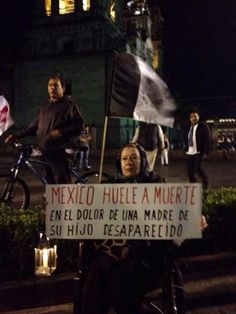
Mothers, sisters, brothers, husbands, fathers, sons and daughters have taken up the pink cross in their march for justice in Moroleon, in Guanajuato, in Mexico, and in Latin America.

Ni Una Mas!

*************************


disclosure

7 Comments

Filed under Cultural Challenges, Death and all its trappings, Safety and Security

Claudia’s San Pancho Marine Turtle Adventure–The Journey There

While I enjoy sharing my adventures and disasters in Mexico, I never really thought of myself as adventure inspiring. In fact, I recently received an unsubscribe request that said I was boring. Whatever! So when I was given this story and I’m mentioned as the catalyst for the adventure, well, to say that I was surprised would be an understatement.

For the next 5 days, I will be sharing your Claudia‘s adventure volunteering at the marine turtle nursery in San Pancho, Nayarit. I’ve translated her escapades for my English language readers adding in a few of my own comments here and there. Spanish literate readers can find her unedited story following the English version. I hope you enjoy her adventure in Mexico as much as I did!

14001799_1106708539377258_405826518_o

My trip to San Pancho to save the marine turtles

Well, to begin, if it weren’t for C. (that’s me) I would not have been inspired to even make a trip alone. She has been motivating me for 2 years to do some of the many things that I have wanted to do. Thanks C. for your encouragement and patience with me. (You’re welcome Claudia!)

Well, for starters it was hard for me to deal with my family about this solo trip mostly due to the fears they have about the insecurity here in Mexico. They are always watching the news reports about rape and trafficking in women in other states, which fills their heads with fear. They don’t have much confidence in me and often consider me scatterbrained. You can just imagine the drama that this trip caused at my house. (She came to see me in tears on a few occasions, so opposed were her parents to this trip.)

Since the moment I got on the bus from Moroleon to Morelia, I was nervous. I couldn’t believe that finally, I was traveling alone. I arrived at the bus terminal in Morelia to get the connection that goes directly to Puerto Vallarta. I got on the bus and I felt nostalgic. A small tear ran down my cheek as the bus left the terminal and I saw my father becoming more distant. This feeling disappeared once we left the terminal and changed into one of euphoria and happiness. I felt so free, sitting in the seat, watching the streets of Morelia pass by, distancing myself from the city and watching how the landscape changed as the bus continued on its route.

Before getting on the bus, I had collected some inspiring music and made an album called “Adventure” to listen to precisely at this moment, which I did. I put on my headphones and hit play to feel the full range of emotions this adventure had inspired.

clau en el autobus

I listened to Owl city’s To the Sky and Galaxies, Justin Timberlake’s Can’t stop the Feeling, Coldplay’s A Sky Full of Stars, the New Radicals’ You Only Get What You Give, E.L.O.’s All Over the World, Smooth Gravity’s Best Day of my Life, among others. If you like, I’ll give you the complete list so that you can hear and be motivated to make your own inspirational playlist. (That’s ok Claudia. I’m sure it’s a wonderful playlist.)

(After reading that, this scene from Zootopia came to mind.)

After that, I slept peacefully, the likes of which I had never slept before. We arrived in Guadalajara to let those off who had this stop as their final destination. My seat companion, who had been female up until now, became a thin, young man whose appearance, the quantity of medicines he carried in a small cooler, and the cane in his hand, led me to think he was ill. The vocabulary he used to talk on his phone made me feel so uneasy that I kept my hand on the pocket knife I carried just in case. I wasn’t able to sleep well. In any case, I dozed off a bit but woke when we arrived. (A knife, really? Well, better safe than sorry I suppose.)

I arrived at the bus terminal in Puerto Vallarta at 6:30 am. I was supposed to meet Miriam at The Holistic Center at 9 am. I thought it was a well-known place and maybe someone could give me directions but I was surprised to find that no one I asked knew where it was. This worried me because it was too early to call Miriam and ask for directions so I decided to wait for a decent hour to call. However, when I called, she didn’t answer my calls or my messages. I started to feel anxious since by now it was 8:50 and the battery on my cell was about to run out.

Another thing bothering me was the strange man watching me. Every time I moved, he moved too. I had my hand on my knife again but then I remembered that I was at the bus station, surrounded by people, so was safe enough. Eventually, I realized he was only trying to annoy me. He had his suitcase up on the chairs in the waiting area and finally left.

I approached a young man that set up tours to ask for directions. He was very nice and helped me look up the address. “Venezuela Street is between the hotels Pescador and marlin, near Malecon.  Take the white and blue bus.  It should have the sign “Centro” on it.”

I thanked him quickly for his help and went to grab a taxi. (But he told you to take the bus!) The taxi driver didn’t know where the street was. He had to ask a fellow taxi driver. In order to see if the taxi driver was trustworthy, I tried to break the ice and see if I could earn his sympathy, so I began with questions about the price of gasoline and his work. Then I changed the topic to that of the teachers and their protests until we finally became friends and he gave me his name, Heriberto. He had the same name as an old and dear friend from Moroleon, and in some way, I felt that was a good sign that everything would be ok. (Because someone with the same name as a friend wouldn’t kidnap you?)

We made numerous turns looking for the address, stopping to ask various people, but no one seemed to know. There were moments that I was afraid because some of the places seemed far from downtown and more so because I had called and sent several messages to Miriam without a response. Finally, a traffic cop was able to tell us where to find it. We continued and had to stop yet again to ask a young lady who called her mother to give us some clues as to what to look for. It was up ahead in front of Woolworth’s, but the sign was small and we would have to pay attention so as not to miss it.

Finally, I saw the sign and we stopped. I got out of the taxi and went up some steps to enter the office under the sign. I saw a woman seated at a desk and knocked. She opened the door. She was wearing a long turquoise skirt and white loose blouse, hippie style like the way Miriam dressed. I asked for Miriam. The woman admitted that she knew Miriam but she didn’t know who I was or what I wanted. I asked her if I could leave my suitcases with her until Miriam finished work.

She said “No, Miriam didn’t tell me anything and she doesn’t work here. She’s much further away. But don’t worry. The good thing is that I know her and you arrived here. How is it you arrived here?”

I replied, “Well, I don’t know. I only asked people and here I am.”

She continued, “Goodness. That’s curious. How fortunate (literally God directed coincidence) that you arrived here.”

She was very nice and we talked a little. She allowed me to leave my suitcases there until 5 pm so I could sightsee along the seawall. When I left her office, I checked my phone and saw that I had messages and missed calls from Miriam. I called her back. She apologized for not giving me the address and remarked how amazing it was that I found one of her friends seemingly at random.

*****************************************

Mi viaje de tortugas marinas a San Pancho

Bueno para empezar, si no fuera por C. no me habría animado siquiera a hacer un viaje yo sola. Ella ha estado motivándome por 2 años a realizar algo de las muchas cosas que he querido hacer y de las que le he contado. Gracias C. por tus ánimos y la paciencia conmigo.

Bueno, para empezar fue muy pesado lidiar con mi familia sobre realizar este viaje yo sola, por los miedos que tienen sobre la inseguridad del país y de que siempre se saturan la cabeza viendo noticias de la televisión acerca de violaciones, trata de mujeres en otros estados y por la razón de que no confían mucho en mi por ser despistada, así que ya se imaginarán el show que se armó.

Ahora, desde que entré al Autobús de Moroleón a Morelia, ya sentía los nervios de la emoción de que aún no creía que estaba por fin realizando un viaje yo sola. Al estar ya en la central de Morelia para ir directo a Puerto Vallarta y al entrar  al autobús listo para caminar, sentí nostalgia y una pequeña lagrimita corrió por mi mejilla al ver alejarse el autobús de la central y ver a mi papá a lo lejos.  Pero esa sensación desapareció una vez que salimos de la central y cambió a un estado de euforia y felicidad. Me sentía tan libre estar sentada en el sillón viendo pasar las calles de Morelia; alejarnos de ella y viendo cómo cambiaban los paisajes conforme avanzaba el autobús. Antes de subir al autobús guardé música que me inspira y creé un álbum llamado “Aventura” para escucharla precisamente en ese momento y eso hice, tomé mis audífonos y le di play a mi lista para sentirme aún más plena.

Entre las canciones que escuché fueron: Owl city-To the Sky y Galaxies, Justin Timberlake-Can´t stop the feeling!, Coldplay- A sky full of stars, New Radicals- You only get what you give, Elo- All over the world, Smooth Gravity- Best day of my life (Lounge tribute) entre otros que si quieren les dejo la lista para que las escuchen igual y se motivan para crear su propia lista también.

Después de eso, dormí tan tranquila y en paz como nunca antes.  Al llegar a Guadalajara para hacer la parada para quienes tenía que llegar a ese destino; mi compañera se transformó en compañero, un joven adulto, delgado y enfermo por su apariencia y la cantidad de medicinas que cargaba en su pequeña hielera y el bastón en su mano. No me daba mucha confianza por el vocabulario que usaba al hablar por teléfono. Incluso guarde a la mano la navaja que llevaba conmigo por si acaso. Jeje. Ya no pude dormir, pero ya estábamos llegando cuando desperté de mi media siesta.

Llegué a la central de Puerto Vallarta y eran las 6:30 am. La única referencia que tenía del lugar dónde me vería con Miriam era “El centro Holístico”  a las 9:00 am. Pensaba que era un lugar conocido y que tal vez alguien podría darme dirección si preguntaba pero para mi sorpresa nadie sabía siquiera lo que era. Eso me preocupó bastante porque era muy pronto como para marcarle a Miriam y pedir dirección, así que decidí esperar a que fuera una hora decente en la que ella ya estuviera despierta para preguntarle; sin embargo pasado el tiempo de espera, no respondía mis mensajes ni llamadas. Ya desesperada por hacer algo porque ya faltaban unos 10 minutos para las 9:00 y mis baterías de celular estaban por agotarse.

Otra frustración que tenía es que había un hombre extraño vigilándome, cada vez que cambiaba de lugar también lo hacía y no dejaba de verme, tenía nuevamente lista mi navaja pero recordé que estaba en la central y no dejaría de haber gente en el lugar, así que estaba segura; hasta que finalmente me di cuenta que sólo estaba enfadado y tenía su propia maleta en las sillas de espera y se fue, jeje.

Finalmente ya cercano a las 9:00 me acerqué a preguntar a un joven que programaba tours y muy amablemente me ayudo a buscar una dirección. “Calle Venezuela; entre los hoteles Pescador y Marlín, cerca del Malecón, toma el camión blanco con azul debe tener el letrero de *Centro* “

Agradecí su ayuda y rápidamente salí por taxi y para colmo el taxista no sabía dónde quedaba la calle hasta que un compañero suyo le dijo por dónde estaba fue que partimos al fin de la central. Para ver si era confiable el taxista, quise romper el hielo y ver si me ganaba la simpatía del taxista, empecé con preguntas acerca del precio de la gasolina y sobre su trabajo, después se cambió el tema sobre los maestros y su lucha hasta que finalmente hicimos amistad y me dio su nombre: Heriberto, jeje qué simpático que se llamara como un viejo y querido amigo de Moroleón, de cierta manera sentí como buena señal de que todo estaba bien. Dimos tantas vueltas buscando el dichoso lugar sin dar con él, preguntamos a varias personas y nadie sabía nada; hubo momentos en los que sentía miedo por algunos lugares que parecían estar lejanos del centro y más porque había mando mensajes y marcado varias veces al teléfono de Miriam sin ninguna contestación, hasta que más adelante había un tipo tránsito y por fin nos dijo por dónde podíamos encontrar el dichoso lugar, continuamos y nos detuvimos a preguntar nuevamente a una joven que llamó a su mamá para que nos diera pista de que estábamos cerca, más adelante en el edificio de “Wool Worth” dijo, pero nos advirtió que el letrero era pequeño así que debíamos poner atención.

Y por fin vi el letrero y paramos. Bajé del taxi y subí por unas escaleras para llegar a la oficina donde estaba el letrero, vi una mujer sentada en un escritorio y toque la puerta. Abrió la puerta, observé estaba vestida con falda larga color azul Turquesa y blusa Blanca holgada, tipo hippie o del estilo que usa Miriam y le pregunté por ella, acertó que la conocía, pero tenía duda de quién era y que quería. Nuevamente pregunté si sabía que iba a dejarle mis maletas mientras ella se desocupaba de trabajar.

“No, no me dijo nada y ella no trabaja aquí, es mucho más lejos. Pero no te preocupes, lo bueno es que la conozco y llegaste conmigo. ¿Por cierto cómo llegaste hasta aquí?- Pues no sé, sólo preguntando a la gente.- ¡Vaya! Qué curioso, de verdad tenías que llegar aquí, qué genial Diosicidencia.” Ella fue muy amable conmigo y platicamos un poco y me permitió dejar las maletas hasta las 5:00 pm para poder turistear por el malecón.  Cuando salí de su oficina, revisé mi celular y ya tenía mensajes y llamadas perdidas de Miriam y nuevamente me marcó disculpándose por no darme una dirección y también quedar asombrada por cómo había dado con una muy amiga suya al azar.

*********************


disclosure

Leave a comment

Filed under Driving Hazards, Guest Blogger Adventures, Safety and Security, Tourist Sites in Mexico

La Llorona Returns

mother1

There have been a rash of horror movies made recently, even an animated cartoon, about the legend of La Llorona (The Weeping Woman). It seems a bit tawdry that this Mexican myth has been regulated to the same genre as The Nightmare on Elm Street and other such slasher movies.

As with any story, there are several versions of this legend. In one version, La Llorona roams the streets weeping for her children who have accidently drowned in the canals. In another version, the children of La Llorona are murdered by their father. In yet another version, La Llorona drowns her children herself in a fit of insanity when the father of the children, a Spaniard, abandoned the family and married another.

mother2

Most experts agree that the basis for the legend most likely comes from the goddess Cihuacoatl of Aztec mythology. She was one of several goddesses of motherhood and fertility and the mother of Mixcoatl.  Myth states that she abandoned her son at a crossroads, but often returned there searching for her lost son.

mother3

La Llorona, Cihuacoatl, or perhaps another aspect of the goddess in the form of Coatlicue, was reported to have appeared prior to the conquest of Tenochtitlan by Hernan Cortes. The Florentine Codex record her words as “Ay mis hijos! Ya se acerca la hora de irnos. Ay mis hijos! ¿a dónde os llevaré? (Oh, my children! It is nearly time to leave. Oh, my children! Where will I bring you?)

mother4

Some believe that La Llorona was actually La Malinche. La Malinche, whose given name was Malinalli, then Marina once baptized, served as interpreter and advisor to Hernan Cortes. She did have two children. Martin was the son of Cortes. Maria was the daughter of Juan Jaramillo. There is no evidence that Malinalli murdered her children. On the contrary, her children were forcibly taken from her when both men abandoned Malinalli to marry titled Spanish women.

mother5

The legend of La Llorona reappears in the 1700’s. In the colonial version, a young indigenous girl is abandoned by her Spanish lover. In a fit of insanity, she drowns her children. When she recovers her senses and realizes what she has done, she drowns herself. She appears before the gates of Heaven where she is asked the whereabouts of her children. She is denied entrance and sent back to Earth to search for them, condemned to spend eternity trapped between the living and spirit world.

bridge

Some versions of the legend claim that La Llorona kidnaps children out at late at night and drowns them. She is said to appear in the late evenings near the rivers and lakes of Mexico City. Hearing the cry of La Llorona is said to be an omen of death.

The name most often given to La Llorona in most versions of the legend is Maria, which is fitting. Maria (Mary) had a son who was forcibly taken, tortured and executed by the state. (John 19) And Maria, in the form of the La Virgen de Guadalupe, is the embodiment of Mexico.

child1

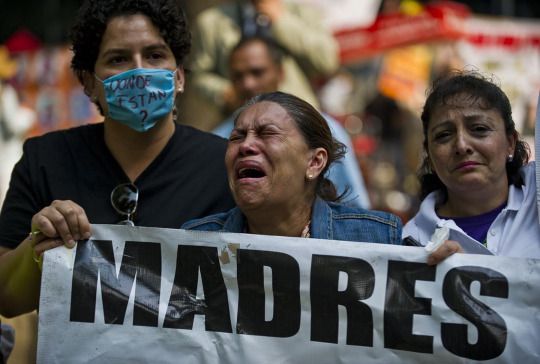
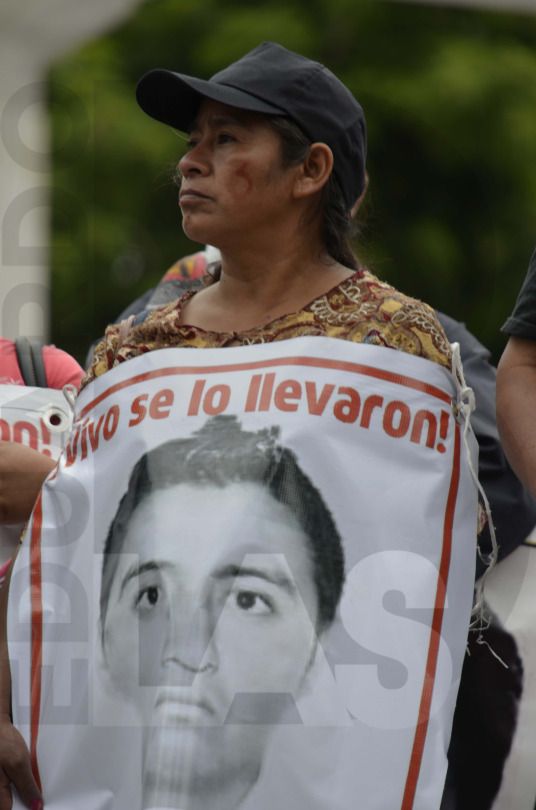
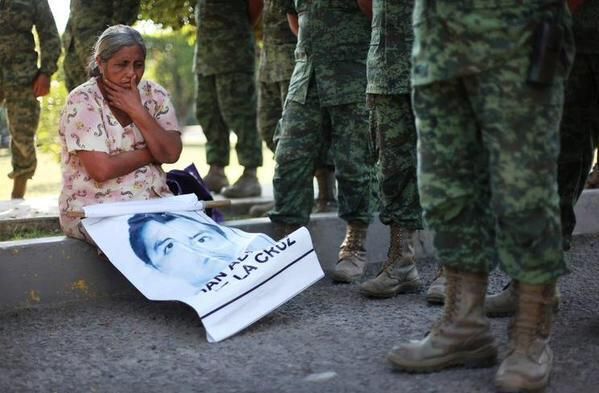
Today, La Llorona’s cry is heard again in Mexico. One year ago, September 26, 2014, Mexico, in a fit of insanity, murdered her children of Ayotzinapa. How long will she weep, searching for her children?

Ah mis hijos!

*****************************************

disclosure

5 Comments

Filed under Death and all its trappings, Mexican Cultural Stories, Safety and Security