Category Archives: Mexican Food and Drink

Invasion of the Flying Edible Ants (Chicatanas)

This morning my classroom was invaded by huge flying bugs. I spent some time before class using the broom to swat out these loud buggers which appeared to be dying. I wasn’t completely successful as there were still one or two flying about when the first graders arrived. However, to my surprise, not only did the kids not freak out like they do when there is a wasp, bee or mosquito in the room, but they could identify them as an ant and reassured me that “no pasa nada”.

I mentioned the flying ants to another teacher and she said they always come before the rainy season begins. Some insist that they arrive June 23, the eve of the birthday of John the Baptist (provided Jesus was born on December 25). Others claim that they come with the summer solstice.  And still others say that they come June 13 in honor of the Patron Saint of Huatusco, San Antonio de Padua.

Typically, the chicatanas appear for one to three nights between June 12 and June 20, although sometimes the rainy season comes a bit earlier. Whatever the exact day, the conditions must be just right. Generally, the chicatanas appear after a hot day followed by a very wet, humid night. This year, those conditions were met on June 15/16, at least in Moroleon.

This was my first experience with the chicatanas, even though I’ve lived more than 10 years in Mexico. The chicatana, also called cuatalatas, chancharras, cochonas, arrieras, zompopo, mochomas, sontetas, nokú, tzim-tzim, tepeoani or tzicatl, is a species of the Atta genus (leaf-cutter ants). The Florentine codex referred to these insects as tzicatana (homiga arriera) and mentioned that they were used as food.

Used as food? Yep. Mexico has more than 250 edible insects, including this one. The chicatanas are prepared in a variety of ways, depending on the region, after their wings, heads and legs are removed. Sometimes fried and served in tacos, sometimes ground into salsa with garlic, salt, and chili, they are considered quite the delicacy.

Really, it’s just the queens that are eaten, as they are the huge buggers flying about looking to establish new colonies during this period. The food or salsa prepared from the queens is traditionally thought of as an aphrodisiac and may have something to do with the tradition in Huatusco when girls looking to be married visit the shrine of San Antonio de Padua with 13 coins to ask for his intervention on the matter. But then again, they could be unrelated.

I wasn’t able to find anyone who knew how to prepare the chicatanas, so missed out on trying yet another exotic Mexican food for this year. I’ll have to keep it in mind next year, where the queens swarm again.

************************************

1 Comment

Filed under Mexican Food and Drink, Native fauna and flora

Harvesting cactus

I love cactus! It has a fresh, green taste that is all its own. And it can be found right in our little community, no trip to the fruteria (greengrocers) necessary. We’ve even planted some cactus in our backyard, however, it will be YEARS before they are big enough to harvest from.

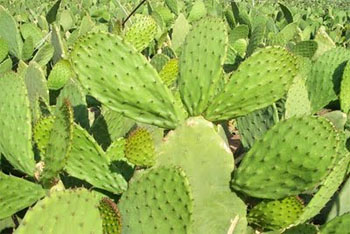
nopal

The nopal (cactus) is one of the fundamental symbols of Mexico.  It is considered la planta de vida (life-giving plant) as it seems to never die.  Fallen pencas (leaves) form new plants, therefore an apt symbol of the life-rebirth cycle found in the most ancient of Mexican myths.full of tunas

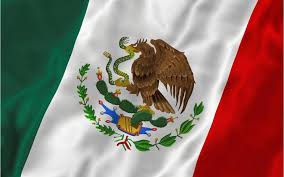
According to legend, the first nopal (cactus) grew from Copil‘s heart, son of Malinalxochitl, the moon, and Chimalcuauhtli.  Copil had attempted to murder his uncle Huitzilopochtli, the sun, because he had abandoned his mother.  According to legend, Huitzilopochtli defeated his nephew and removed Copil’s heart, which was later buried. The next day, the first nopal appeared, complete with the thorns of a warrior and flowers that blossomed with the love Copil had shown in defending his mother. This nopal (cactus) was discovered by the wandering Aztecs.  Atop the nopal was an eagle, devouring a serpent, over a lake, the sign the nomads had been waiting for.

flag

To have la cara de nopal (the face of a cactus) is to say that one’s indigenous ancestry is evident.  My husband has a decided cara de nopal and that isn’t a bad thing.

cara de nopal

Yes, I’m pocho (a Mexican who has turned his back on his ancestry usually living in the US) but I haven’t been able to get rid of this cara de nopal (Mexican face).

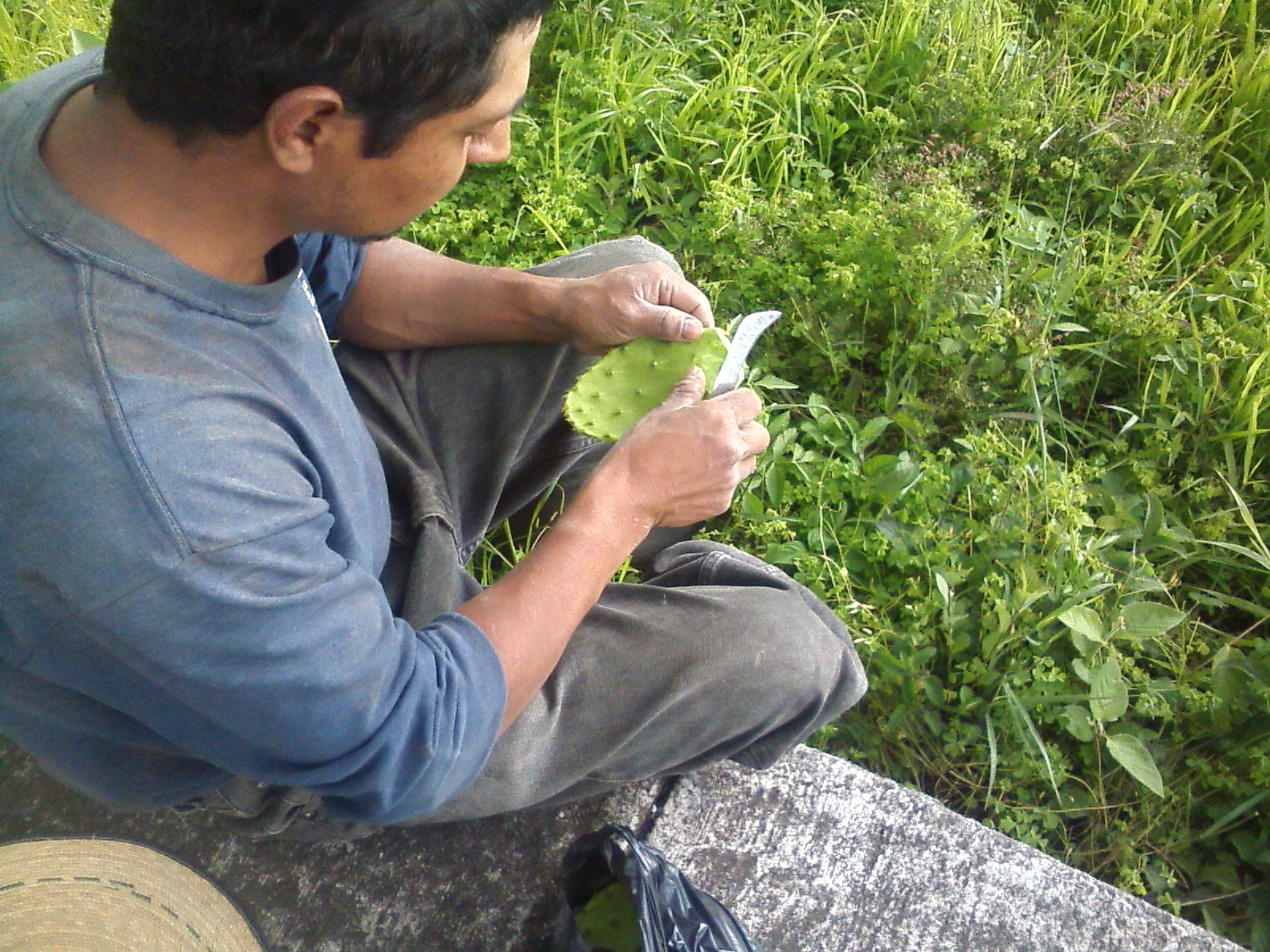
There is a technique however to harvesting. The pencas (leaves) should be a light green. Older pencas can be eaten, but they tend to have a bitter taste. The penca should be cut at the base, and handled gingerly. It is a cactus after all and there are espinas (thorns).

nopales to harvest

Once a good number have been collected, it’s time to despina (remove the thorns). It isn’t a terribly difficult process and practice makes perfect. The base of the thorn is cut, away from the cutter, and discarded. The outside edge is also skinned off. My husband always does this outside–less clean up involved. And that’s pretty much it. The cactus is ready for cooking.

dethorning cactusdethorning side

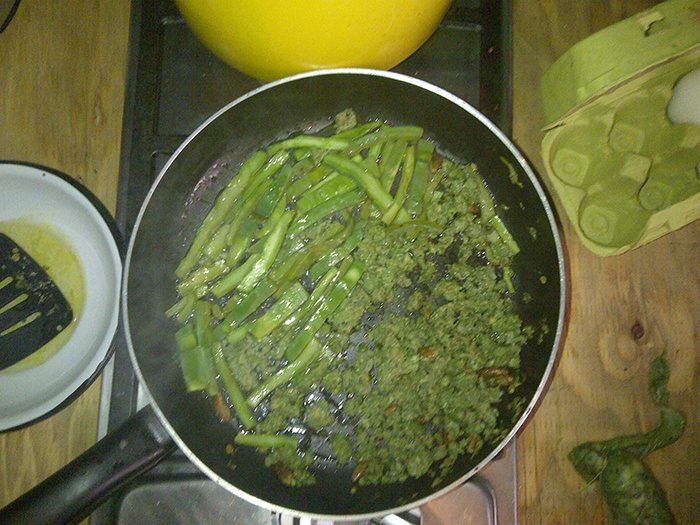
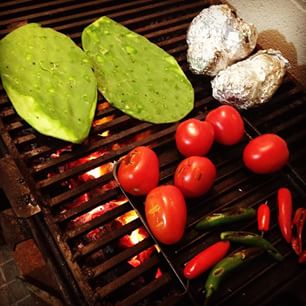
Cactus can be cooked as an entire leaf on the comal (griddle) or cut into pieces. It can be boiled or basted in tripa (intestine) juice, which is my favorite manner of preparation. It can be eaten warm or cold, used like a tortilla around cheese–a nopaldilla if you will–eaten as a salad with tomato and chili, or with beans and onions or ..well you get the idea.

boiled nopal

roasted nopal

nopales

A nice size bag of the nopales, tomato, onion and yellow chili mixture can be bought from the corner vendor for 10 pesos. Fast-food at its best!

Cactus also provides fruit in season, tunas (See Picking Tunas), the heart of Copil. Just more evidence that even in the desert, “the Earth provides enough for every man’s need” –Mathama Gandhi.

*****************************

disclosure

8 Comments

Filed under Mexican Cultural Stories, Mexican Food and Drink, Native fauna and flora