
Category Archives: Cultural Challenges

A room of her own–painting, internet and water

internet-high-five

Although the electricity was on, the water had been cut due to non-payment. The owner collected my deposit and assured me that she would go on Monday and get that all straightened out. I also needed to go and find out about the internet hook-up that week.

So I headed to Telmex (the only internet company available) and climbed to the fourth floor (I wondered how disabled people would get up those stairs) to talk with someone. I didn’t want a phone line, so I applied for Infinium Puro which was just the internet package. I was a little taken back that I could only get the 8 Mbps option because of the area the house was located in. Downtown had all the fiber optic options and the like, but in Los Girasoles (Sunflowers) where I had rented, only the basic service was available.

My brother assured me it would be enough to teach my classes, so I signed up for a 6-month contract. I gave the woman my Mexican driver’s license, but she wanted my IFE (voter’s registration card) which of course I don’t have. I gave her my permanent residency card and explained what it was. It seemed to be enough ID for her to work with. I filled out some paperwork, and she said everything was good to go. I could pay the internet online or come to the office and pay, but not until the end of the month. It would be about $349 pesos monthly.

I asked about installation and told me she couldn’t be sure which day, but the installers would call me before arrival. Ok, well, I would just have to hope that it would be a time when I was available. The clerk was all in a tither about my online teaching job. She had heard about the company on the TV, but she was amazed that I lived here as everyone wants to move to the US. I’ve heard it all before, but I tried to smile and nod. I really needed that internet set up.

The next step was to start cleaning and painting the little house. There was about a half a bucket of cream paint left from some remolding projects we did in La Yacata, so I hauled that over the little house in The Sunflowers. La Yacata and Los Girasoles are about 1 mile apart, the major difference being Los Girasoles is on the other side of the highway and thus all connected up to Moroleon’s water, sewer, electric and internet services.

8810_painter

Painting proved more of a challenge that I first anticipated. It seemed the walls were made with yeso (plaster), and the paint just wouldn’t stick. I ended up using the half-bucket but didn’t even get the front room done. That was disappointing.  It ended up taking a full 2 weeks to get this itty bitty house painted since the paint would just slide right off.  I spent way more than I wanted to on paint.  I ended up buying a bucket of yellow and a second bucket of cream.  Very frustrating. That promised painting help from my husband never materialized.  My son (as a teenager) moaned and complained every single second we painted.  So I ended up doing most of it myself.

water-bucket

Then there still wasn’t any water. How was I supposed to clean without water? The English teacher across the street again saved the day. She brought me buckets and buckets of water from her house and even stayed to help me clean and paint. And boy did it ever need cleaning! We did what we could that day and left to teach our various afternoon classes.

Saturday morning I got a call from the Telmex installers. I told them I wasn’t at the house but could be there in 10 minutes. It actually took me 5, but who’s counting? They had the internet installed in the back room in less than 30 minutes. I hopped about and did the happy dance. Then the English teacher across the street called the owner to ask about the water. She said she’d call somebody to fix it. Apparently, her brother-in-law works for the water commission. He showed up not 15 minutes later and turned the water on, on his day off no less. I did another little happy dance.

My husband came later that afternoon and changed the front door lock for me. Another unanticipated miracle!  Since I had no idea who last rented the house and how many house keys they had made, it seemed like a sound investment.  I felt like things were progressing nicely if a bit slowly.

*******************************

disclosure

1 Comment

Filed under Construction, Cultural Challenges, Electricity issues, Employment, Water issues

Mexican Chicanery

thief

On Sunday, my husband comes rushing over from his brother’s house to plug in his phone to charge in the truck. He said that the owner of the house he had been building in La Yacata kept calling him from el Norte (the US). Sure enough, a few minutes later the phone rang again. Seems the guy was on his way back to Moroleon. Well, bully for him.

A few hours later, my husband comes running back over to ask if I would loan him 3,000 pesos to send to this guy. So, as a dutiful wife, I look through my savings and sure enough, I have just 3,000 pesos that I’ve been saving for a washing machine. I ask why the guy doesn’t just call his wife if he needs money. My husband didn’t know. Now just a dang gone minute–this seems a bit fishy.

So here’s the story. The guy calls my husband to say that he’s on his way home but that he doesn’t want to travel with all the cash he’s bringing. He asks if he could deposit the money in my husband’s bank account. Additionally, he asks my husband what tools he still needs and says that he’ll bring him something. There must have been some interaction where the guy goes to the bank, gets my husband’s information and “deposits” the money. Of course, it being Sunday, there isn’t any way to verify this. My husband assures him that the $6,000 USD he “deposited” will be more than enough to finish the house in La Yacata.

Then the guy calls back later. He said he just crossed the border with $2000 USD. He legalized his truck and trailer, which cost him $1700 USD for the truck and another $200 USD for the trailer. Now he’s got a problem because he doesn’t have enough money for gas to get to Moroleon. So here’s where he asks my husband to send $3000 pesos.

So I told my husband, if I gave him the money to send, we wouldn’t have anything to eat this week. Plus there is the fee for sending the money which usually is like $500 pesos. My husband asks the guy if $2,500 pesos would be enough. The guy says that if he sends the money through XOXO, there isn’t any fee. He assures my husband that he will repay the money tonight if he arrives in Moroleon tonight, or tomorrow morning at the at the latest. He was in Tamaulipas and the trip to Moroleon is about 7 hours barring disasters. So my husband asks what name the money transfer should be in and the guy hangs up. A few minutes later, he gets a message that reiterates that if he sends the money through XOXO, there is no fee.

I suggested that he go and see the wife before he sent any money. My husband assured me that it was this guy, he sounded just like him anyway. He got all defensive and I finally pocketed the money again. I would not give him the money unless he talked to the wife. He said he’d see the wife but that I should give him the money so that he can “luego, luego” (quickly) send the money while he was out and about. I said no. My husband left the house in a huff.

I had to go and work, so I was not privy to the continued goings on. My husband, who is of the mentality that vatos (guys) help each other out, managed to borrow the money from Azul the vet and his brother B. He went ahead and sent it at XOXO. THEN he went to talk to the wife who said that her husband wasn’t due to come home until Christmas. It had all been a setup.

So this morning, my husband, who is unemployed yet again, needs to come up with $3000 pesos to repay what he sent to some crook. He says he’s going to sell some goats–he’ll need to sell four or so to cover the debt. And this is how things are done in Mexico.

See also Western Union Fraud Education Program

disclosure

1 Comment

Filed under Cultural Challenges, Economics, Education, Employment, Safety and Security

Ni Una Mas (Not One More) Femicide in Mexico

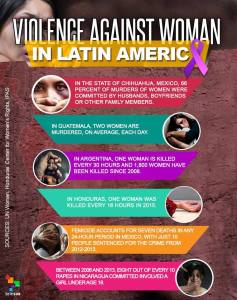
I’ve written how mothers are venerated here in Mexico. I’ve written about how the Virgen Maria de Guadalupe, the ultimate mother, has played a key part in the independence of Mexico. However I’ve also written about the hissing and booing of Malinche in Mexican history, and here is where the juxtaposition of femicide in Mexico begins. Femicide is defined as the killing of women by males because they are female. As opposed to homicide, femicide is linked closely with sexual violence enacted to punish, blame and control the actions, emotions and behavior of women. It is the most common crime in the world and has the highest level of impunity for perpetrators. It’s hard to even find reliable statistics for Mexico since murders are covered up, bodies are never identified, disappearances remain unreported, and justice is sorely lacking. It is estimated that an average of 6-7 women per day is murdered in Mexico. Perhaps that doesn’t sound like very many, but 6 per day is 42 per week, 180 per month, 2190 per year. That’s two thousand one hundred and ninety daughters, mothers, and sisters every year. In some Mexican states, femicide rates are 15 times higher than the global average. With the death rate so high, it comes as no surprise that 63 percent of Mexican women over the age of 15 have experienced some form of gender violence, although 95 percent of the aggressors have never been held accountable in the court of law.

femicide-pic

To understand these staggering figures, it’s necessary to look at the nature of femicide itself and the underlying cultural of machismo in Mexico. I’m not going to write a dissertation about it, but suffice it to say that femicide is considered acceptable in many segments of Mexican society. Women are considered expendable as demonstrated by the low number of murders actually brought to justice. During 2012-2013, 3,892 women were classified as victims of femicide. Of that number, only 24 percent of the crimes were investigated and only 1.6 percent led to sentencing.

This idea of expendability was further reinforced culturally with the implementation of NAFTA. The factories that have sprung up at the border (maquiladoras) hire mostly lower wage earning young women. These working women have left the relative safety of their hometowns and family circles in order to work at the border town sweat shops and have become easy prey for unprovoked violence by strangers. Men who have been denied work because of their higher-wage earning gender seek out to harm these women to prove their macho-ness.

Not only strangers but husbands and boyfriends have also been unmanned with the economic shift. This shift directly challenges the cultural idea of Marianismo (relating to the Virgin Maria) found in Mexico.  It comes as no surprise that domestic violence is on the rise when these traditional gender roles are challenged.

In one such border town, Ciudad Juarez, over it is estimated that 700 women have disappeared and more than 360 more killed. The majority of these victims are young women, many workers in the maquiladoras, and have been sexually assaulted before their death. The Inter-American Court of Human Rights found the state complicity guilty of these deaths in 2009 because so few were ever even investigated much less documented adequately. Ciudad Juarez was previously sanctioned by the National Human Rights Commission for gross irregularities and general negligence including the misidentification of corpses, lack of expert forensic evidence, failure to conduct autopsies or obtain semen samples, failure to file reports and incompetent record keeping when it came to female victims.

One important differentiation between femicide and homicide is that the murder is committed by someone who takes advantage of his elevated social of physical power over a woman. There are countless known examples of the authorities in Mexico abusing their social position and power. Some femicides are believed to be related to the powerful drug cartels, found in Ciudad Juarez and other areas of Mexico. Prostitution rings and human trafficking are real dangers for women in Mexico.

In the State of Mexico, while now President Peña Nieto was governor of the state, at least 1,997 women were murdered. One particularly horrifying incident of abuses done to women by those in power occurred in 2006 when Mexican troops were called in, by Governor Peña Nieto, to end the protestations of local flower sellers in a community near the capital. In San Salvador Atenco, at least 11 women were detained by police and transported to a holding facility. They were raped and beaten and denied medical treatment for days. The Inter-American Commission on Human Rights (IACHR) investigation of the matter found that the state government (under Peña Nieto) attempted to minimize the crimes. Instead of prosecuting the officers involved, the state arrested 5 of the women, having them serve more than a year in prison for blocking traffic during the initial flower seller protest. Within a culture where those in power can do as they wish to women with consequence, it is no wonder femicide is rampant in Mexico.

The Inter-American Commission on Human Rights (IACHR) investigation of the matter found that the state government (under Peña Nieto) attempted to minimize the crimes. Instead of prosecuting the officers involved, the state arrested 5 of the women, having them serve more than a year in prison for blocking traffic during the initial flower seller protest. Within a culture where those in power can do as they wish to women with consequence, it is no wonder femicide is rampant in Mexico.

Quintana Roo has one of the highest human trafficking rates in Mexico. In 2005, reporter Lydia Cacho pointed fingers and named names of high-profile businessmen in Cancun and their involvement in child pornography and prostitution rings. In yet another power play by authorities, she was subsequently arrested for defamation of character, tortured and threatened with rape in an attempt to silence her.

5 Latin American Feminist Groups You Should Know About

The Ni Una Mas (not one more) social movement in Mexico was originally organized to raise awareness for the violence against women in Ciudad Juarez. Since its initial formation, it has grown to include a variety of domestic and international organizations, all with the idea that not one more woman will disappear, not one more woman will be abused, not one more woman will be murdered.

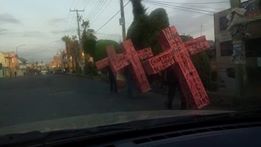
Ni Una Mas protest September 3, 2016 Moroleon, Guanajuato

Ni Una Mas protest September 3, 2016, Moroleon, Guanajuato

On September 3, 2016, a representative group passed through Moroleon on their way to the state capital in order to ask the governor to better address the local situation. While violence against women is not as staggering in the state of Guanajuato in comparison to those areas previously mentioned, in 2015 there were 45 murders classified as femicide in the state with 13 of these occurring in the city of Leon. Only 13 arrests have been made in the 45 wrongful deaths and to date, not one conviction.

A study conducted in 2011 by ENDIREH reported that over 38% of women 15 years old or more have been victims of some sort of emotional, economic, physical or sexual violence in the state. In 2012, and 2013, there were 1034 reported rapes in Guanajuato. In 2012, there were 65-68 murders classified as femicide. Thus, this international issue is also a local issue. (See also En cuatro años, aumenta 974% desaparición de mujeres adolescentes: Redim)

Mothers, sisters, brothers, husbands, fathers, sons and daughters have taken up the pink cross in their march for justice in Moroleon, in Guanajuato, in Mexico, and in Latin America.

Ni Una Mas!

*************************


disclosure

7 Comments

Filed under Cultural Challenges, Death and all its trappings, Safety and Security