Category Archives: Animal Husbandry

Goat Genetics

mama and baby goat

Tweedledee and Harry. No horns, no campanitas, white, big ears.

One of the most interesting features for us in raising goats is learning about genetics without hours in the classroom studying the theory. As goat gestation is five months, we have at least one, probably 2, chances to see the results of genetic matings each year.

We aren’t looking for thoroughbreds or rare breeds, but we are interested in healthy, productive goats, maybe with a few extra colors or characteristics thrown in to give each goat distinction.

The majority of the goats in our area are white with long ears. While there is nothing wrong with white, it is a little boring. We have been hard pressed to find a little natural variation with which to infuse our stock.

Vaca the goat

Vaca the goat, pinta, horned but no campanitas

A few months ago we came across a small black and white pinta (black and white) that we paid a little more for and subsequently named Vaca (Cow). Much to our surprise, she was pregnant. However, we weren’t sure if the father was Chivo Pestoso (Stinky Goat) our macho or the macho from the herd she had been with, that seriously resembled Mr. Snuffleufagus, huge, shaggy and brown. We tried counting the months, but without knowing the exact time she became pregnant, we couldn’t say for sure.

Firoles

Large, hairy, pinto, no campanitas, no horns, big ears.

Nothing to be done but wait. So we did. And out popped Firolais one bright morning. He didn’t look like Chivo Pestoso. He didn’t look like Mr. Snuffleufagus. He didn’t even look like Vaca. He looked exactly like our puppy Hershey! Talk about genetic anomalies! We determined that he had to be Mr. Snuffleugagus’ son based on his ears. His ears were not like Vaca’s or Chivo Pestoso’s ears. He also has longer than average hair and seems to be developing into quite a big guy, while his mother is rather on the small side.

One male goat is enough manliness for our small herd. Males have a strong odor emanating from the base of their horns that they add fresh pee cologne to when a lady goat is in heat through the impressive feat of urinating on their own faces. So believe me, one macho is quite enough. We had been using a rent-a-stud service, but the arranging, transporting and servicing fees made it more practical to keep one of our own machos as the herd stud muffin. Last year, Queenie gave us twin boys from which to choose.

stinky chivo

Stinky Chivo, little ears, horns, campanitas, not white and a twin son from a mother who was herself a twin and a father who was one of 4!

My husband kept Chivo Pestoso instead of his twin brother, based on the size of his ears. Chivo Pestoso has itty bitty ears, even smaller than his mother’s ears. The twin had ears that were the same size as Queenie’s. All our adult female goats are currently expecting, and the now teenage Chivo Pestoso is the father. It will be interesting to see if little ears is a dominant or recessive trait. Personally, I think it is an unattractive characteristic. Furthermore, it has become evident that Chivo Pestoso has some hearing issues. All the goats come running when we shake corn in a tin can. All but Chivo Pestoso that is. He continues munching away, oblivious to the stampede for corn and often gets left behind. Finding himself alone, he panics and begins his high-pitched bleating. But, as he doesn’t hear so well he can’t hear the rest of the goats when they answer, and he wanders about lost until we go and fetch him in.

queenie

Little ears and campanitas!

Chivo Pestoso, Queenie, Tinkerbell, and Caramela have campanitas, small balls of hanging skin on the neck resembling “bells” hence the name, which is another trait my husband prefers. This particular characteristic is cosmetic, nothing more. It doesn’t appear to be tied to twinning, fertility or milk production, which are traits I am more interested in.
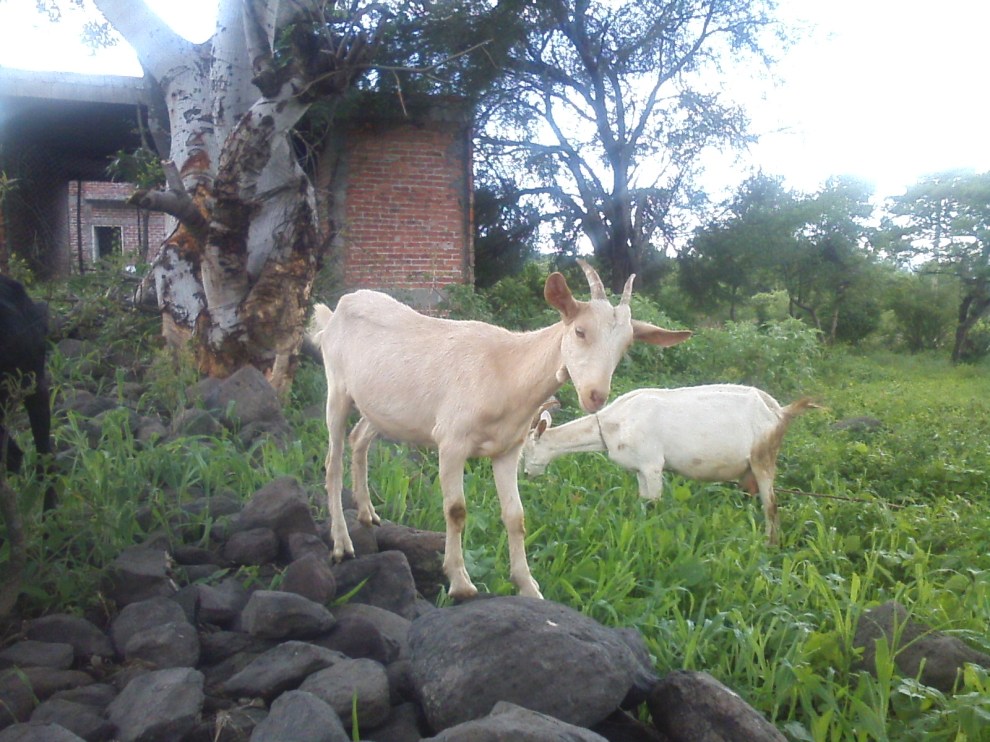
Caramela

Caramela, big ears, campanitas, not white and horns

Horns, however, are not just for looks. In goat reproduction, it’s important that the macho has horns. A macho without horns has a 50 percent chance of his daughters being sterile. So any male kid without horns is sold. Males that grow horns are watched to see if they are a potential replacement for Chivo Pestoso. My husband can usually tell if the kid will have horns or not shortly after birth, but it takes me a few days to determine whether the hair swirls will remain swirls or grow horns. As not all of our nanny goats have horns, it is important that the male does to avoid that chance of infertility.

goat family

Frank and Jesse, little ears, campanitas, pintos, twin sons of Duchess, a twin, and Stinky Chivo, a twin, and looks like both will have horns

Twinning is another genetic factor we consider when buying, keeping or selling our goats. Queenie has produced two sets of twins in 2 years and was herself a twin. She’s a keeper. Tweedledee has delivered twins 2 out of 3 births; we don’t know if she was a twin or not. Duchess was a twin, but her last two births were single offspring. However, yesterday, she presented us with twin boy kids (pinto with little ears and horns). Vaca had a single birth, but as her offspring is not related to any of our goats, the jury is still out on whether he will stay or go. We try to avoid too much inbreeding. Tinkerbell, Cookie (otherwise known as Shortie), Diabla and Caramela are new purchases and have yet to have babies. Venada (Deer), the daughter of Queene, is the current favorite, being a lovely brown color, having horns and campanitas and being a twin. She just turned seven months old, so not ready for baby making yet, but we can’t wait to see what she produces.
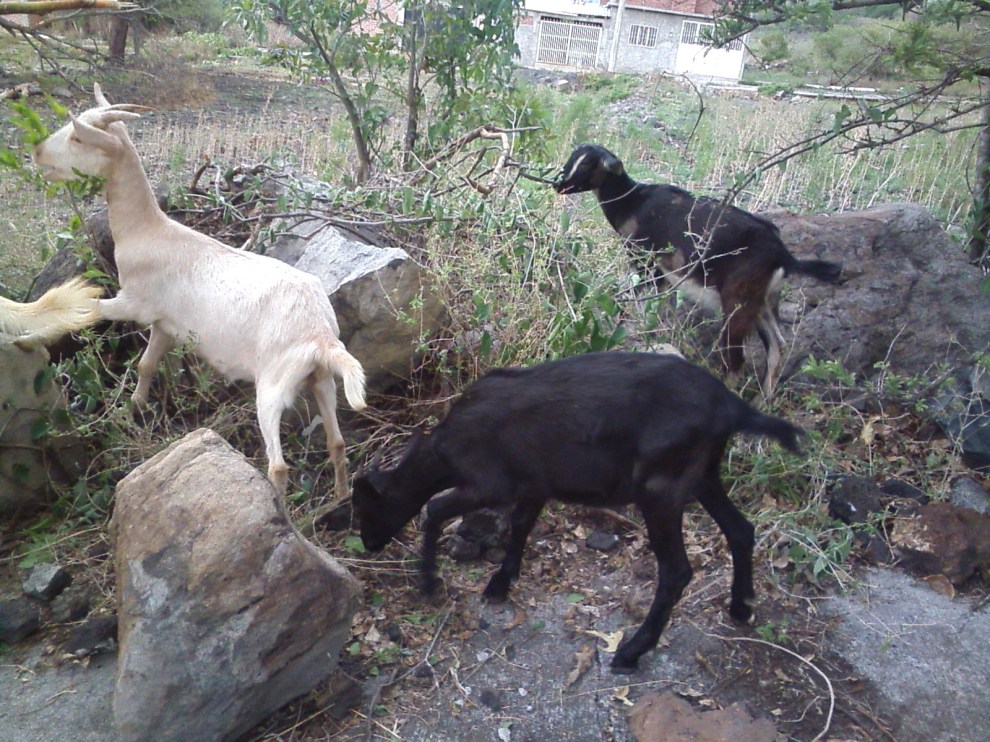
kids

Caramela, Diabla, and Cookie

Milk production is another significant factor when culling the herd. Tweedledee, though not always a twin producer, always has more than enough milk for our evening hot chocolate. Queenie, being small and the mother of twins doesn’t produce much extra milk, but has sufficient for her offspring. Duchess and Vaca have barely enough milk for their offspring and are on the watch list. To be fair, Vaca’s baby is enormous, and Duchess is an excellent mother, so no action has been taken as of yet, but when the time comes, they are near the top of the list.

My husband, as the main milker, has a preference in udders. Some teats are long and hang low. This type of udder is harder to milk, seems subject to more infections and often gets tangled or cut when out foraging. Other teats are shorter and found under a rounder udder and the goat booby preference around here. My husband insists that this trait is determined through the male. I can’t say whether I completely believe that or not. His theory, and one I’ve heard from several other locals is the hang and shape of the testicles has a bearing on the type of udder any daughter born will have.

venada

Venada–Long ears, twin, campanitas, not white and unique personality

Personality also plays a role in whether a goat is kept or not. It may be more of nature vs. nurture though rather than true genetics. For instance, Queenie lets us know the minute food supplies are dwindling, even if she is still has a bite in her mouth. Her daughter Venada is just as assiduous in keeping us informed. Tweedledee, although a good breeder and milk producer, doesn’t have the “spark” that Queenie and her offspring have. Her twin boys, although both having keepable (i.e. good color, campanitas, and horns) characteristics, were not considered as potential macho replacements because they too lacked the “intelligence” we were looking for. The verdict is still out on Duchess’ little boys. A week or so watching them play a rousing game of bump heads or king of the rock will tell.

****************************************************

Herbalist Courses for all levels

disclosure

7 Comments

Filed under Animal Husbandry

Parenting Challenge–Learning from Animals–Running the emotional gamut


Welcome to the June 2014 Carnival of Natural Parenting: Kids and Animals

This post was written for inclusion in the monthly Carnival of Natural Parenting hosted by Code Name: Mama and Hobo Mama. This month our participants have shared stories and wisdom about kids and pets.

***
puppy love

We have animals. We interact and coexist with them on a daily basis. How can we not learn from them?

Having animals is an emotional training ground for my son, or so I believe. I hope that when he moves on to the emotional truckload found in adolescence and young adulthood, he will remember some of these experiences and maybe be just a little more prepared and not blind-sided with their impact.

little puppy

Unconditional love

We have had quite a few baby animals under our care. Some have been abandoned, some orphaned and some we bought young. These babies, whether puppies, kitties, colts, ducklings, lambs, bunnies, piglets, kids or chicks, have looked to us with unconditional love. They greet us with shining eyes in the morning. They wait at the gate for us to come home. They follow us trustingly wherever it is we go. They crawl into our laps for comfort. Everyone should experience unconditional love.

colt

Group Identity

Some of our orphans have been accepted immediately by our other animals. Others have been rejected for whatever reason. Maybe their color was wrong, or they were seen as a threat to the already established status quo. It comes as no surprise then that the rejected form their own iron-clad gang, finding love and acceptance among themselves. Everyone should have a feeling of belonging.

Unrequited love

Some of our animals we have found had been abandoned and took them in. It is harder for us to love these older animals with their already formed personalities and behavior issues. We go through the motions, but the unrequited love these animals look at us with is difficult when our emotions do not run so deep. The kindest thing we can do is to try and find a more appropriate home for them. Everyone should learn to deal compassionately with a love that is not returned.

kissing horse

Betrayal

Sometimes, no matter how much lavish attention and love we shower on our animals, it isn’t enough. My husband has been the most affected by animal betrayal. Those dogs and horses he feels closest to have been the ones that ultimately have to go after a particularly horrendous crime. Everyone will experience betrayal.

sad boy

Loss

Animals have a shorter life span than humans even when allowed to live out their natural life. Outside events are also a factor. Some of our animals have been poisoned by not-so-well-meaning neighbors. The sadness and pain of loss is not lessened with frequency. Sometimes the only thing that  we can do is sit by a dying animal and give comfort with our presence. Everyone will experience loss.

bunny

Sometimes, when we have to make a particularly difficult decision with regards to our animals, I look at my son’s shining eyes and wonder if it is fair that I force him to experience these emotions right now, at his age. I wonder if it would be better if he didn’t have to deal with their magnitude and if I could keep him protected in a hazy bubble, maybe by giving him a fairy tale to believe, a Disney version of All Dogs go to Heaven perhaps. Then again, I know my son and doubt that he would believe such a story even if I could present it well. After all, life isn’t the Disney channel and childhood isn’t an isolated period of growth and development. He already knows that and so do I.

***************************************

Online Advanced Herbal Course

disclosure

*********************************************************

Carnival of Natural Parenting -- Hobo Mama and Code Name: MamaVisit Code Name: Mama and Hobo Mama to find out how you can participate in the next Carnival of Natural Parenting!

Please take time to read the submissions by the other carnival participants:

  • What Animal Rescue is Teaching My Children
  • Tips on Picking the Perfect Kid-friendly Dog — Lactating Girl at The Adventures of Lactating Girl shares some tips she’s learned on how to find the perfect child-friendly dog for your family.
  • All New Animals Are “Woof” — Baby Boy is still learning animals. Life Breath Present doesn’t yet have any at home, but he still believes that all animals are “woof.” Here’s the proof.
  • Dude, where’s my Horse? — Adora loves horses, but Erin at And Now, for Something Completely Different really doesn’t. However, Adora’s longing wins out; learn about their interactions with horses here.
  • Weighing the Pros and Cons of a Family Pet — When is a family ready for a pet? Donna at Eco-Mothering discusses her worries as well as the benefits of adopting a dog, including how it will affect her seven-year-old daughter.
  • Parenting Challenge–Learning from Animals–running the emotional gamut — Survivor at Surviving Mexico writes about the emotional learning her family has experienced through sharing their lives with animals.
  • Puppy Love for our Family — In case you didn’t catch it from the blog title, Pug in the Kitchen, the family pet is an integral part of Laura’s family and home life!
  • Vegetarianism and Animal Rights: Explaining to Children — Becca at The Earthling’s Handbook is mostly vegetarian…not 100%, and not because of animal rights…yet she has found that the idea of not hurting animals is the aspect of vegetarianism most easily understood by a young child. She explains what her son has learned about not eating meat and how it has affected his social life.
  • Pets & kids: The realities — Lauren at Hobo Mama lays out the benefits and drawbacks of pet ownership when young kids are involved.
  • HOW PETS CONNECT WITH EMOTIONS: KIDS & PETS AFTER 9-11 — Parenting Expert Laurie Hollman at Parental Intelligence discusses the importance of pets in lowering stress after traumatic situations, why children choose certain pets, the loss of a pet, and the role of parents in teaching care-giving to animals in a warm, gentle way.
  • It’s not our house without a dog! — Amy at Me, Mothering, and Making it All Work describes why giving a loving and disciplined home to at least one shelter dog at a time enriches the life of her family, and has become a vivid memory in the minds of her children.
  • Canine Haikus —Kids, dog, haikus, atDionna (Code Name: Mama).Pet-centric poems.
  • Beanie’s BunniesOur Mindful Life‘s Sofi Bean has gotten her first pets!
  • Montessori Care of Pets — Deb Chitwood at Living Montessori Now tells about her experiences with kids and pets and shares Montessori resources for pet care.
  • No Puppy! — Meg at the Boho Mama shares her tips for dealing with toddlers and the (very real) fear of animals.
  • Year of the Pets — Jorje of Momma Jorje wasn’t sure she ever wanted pets again, but things have changed a lot this year!
  • 3 Reasons Why Keeping Backyard Chickens is Good for my Toddler — Bianca, The Pierogie Mama, started keeping backyard chickens for the benefit of their eggs, but what she wasn’t prepared for was what they would teach her two-year-old daughter too.


18 Comments

Filed under Animal Husbandry, Carnival posts, Parenting Challenges and Cultural Norms

Our Family Hobby

Welcome to the April 2014 Carnival of Natural Parenting: Parenting Fears

This post was written for inclusion in the monthly Carnival of Natural Parenting hosted by Code Name: Mama and Hobo Mama. This month our participants have shared stories and wisdom about family pastimes.

***

A family hobby? Us? We are so busy in our day to day lives that we don’t often have time for leisure activities like travel or bungee jumping or arts and crafts. But we spend time together as a family and we enjoy the time we spend together as a family. So what do we do together as a family? Our daily discussions, activities, and lives are centered around our animals. Animal husbandry is our hobby.

We play around with animal husbandry, not in the Wikipedia definition of Animal husbandry as “the management and care of farm animals by humans for profit,” since we certainly do not realize a profit, but more as the now obsolete meaning of the word husbandry as a “steward” of a household. We are definitely stewards.

Since moving to Mexico, we have been involved in purchasing, raising, caring, breeding, healing, feeding, selling, butchering and sometimes burying all sorts of animals.

Afternoons will often find us settled on the back steps watching some aviary antics.

Mrs. Macho setting on the eggs.

Mrs. Macho setting on the eggs.

We have been host to domesticated pigeons escaped from the tiro de pichon (shooting range) and watched them raise generations of babies in the eves of our animal area. Eventually, Mrs. Macho moved on when we had to change the roof slant, but it was fascinating to watch the love and care both Mr. and Mrs. Macho took by sitting on the eggs and feeding the ugliest little broods. We enjoyed watching the babies growth and their first practice flaps and then rejoiced as they left the nest one by one.

quails

Codornices are small, native quail.

We have also had codornicess, which are a small native quail. We noticed most how the little guys would come to greet us at feeding time, even pecking at our shoelaces when we were slow to acknowledge them, hopping up and hooting just like in the cartoons.

chickens

Chicken hierarchy

Of course, our mini-homestead has chickens and chicken culture is amazing. Their socialization and hierarchy are as intense as any telenovela (soap opera). We have watched young roosters make their first macho challenges to the current head mucky-muck. We watched as Henny Penny gave up the will to live when the love of her life was no longer there. We chuckled at Jovencita’s attempts to adopt every single chick hatched and shook our heads at the poor mothering done by Hilda. We were horrified in the pecking death of Gringa, for the crime of being different from the others. And we are on hand to cluck over the newest batch of hatchlings. (See Why did the chicken cross the road?)

bump head goats

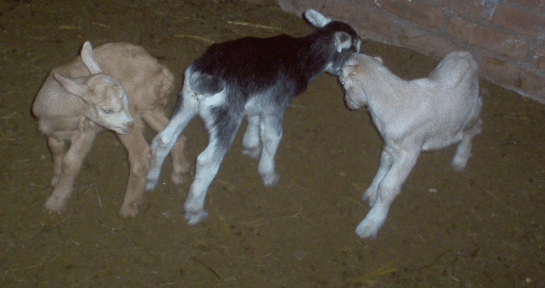
These goats are less than a week old and already playing bump heads!

One of our daily activities is taking the goats out to forage. Some days this is a run for your money if Duchess or Twiddledee get it into their heads to head for the hills. Most days, it’s a relaxing afternoon under the mesquite watching the antics of the goat kinder (kindergarten) as they play king of the rock or a rousing game of bump heads. We have even had kids that wanted nothing more than to sit in your lap, although this tends to be a bit cumbersome as they grow. (See Separating the sheep and the goats)

beauty

Beauty getting saddled up.

Sunday afternoons will often find us spending time with our hoofed animals, which currently includes Fiona, the donkey, Beauty, the yegua (mare) and Shadow her colt. It is not unheard of for us to take a family ride up and past La Yacata and back, sometimes further. We have even been known to have donkey races just for fun. (See Donkey Races, A horse is a horse or not, Beauty’s Babies)

gato

Smile for the camera now kitty!

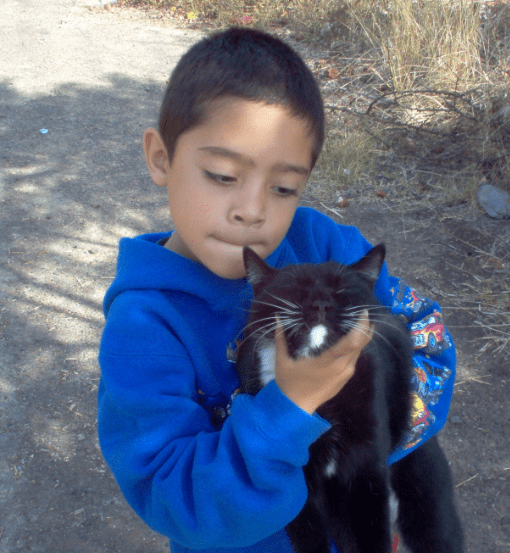
I must not forget to include our long list of puppies and kitties that have come into our lives, sometimes for an extended period, sometimes for just a few days. Their personalities, travasuras (naughtiness) or amiableness, have made them such a pleasure to come home to. Currently, we are hosting 2 dogs, Hershey and Chokis and one cat, Little Miss Licorice Stick, otherwise known as Licky. (See 101 perritos)

Whether we have been strictly observers or had a hand in their daily lives, we have enjoyed our foray into animal husbandry. We have come to know that animals are sentient beings and that our actions and attitudes towards them affect their lives, sometimes drastically. Ahh, a hobby with moral value. What more could anyone ask for?

***********************************************************
A complete Herbal Starter Kit by Herbal Academy

disclosure
***********************************************************

Carnival of Natural Parenting -- Hobo Mama and Code Name: MamaVisit Code Name: Mama and Hobo Mama to find out how you can participate in the next Carnival of Natural Parenting!

Please take time to read the submissions by the other carnival participants:

  • 8 Reasons to Go Camping with Your Kids — The weather is warmer, and it is time to think about taking a break. As you plan your family vacation, Mandy of Living Peacefully with Children, guest posting at Natural Parents Network, explains why you should consider hitting the trails with your kids.
  • Crafty Cohorts — Kellie at Our Mindful Life enjoys crafting with her kids, and the skills they are learning.
  • Helping Himawari — Sophelia’s family at Sophelia’s Adventures in Japan share a passion for helping when a dog is abandoned at the nearby elementary school.
  • The ‘Art’ of Having FunMarija Smits shares some thoughts on family art and fun.
  • How we made our own Family Day — Lauren at Hobo Mama shares how her family celebrates the best day of the week, a chance for connection and adventure and endless possibilities: Family Day!
  • Our Family Hobby — Survivor talks about how animal husbandry has become her family’s favorite hobby at Surviving Mexico Adventures and Disasters.
  • Sowing the Seeds of Passions — Christy at Eco Journey In The Burbs wonders if her interests, and her husband’s, will shape her children’s passions as they mature.
  • Harry Potter Potions Party — One of the best activities Dionna at Code Name: Mama has ever done with her family has been a Harry Potter Potions Party. She is sharing the resources she used to create their potion recipes, the ingredients and tools they experimented with, and the recipes themselves. Feel free to use and adapt for your own budding wizards and witches!
  • Pastimes Have Passed Me By — Kati at The Best Things takes a new perspective on projects that never get done.
  • Food as a cultural experience for preschoolers — Nathalie at Kampuchea Crossings finds that food is a good way to engage her preschoolers on a journey of cultural discovery.
  • Pastime with Family vs Family Pastime — You can share lots of pastimes with your family, but Jorje of Momma Jorje discovered a family pastime was much more pleasant for sharing.

15 Comments

Filed under Animal Husbandry, Carnival posts