

Authentic Teacher, Authentic Learners and me

Welcome to the January 2013 Authentic Parenting Blog Carnival: Authenticity

This post was written for inclusion in the monthly Authentic Parenting Blog Carnival hosted by Authentic Parenting and Living Peacefully with Children. This month our participants have written about authenticity through character, emotions, and establishing authentic communication with their children. We hope you enjoy this month’s posts and consider joining us next month when we share about Honesty.

***

small poppins

The word authentic means “something that has the authority of its original creator. . . The adjective’s original meaning in English was ‘authoritative’; the modern sense ‘genuine’ did not develop fully until the late 18th century.”
–from the Dictionary of Word Origins by John Ayto.

Today, looking through the paper, I came across a help-wanted ad for a teaching position. Hmm, this could be just what I needed, I thought to myself. I could use that extra bit of money and it would only be a few months, 6 at most, until the school year ends. I wonder what happened to the other teacher that he/she didn’t finish out the year.

Then I noticed the name of the school. It happened to be the same school I had worked at 3 years ago and quit before the end of the school year.

Now, I’m not the type of person that just gives up on something, especially teaching. I love to teach. That year I was teaching first grade and it couldn’t have been more delightful. Students are so open and excited to learn at that age. So what happened that I felt there was no other option but to pack up and leave?

The coordinator accused me of incompetence. She said that I did not turn in my lesson plans or complete the activities required in the classroom. It wasn’t true. As it wasn’t the first lie she told about me to the school owners, I knew it wouldn’t be the last and I felt the time had come. I had all my materials moved out 30 minutes after school finished that day. I don’t know this woman’s reasoning, perhaps she was jealous, perhaps she felt insecure about her own English, perhaps she just didn’t like me. Whatever her rationale, from that day on, I refused to continue to give authority to someone who would speak lies about me. So I walked out.

Since then I have discovered or rediscovered passion for my work. I teach ESL students that range in age from 4-75 with a twist. I’m no longer the typical teacher with a certain agenda to plow through. I no longer have to answer to anyone for the number of pages we cover in a day. We play language games, listen to Shel Silverstein’s Where the Sidewalk Ends: Poems and Drawings silly ly poems, sing songs, and always have time for a conversation that is only slightly unrelated to the class topic.

As I am teaching English in Central México, not in the United States, I teach my students not just a language but a culture and a way to communicate with persons of that language and culture. It means sometimes explaining the dirty jokes, or correcting pronunciation or grammar, or talking about the history and transformation of the language over time. It’s more than memorizing where to put the verb in the sentence. There are things that just can not be translated and there are things that for which no words are necessary, so we look for alternate ways of communicating together. It doesn’t get much more authentic than that.

And my students learn, as only they can in an authentic language learning setting. They come to class full of excitement, express disappointment that the class hour has finished and look forward to the next lesson. They have learned how to be authentic students as well, something sorely lacking in a traditional classroom. I grant them the authority over their learning and they teach me what it is they need to learn. It’s a win-win situation. This is how it should have been all along.

Instead of taking that traditional job, (although I could use the extra bit of money) I will continue spending my days with my not-so-little anymore son, whose wacky teacher I have always been.

See Also: Learning and Teaching Year 1, Learning and Teaching Year 2, Learning and Teaching Year 3, Learning and Teaching Year 4, Learning and Teaching Year 5, and Authentic Teaching and Learning and me

***

 
disclosure

***

APBC - Authentic ParentingVisit Living Peacefully with Children and Authentic Parenting to find out how you can participate in next month’s Authentic Parenting Blog Carnival!

Please take time to read the submissions by the other carnival participants:

(This list will be live and updated by afternoon January 25 with all the carnival links.)

10 Comments

Filed under Carnival posts, Education, Teaching

Learning and Teaching Year 1

teacher 5

Finding employment is not a problem for me. It’s keeping it that is. I have a degree in Education with endorsements in both English and Spanish and a specialty in English as a Second Language (ESL). As it’s currently hip to say that a school is ‘bilingual’, I have more than enough job offers every year. It’s the keeping employment that seems to be the problem.

I started at a bilingual kindergarten just 6 months after we arrived. I didn’t feel ready to jump right in there with both feet, however, my husband thought it would be best that I work while he built our house. Another perk was our then 4-year-old son would be able to attend the same school, introducing him to this new culture while allowing him to have his mommy as a teacher for part of the day. I taught 2 groups of 20 students ages 4 and 5 and let me tell you, it was exhausting.

Don’t get me wrong, I was up to the teaching part. I had all of our son’s age appropriate toys and activities to work with. It was the other adults that made it so tiring.

I was expected to be the classroom teacher, lunch supervisor, traditional Mexican dance instructor (like I even knew a traditional Mexican dance to teach) gym teacher, music teacher, art teacher (although what the owner really wanted was for me to do the artwork and have the kids just sign their names) singing coach, special event decorator and janitor, all without raising my voice. I did try pointing out that I was the English teacher and not trained or talented enough to complete these other roles, but then they labeled me as a complainer.

I endured, sometimes going home in tears, the entire school year, which here is from the end of August until the first week of July. It wasn’t for the pay, (a mere 2000 pesos every 2 weeks.) It wasn’t for the Christmas bonus. (which I didn’t receive not knowing enough to insist on it). It wasn’t because the kids were especially nice. (What a bunch of rich kid brats!) It wasn’t because the parents liked me, kept telling me that I needed to translate everything so that their kid would understand (So tell me what is the point of me being an English teacher?) It wasn’t because the owner liked me. (She always had something to complain about with my teaching or manner or activity or materials.) But I endured so that my husband would be free to finish our house and we could stop renting in town with its myriads of cockroaches and noise.

And I made it. I quit the last day of classes. Of course, then the owner didn’t want to pay me the last check, but I carried on a bit, pointing out that I had paid for my son for the month of July, so I was entitled to that last check and I wouldn’t demand August’s pay. And finally, I got it.

*****************************************************************

See Also: Learning and Teaching Year 1, Learning and Teaching Year 2, Learning and Teaching Year 3, Learning and Teaching Year 4, Learning and Teaching Year 5, and Authentic Teaching and Learning and me

disclosure

8 Comments

Filed under Employment, Teaching

And down comes the rain. . . Phase 4

post on the ground

The cattle owner just built his fence over the post and let it lay where it fell.

R, who reminds me a bit of Ronald McDonald, was elected as the new president, however, I immediately had misgivings about him. He basically brought his own supporters to the junta (meeting) so of course, he would win. Majority rules. He was very focused on collecting from the colonos (associates), although I don’t know what he thought to collect for. The only cooperation we had asked for was 50 pesos per owner for office supplies and advertisements. His thoughts were random and scattered. And it turned out, he was a treasurer under Jesus’ regime, but they had a row and he quit.

Finally, but without R, we were able to meet with the electric contractor that worked for the presidencia (town hall). He hadn’t made it out to La Yacata for any sort of inspection as we had requested and when we went to see him at the presidencia (town hall) when he requested the governor of GTO was giving a rally speech or something and he couldn’t meet with us. So we returned the following day and were able to have the meeting.

However, I’m not sure that it was at all helpful. First, he said he needed the electrification plan, which Chuchi refused to give us. Then he told us it was a long and extensive complicated process and mentioned that he was so near retirement that he was tired. This wasn’t encouraging at all. He asked if we had escritoras (deeds) but again, he should know that we don’t because you can not have a deed until the lot has services which include electric, sewer and water. As we had none of those, we had no deeds. To me, it seemed he was putting the cart before the horse, but anyway. . .

So he said that we need the receipts of the posts and transformers and wires that are already in place, which of course we didn’t have.  He suggested we write the numbers on the posts down and possibly the factory that made the posts could give us some information about it.  The wires may be able to be reused as there had been no electric passing through them.  But the transformers would have to be taken down and sent to a lab to see if they were still functioning.  Additionally, he says that the new rule is that all wires must go underground, so the system we had in place was obsolete.  This seemed ridiculous because we already had the posts and wires and transformers and it was only a matter of updating what needs updating, repairing anything that needs repaired and turning on the electric, at least in our minds.  Then he intimated ominously that we would also need the “cambio de uso de suelo” (zoning change) to proceed and permission from Desorrollo Urbano, (zoning office) which he knew we didn’t have and hadn’t been able to get. He further went on to speculate that the change from agricultural to habitation may be more difficult that we would like to imagine since farming is considered ‘sacred’ in México. I found it hard to believe that the area that was still being farmed in La Yacata, which was plowed and planted and harvested by one elderly man, would be considered so sacred that the necessities of the families living there would not be considered, but who could say for sure.

Well, we did what we could. We copied the numbers off the posts and went to CFE, the electric company, and asked about them. They had no registration of any of the posts and referred us to the main office in Celaya. So another day trip to Celaya, who referred us to the contractor who had supposedly done the job, since their office had no record of a permit ever being issued nor work ever being completed. As el contratista was from Moroleón, we returned home, no progress made.

Two months after R’s election, he still hadn’t registered his presidency, probably because there was a cost involved and the La Yacata funds were non-existent at the time. So I took matters into my own hands again and went to see the son of the original owner.

We had met with him when J was still president to ask about what he knew about making La Yacata conform to current norms. He was polite and helpful. But we needed something more. He had a vested interest in the success of La Yacata as a good portion still belonged to his family. Furthermore, he was the contractor and president of several other developments, so knew how to obtain the proper documentation from the presidency, which seemed to have all of us stymied.

I don’t know what he was thinking when I went to his office to plead our case. There was so much I didn’t know about these things, both the legal and illegal aspects of it. So he started at the beginning. He explained how we would have to purchase water rights before we could even apply for the electric. That will cost about $10,000 pesos per lot. Seems expensive, however then the municipality would do all the work and it would be done right. But before he became overly involved, we would have to have another meeting and present both the information we obtained and the motion to remove the current president, who had done nothing thus far.

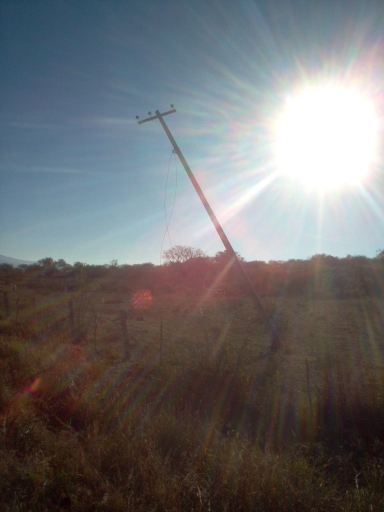
Meanwhile, it was rainy season in La Yacata. All the desert blossoms were nearly in bloom and the ground was covered in springy plants. Unfortunately, with the heavy rains and the fact that the electric posts were put in a swamp without any sort of base, one had fallen over. It pulled the rest of the wires and created an incredible tension on them, causing a domino effect with the other posts in both directions. The electric company didn’t bother to come out when we called because they have no record of posts being there.  Civil Protection did come, however, and move the posts and wires off the road, where it sits still.

*******************

disclosure

1 Comment

Filed under La Yacata Revolution