Demanda 3…. What the….?

Just when things looked like they were wrapping up with the second lawsuit (see Demanda 2 and the Visit from Desorrollo Urbano) and we could proceed with projects estimates for the water, sewer and electric in La Yacata, there came another demanda (lawsuit). Unbelievable! This demanda (lawsuit) was from the very same perforador del pozo (well-hole driller) that sent the first lawsuit (See Demanda 1) and for the same reason. He claimed that La Yacata owed him money for services rendered, this time in the amount of $500,000 pesos plus interests and court costs.

Since the judge ruled in our favor in the first lawsuit, we had assumed that would be the end of it, because no case can be reopened once the final verdict has been rendered. Not so folks! The claimant (el perforador del pozo well-hole driller) submitted a Pagaré (promissory note) and a claim that did not specify why La Yacata owes him money, just that the community does.

pagare

Promissory note

Our mutual acquaintance Chuchi had been summoned to give a confessional (testimonial) about the details of this debt, because of his good moral character (or so the summons read). I asked Super Prez if we could submit questions to the confessional. Lying before the judge carries a hefty fine and jail time so he may be more apt to tell the truth and finally finish this travesty of the justice system. He said he would look into it with R2, who continued to be our legal representative.
The basis of this lawsuit was the Pagaré (promissory note) and a copy of it was included in the summons. It was dated 2007 and signed by Chuchi with p.p. in front of his name. This p.p. is the legal abbreviation (por poder) and indicated that Chuchi was the legal representative of the community. However, in 2007, R was the registered president of La Yacata and we have the testamento (document) to prove it. The amount of the Pagaré (promissory note) was an even $500,000, half the amount of the first lawsuit. The address of the debtor was listed as calle Puebla (Puebla Street) which was where Super Prez currently has his own private business office, not Chuchi. Super Prez did not open his office until 2008 and had the town registration to prove it.

On the back of the Pagaré (promissory note) was the handwritten notation that the well-hole driller dude received two payments on the interest, one in 2009 for $1,200 and another in 2011 for $1,500. Writing anything but the names, address and signatures of the guaranteers on the back of a promissory note invalidates it, but I guess no one told him this. Furthermore, in 2011, J was the registered president of La Yacata, not Chuchi and I was the treasurer and I certainly didn’t authorize any payments for a well from the community funds.

So the first Monday in June, I went to drop off some papers at Super Prez’s office and chat about La Yacata progress when he informed me that he was to report to court that morning and I was scheduled for Tuesday. He had known since Saturday afternoon but didn’t want to tell me so that I wouldn’t spend Sunday fretting about it. He also said that R2 was on his way to the office, so I should wait there to talk to him. So I did.

As R2 was going over some of the questions Super Prez would be asked, I pointed out that I was the treasurer of the association when the second payment on interest was supposedly made, so I knew for a fact that the community hadn’t made a payment because I had never received a request for payment nor made a payment from the community funds. R2 was so pleased with this information that he clapped his hands, however, it occurred to me that as our legal representative, he should have already known that.

So Tuesday came and I arrived at the juzgados (courthouse) at 10:30 as requested. R2 arrived 15 minutes later (early for Mexican time) with R’s wife. I never quite understood why she was brought to testify since R was president and then secretary of the association and a person can not be represented by another person, but perhaps it was because R was currently out of the country. Regardless, she was called to be the first witness, then me, then…could this be…Chuchi!

Chuchi arrived at 11:00 and was greeted by R2, if not warmly, then at least with a handshake. R’s wife and I nodded our heads at him and turned away. Chuchi was, at least, clean, if not well dressed for a court appearance in khakis and t-shirt. He also carried a used water bottle. It appeared he brought his own courage (vodka) with him.
R2 took me outside and gave me a general gist of what his questions would be. I was a little concerned about the first one–what my name is and spent some time practicing in my mind while I waited. The problem was that my Mexican identification used my married name but the notario (lawyer) that registered the mesa directiva (community council) used my maiden name since women in Mexico do not change their names when they marry and to top it all off he spelled my maiden name wrong.  So I was not sure how to answer that question.

So R’s wife went in for her testimony and Chuchi and I waited outside. After about an hour of waiting, it was my turn. I thought we would actually be in a courtroom, but no. Our testimonies were recorded in an office room with what seemed to be acoustic panels on the walls, drawn blinds, a computer that looked to be from the 1980’s and bright blue office roller chairs. I admit I was hard pressed not to spin on my chair during questioning.

R2, the female lawyer representing the pozo guy, the secretary and myself were the only people in the room. R’s wife was sent out at first but since Chuchi was outside, she was called back in so that the two witnesses would not collaborate on their answers.

I needn’t have worried so much about the name question. The secretary used my identification to get the information. Then I was asked where I was born, if I lived in México now, if I was related to the pozo guy or Super Prez and whether I could read and write. I later asked R’s wife if she had been asked the same and she said yes, even the same questions about the case, so I didn’t feel as affronted about being asked if I could read and write after that.

The questions and answers from R’s wife were already in the computer and when I answered, the secretary only changed answers. I was a bit worried when at question 7 the computer shut down, but only the last question was lost.

I was asked whether I had any interest in the outcome of the case, whether I had any malice toward the pozo guy, whether I knew the pozo guy and whether abonos (payments) had been made by the association, all of which were no. I was asked whether I knew Super Prez and since when, whether I knew Chuchi and since when, whether Chuchi had been president of the association and when, and when we began using the office on Puebla, all of which I could answer easily. I must not have been as wordy as was expected since the secretary would ask me “y qué” when I would answer with a sí or no. The final question on the list was not allowed by the judge, so I wasn’t given an opportunity to answer it.

I was never asked directly how I knew this information, so I hope that point was made clear through the copies of the testamentos (documents) that registered the 3 presidents of the asociación since Chuchi was ousted and their councils. I also didn’t think I answered some of the dates well since I didn’t have the exact dates and could only give years, but I answered truthfully so no jail time or fine in the future for me.

R’s wife and I were then sent out of the room while Chuchi and his bottle entered for testimony. She and I had a chance to talk a bit. She seems nice and normal, not like R who sometimes se van las chivas–or in other words gets off track. She had known my mother-in-law and even remembered that it had been a year since her death, however, I don’t remember seeing her at any of the funeral services last year, just her husband.

When Chuchi came out, he wasn’t happy and neither was the lawyer for the prosecution. R2 slipped out and gave us the ok sign, pleased with the way things were going. Then we had to wait while the testimonies were printed out and given to the judge for his approval to be admitted as evidence in the case, then sign every page of our testimonies. While we were waiting for all of this to be completed, Chuchi gave different lawyer $500 pesos right in front of R’s wife and myself. As we were leaving R’s wife commented on this to R2, identifying the lawyer to him, and he wasn’t pleased but said it must have been on some other matter. Chuchi also tried to talk to the female lawyer that was legal representation for the pozo guy and explain that he had never turned over the accounts because they had been asked for 3 months after the new mesa directiva (community committee) had been elected. The lawyer’s response was to put up her hand signaling that she didn’t want to hear any more and turn away. If it comes down to nit-picking about dates, I have a dated copy of the letter we took to his office to formally request the documentation and others can be called in to testify that he was publicly requested to hand over the papers at the junta (meeting) prior to the letter and refused in front of more than 30 colonos (property owners). (See The Battle for Power)

Another lawyer greeted Chuchi while we waited and asked if he was promoting himself politically. Chuchi was the candidate for PT in the last election campaigns and recently was in the newspaper posing with the PT representative for Guanajuato. (See Politicking) Chuchi made no response and the lawyer went on to say that instead of being here in court, he should be campaigning in the colonias (neighborhoods) because that is where la vida (life) is and then he left.

Finally, we were able to leave at nearly 2:00 in the afternoon. My faithful husband had waited outside for me and was a bit cranky having not eaten his lunch yet. We arrived in La Yacata just in time to see the woman who delivers the summons for court drop off a summons for my father-in-law.  I haven’t yet heard the outcome of that particular summons.

On a post script to the day’s adventures, R2 was contacted by both Chuchi and the pozo guy to see if we could reach an acuerdo (agreement).  I don’t know what they think to bargain with as the items we want (the permit to drill a well and the certificate to the water rights) were never obtained by them.  Plus there is that little matter of court costs.  Just for the first demanda (lawsuit), la colonia (neighborhood) owes R2 $100,000 pesos.  When the verdict for the second demanda (lawsuit) is rendered, we will owe more money.  Then, of course, there is this one.  And as a third point, I am not sure that the lawsuit can be stopped at this point.  Then there is the idea of justice that hasn’t been satisfied, at least for those of us that have been defrauded by these men.  So I guess we will see what they have to offer and go from there.

**********************

disclosure

10 Comments

Filed under La Yacata Revolution

Picking Pitayas

top of cactus

June marks the beginning of the raining season. Most fruits and vegetables are not reading for picking yet, however, the flower of one type of cactus converts to fruit and is ready for harvest at the very beginning of the rainy season. On Sunday, we started off early to minimize heat exhaustion and went in search of pitayas.

presa

la presa de Quirahuyo during dry season

Quiahuyo

We went to the presa (lake) near Quiahuyo where we fetch our drinking water. (See Water Woes) It was especially low because last year’s rains were less than normal.

bones

Cow bones found when this section of the lake dried

During the rainy season, this lake is almost 3 times as wide and has hidden deep areas that often become muddy traps for cattle and swimmers.

fishing with nets

Locals illegally fishing

Even this shallow, the presa (lake) teems with fish.

sign

Prohibited to fish with nets in this area

Fishing with nets is prohibited so that the fish population isn’t eradicated, however, that doesn’t stop local fishermen.

Old spark plugs are used in fishing.

Old spark plugs are used in fishing.

All along the edges of the lake, we found rusty spark plugs. Since there was no way for a vehicle to get through the mud and rocks, this seemed odd to me until my husband explained that the spark plugs weigh down the plastic soda bottles that are tied to the fish traps. When the bottle bobs, fish have been caught.

In order to get to the pitayas, we had to cross an area where cows came down from above to drink. As the cattle didn’t seem too pleased to be disturbed, we moved quickly. My son even took off his red t-shirt so as not to attract the attention of the toros (bulls) guarding their herds.

cactus

Just a bit further on, we found a good number of cactus. Pitayas are the spiny balls found at the top.

cutting

Cutting the pitayas

Unless you are a chuparosas (hummingbird) harvesting them requires a very long forked stick. Fortunately, my husband is an old pro and we had a bucketful in no time.

pitaya

fresh pitaya

To eat pitayas, you must slice them open, being careful not to get espinas (thorns) in your hands as you hold them still.

pop it out

Pop the pitaya fruit out with your thumb

Then, once the fruit is exposed, use your thumb to pop half out and pop it in your mouth, again, checking for stray espinas (thorns). The fruit has the consistency of seedy brains and tastes a lot like strawberries.

red tuna

Red pitaya

Pitayas come in red and yellow, depending on the color of the flower on the cactus. We were in luck and found both and thoroughly enjoyed a sweet treat.

yellow

Yellow pitaya

We are so fortunate to live in an area where the earth provides an abundance for her people. It does take more effort than going to the corner store for chatarra (junk food) but what is life without a little effort?

********************

disclosure

7 Comments

Filed under Native fauna and flora

La Novena and el Luctuoso

la novena
Then began the novena, 9 days of prayers for the release of my mother-in-law’s soul from purgatory.  This was held where her body had been viewed, with the leftover candles from the funeral.  A candle must be lit at all times and no one may sweep, since this would be rushing her soul out of the house. (See Mass and Burial)
Each child took a day to sponsor the novena, providing refreshments for those that came to pray.  I thought my night of hosting went well.  I had to be signaled that the prayer was over and hurried to the kitchen to serve the flan, jello, and juice that I had bought earlier in the day, my son and husband helping to serve.  I hadn’t had time to prepare anything traditional or home-made, but that’s why supermarkets were invented right?
A woman named Socorro did the prayer reading for each evening.  It seemed to be her calling, presiding over novenas when asked.  She isn’t paid per se, the refreshments each night being given in compensation for her time.  (See Parenting Challenge–When someone dies)
Each night, Socorro and her echo, another religious woman, intoned prayers from a little booklet.  It’s important that everyone  sit in the same seat each night, but I didn’t understand the reason for this, just that’s the way its done.  The prayer session lasted about an hour since every few minutes there was a round of choral recitals of Padre Nuestro, (Our Father), and Ave Maria pleading that if my mother-in-law’s soul be found at the gates of purgatory, that she be pardoned as well as any other souls found with her.  Apparently, her eternal damnation or salvation would be based on the strength of our prayers during the novena while her soul was wandering around in purgatory.
A glass of water and a white towel were set out the first night.  This was in case the soul was in need of refreshment.  If the soul visited and drank the water, the towel would be imprinted where it had knelt.
As this was my first novena, I’m not sure how smoothly it goes, but it seemed to me that we had more than our share of issues during the 9 days.
The first night, the little children, who were exempt from the prayer meeting, locked themselves in one of the bedrooms and we had to break the door down to rescue them as they became more and more hysterical on the other side.  Not a very auspicious beginning to the novena.
Then another night all the sons came drunk to the novena and interrupted the prayers abruptly and repeatedly in order to use the bathroom.  Again, not as it should be.
Then the night D was in charge of the refreshments, not only did she not have enough for everyone and I had to supplement with some flan left over from my hosting, but her husband refused to help her serve, demonstrating what an ass he was to all.
Then L was had a screaming fit because my father-in-law had asked where the money from the presidencia was (nearly 3000 pesos) that she had spent on rent for her apartment and local although it wasn’t her money to spend but meant to defray funeral costs.
Another night, I was called away from the novena by the mother of one of my students who happened to be a judge.  She had been given a copy of the lawsuit that Chuchi sent and wanted to speak with me immediately.  As she isn’t the type of woman you say no to, I hurried to her house.  She explained some of the legal terminology and wanted to know for sure if we had answered the charges as there was only a 10-day period to do so.  If the charges were not answered, Chuchi wins by default.  I called R and he assured me that they had.  I wasn’t satisfied so went to the office of Super Prez and asked him.  He gave me a copy of the respuesta (answer to the charges) and I hurried back just in time for the opening prayer.
Then J was to make the traditional corundas for the last night, but B said he wanted enchiladas, and to please him, his sister P made them although it was extra work and angered her own husband and was contrary to tradition.  The three sides of the corunda represent the trinity and the eating of it as a sort of holy communion in honor of the deceased.
The final novena was a 2-hour session.  Not only were the final day prayers said but the dirt that was in the form of the cross on the floor since the viewing must be lifted.  It couldn’t be swept up and had to be scooped by hand in a prescribed manner.  First the right side of the cross, then the left side of the cross, then the foot of the cross where the three Marys wept, and then the head of the cross.  Flower petals, candle wax, and dirt were all scooped into a yellow shoe box.  More prayers were said and the rosary was placed on top.
ceramic statue novena
Each attendee was given a small ceramic crucifix, like a party favor, with the following poem on the back:
Fin de novenario
“Muero pero mi alma no muere los amare y los bendeciré en el cielo como lo hice en la tierra”   Agradece Padre e hijos
Loosely translated it read:
End of the Prayer sessions
I die but my soul does not.
I love you and bless you in heaven as I did on earth.
With appreciation: Father and children
panteon
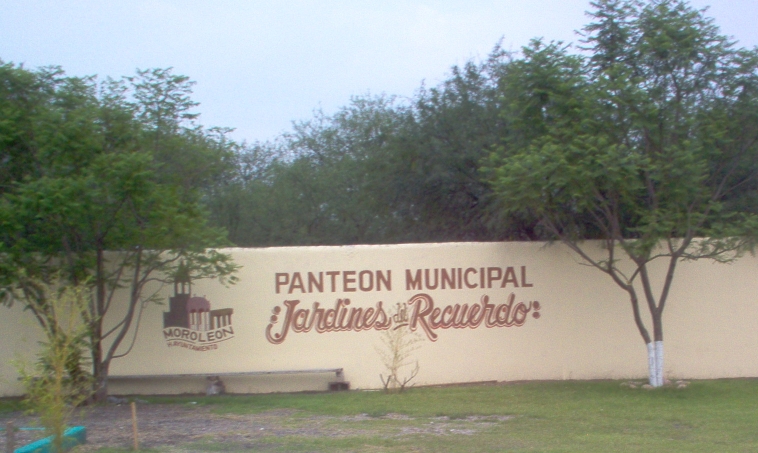
The following morning we gathered again at the panteón (cemetery). The sacred dirt in its shoebox, candles, photo, cross, the statue of the Virgin of Guadalupe, some sacred saint prayer cards, rosaries, the glass of water and the white cloth were all stuffed unceremoniously in the windowed front of the crypt.
The altar of El señor de Escapulitas Catholic Church in Moroleón

The altar of El señor de Escapulitas Catholic Church in Moroleón

But that wasn’t the end of it.  The next week there was a mass en el Templo del Señor de Escapulitas.  The priest was paid to say the names and ask for special blessings for those recently departed, but my mother-in-law’s name was accidentally left off the list.  So it was rescheduled for Saturday.
Then there was another mass in another church in the wealthy section of town.  I misunderstood where this mass was scheduled and my son and I went to the wrong church and then arrived late for the services.
Then there were masses scheduled every month.  My son and I went to the first few, but as the sons would be there either drunk or hung over, which in my opinion was shameful, I refused to go to anymore.
B made a vow that he would not shave until his mother had been gone one year.  I’m not sure if this vow was meant to be a bargain made to ensure that his mother’s soul left purgatory for heaven or not, but the result is that for most of the year looked like a ungroomed Mexican dwarf with a beard halfway down his chest. The night of the first-anniversary mass, he arrived completely bald and clean shaven.
So this week there was a mass to mark the one-year anniversary of her death. It’s called el primeto luctuoso (which as far as I can translate means the first anniversary of a person being called to the light).  An ad was placed in the paper for the first luctuoso.  This year, the masses will only be every 3 months.  An ad will be placed in the paper for the second luctuoso.  Next year they will only be performed every 6 months.  An ad will be placed in the paper for the third luctuoso.  After that, there will only be one mass per year until eternity.  Each year with its own newspaper ad.
Again, I discovered that the quality of the misa (mass) is dependent on the money you pay.  My mother-in-law again was given the basic package service.  I can not imagine how much money the church earns through this system since the masses continue for all perpetuity.  Death is quite a profitable business after all.
first anniversary
As souvenirs, the few attendees were given escapularios (small sewn leather charms to be worn around the neck) and a poem.  This one reads:
Te damos gracias, Señor, por habernos dado la dicha de tener una madre ejemplar y disfrutar de su amor.  Tu la llamaste Señor y ella no hizo sino tomar tu mano; al escuchar tu voz.  Agradecemos su asistencia, Esposo e Hijos.
Loosely translated it reads:  We thank you, Lord, for given us the honor of having an exemplary mother and of enjoying her love.  You called her, Lord, and she did not refuse to take your hand when she heard your voice.  We thank you for your attendance, Husband, and Children.
crypt 2

******************************************************
disclosure

14 Comments

Filed under Death and all its trappings