
Well, I’ve gone and done it. I’ve gotten into a public argument on Facebook with a complete stranger. About what? The civil unrest and protests in Oaxaca.
How did I get myself in such a predicament? It started innocently enough. Another group member posted Mexico: State Terror, Education Reform and the Stock Exchange. The article outlines the violent situation and proposes that The reasons why the Mexican government wants to impose the education reform—even if it means killing people, as with the massacre in Nochixtlan by repressive state forces on June 19—are rooted in economic objectives guided by international financial organizations.
Now, I’ve already discussed at Surviving Mexico the Education Reform package (See Political Wrangling), so I won’t get into why the teacher’s union opposes its implementation here. What struck me was the idea that this whole situation may have a distinct cause, not just teacher examinations. As I pondered this, I remember a seemingly unrelated post called Chinese look to invest in southern Mexico.
As I’m not much interested in economics, I almost didn’t read the article. But I did. In summary: Authorities from China’s Guangdong Province met with Mexican officials and discussed plans to invest in Mexico’s recently-established Special Economic Zones. These zones offer tax benefits and support services to investors in order to generate new sources of employment in southern Mexico (Guerrero, Oaxaca, Chiapas, Michoacán, Veracruz and Tabasco).
These states currently have the highest rate of disappearances.
Just looking at the recent headlines for these areas gives you a good idea who are behind the disappearances.
Guerrero—local police kidnapped no less than 100 people over the last two years in Guerrero, including students, women, children, and an African priest
Oaxaca—Oaxaca Residents Say Mexican Police Began Massacre – Now They Want Them Out
Chiapas—Federal Police Repress Parents that Support Teachers with Tear Gas in Chiapas
Michoacán—New Evidence Shows Police Did Massacre 42 in Michoacan, Mexico
Veracruz—4 state police were arrested in connection with the disappearance in Veracruz of four men ages 24 to 27 and a 16-year-old girl
Tabasco—Teachers clashed with riot police
What if, just supposing, that some of these protests were staged in order to give the government an excuse to come in and militarize the area, paving the way for those Chinese investors? The connection seemed strong enough for me to comment in the Facebook group post. (See also Mexico’s enemy…on Claudio X. Gonzalez)
The poster responded with the following: if you have the time and inclination, I suggest a 55 minute documentary called “The Demarest Factor: US Military Mapping of Indigenous Communities in Oaxaca, Mexico” released in 2010:This film is part of an ongoing investigation which has exposed US military mapping of communally owned indigenous land in the Southern Sierra in the state of Oaxaca, Mexico. The mapping took place under the auspices of the department of geography from Kansas University in Lawrence, Kansas in collaboration with the Foreign Military Studies Office (FMSO) at Fort Leavenworth, in Leavenworth, Kansas. The FMSO senior analyst Lieutenant Colonel Geoffrey B. Demarest declares in several essays and texts that communal ownership of property leads to crime and insurgency. The film exposes an ongoing military strategy to criminalize indigenous land tenure and identity in order to secure political and economic interests in the region.
Wow! This was a real eye opener for me. But then someone else chimed in on the conversation. His contribution was: Put the crack pipe down for a couple days. You have lost touch with reality. One small group of terrorists, sucking the Federal money teat, and finding at some point they need to work and produce to survive in the world. The majority of the States of Mexico approve of children having a real education as opposed to walking barefoot. Deal with reality. What a bullsh*t stupid post.
Now I’ve had a run-in with this particular group member before during a discussion about the relative safety of Mexico. He insisted that Mexico was completely safe and that you should never believe anything posted on the internet. I made the comment that my husband had been kidnapped, my nephew tortured and my mother-in-law killed by police. In addition, I knew 3 people personally who had been kidnapped and ransomed and 3 more that were kidnapped and killed. He told me that he didn’t believe any of it and that I was full of crap. Instead of engaging, I left the conversation. Later, I found out that another member had defended my statement as true and carried on in my stead. To no avail.
Anyway, I replied to his post quoting Facebook’s commenting policy. People use Facebook to share their experiences and to raise awareness about issues that are important to them. This means that you may encounter opinions that are different from yours, which we believe can lead to important conversations about difficult topics. Implying that someone is high or insane is not respectful.
His histrionic comment was: So saying that the teachers burning and destroying the private property of their neighbors is a respectful way to argue a problem that HAS been resolved, to their misfortune? It Takes an uneducated person to not understand that laws were passed by 3/4 of Mexico’s states and still cry and extort money. When the teachers start to act like people who YOU would like to teach your children about right and wrong and 2 +2 and how to spell their name, let me know.
Actually, my son attends public school here in Mexico and his teachers oppose the educational reform, but not for the same reasons as the Teacher’s Union. The exam will not provide educational equality and is a tool being used by the government to cut the power of the Teacher’s Union. And I am certainly not uneducated and fully understand that the government railroaded the reforms through, which leaves little room for negotiation. The government does what it does and we see the results in the protests.
My public response was No one has made the claim that the actions of the teachers are correct in any of this conversation. Only that there are other reasons for the civil unrest. The entire situation is rooted in corruption–by the teacher union AND the Mexican government. So give it a rest bud!
Apparently, he didn’t like that and countered with The burning of public and private businesses and property, hijacking of private vehicles, firebombing, extortion, robbery and murder come from the so call “Teacher’s Union ” Mexico Government is being very nice so far. Look at the history of the world ( I mean entire world) in any other country. These criminals would have been put down years ago. Stop blaming the cause on the Federal Government, the Feds should today be acting with extreme force to allow food and fuel into these areas, but they are not. Yet.
From one of my online friends in another group living in Oaxaca, I know that most of what has been released by official sources is not accurate. She personally saw 4 police officers looting an electronics store, loading up the refrigerator on the back of their police vehicle. As for murder, well, the police are the only ones with guns in this conflict.
Additionally, thanks to a new law passed over Easter break, the government can use deadly force to “keep the peace.”
My response: Again, I have not said in any way that the teacher’s union has been correct in its actions. AND the government is also responsible for burning public and private businesses, firebombing, EXTORTION, ROBBERY, AND MURDER. Perhaps you are correct in saying that in other countries, the insurgents would have been massacred earlier before things got to this point. That doesn’t make it right. Interesting you should mention keeping fuel out of the area. Seems that’s exactly what the government is doing in Chihuahua.
From another online friend in Chihuahua, the whole gas crisis started when PRI didn’t win the local elections. Imagine that.
The conversation continued with another more respectful participant.
Undereducated teachers in fear of losing jobs. Unions in fear of losing members. Teachers who are dedicated to teaching shamed by unions for crossing the picket line. Their heads shaved and forced to walk holding signs.
The current private schools need to stop hiring foreigners with no teaching background or degree.
All Mexico teachers should be tested yearly. If they don’t meet requirements. They should be fired.This is for the better of Mexico’s future.
This comment takes me back to my post about Political Wrangling and Educational Reform.
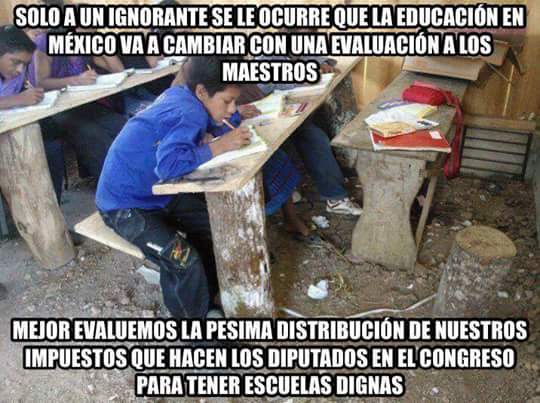
Only someone ignorant could believe that education in Mexico will change with teacher evaluations. It would be better to examine the distribution of tax dollars that members of congress earn in order to have dignified schools.
After making the following comment: All of those things are true. Unfortunately, a yearly test won’t ensure that qualified teachers have teaching positions. It is SO easy to buy your teaching certificate here in Mexico, pay someone to take your exam, or pay the administrator to pass you–con mordida (bribes) o con cuerpo (giving sexual favors in exchange for something). There are multiple layers to the issue which need resolution.
I then bowed out of the debate and unfollowed the post. I have other things to do, like write this post.

*******************************************