The Last Panel

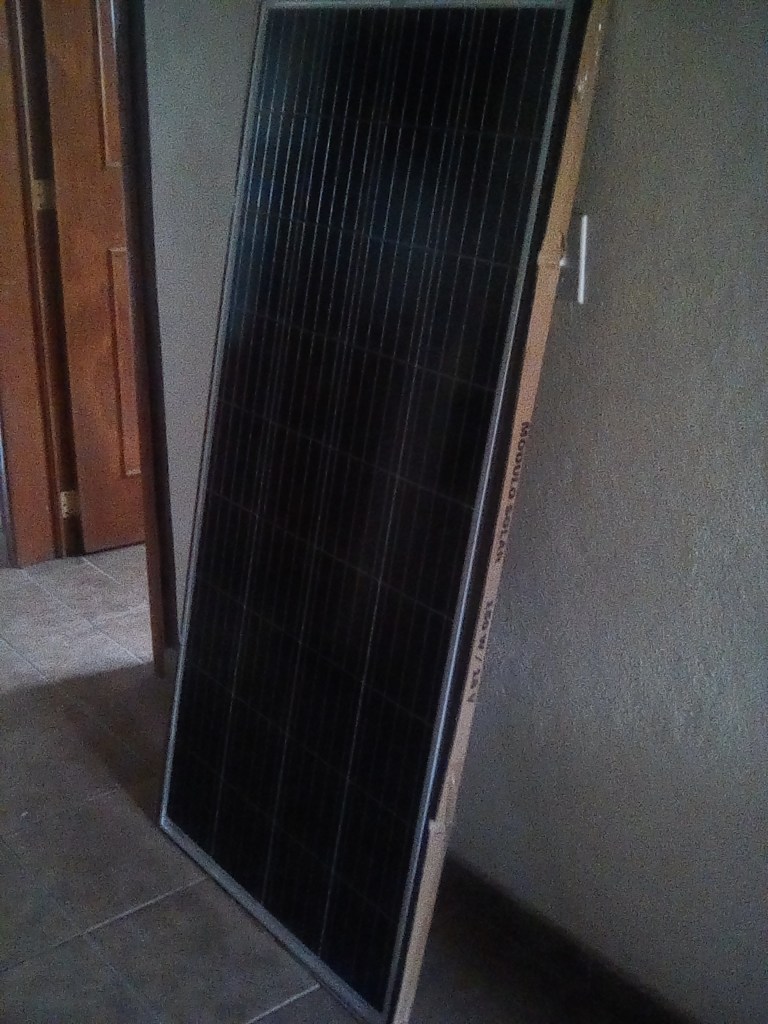
Last week was a momentous day for the Flores family. It was the day we finally purchased the last panel for our solar electric system. Angels were singing, birds were flying through the air with ribbons in their beaks, rays of light beamed down from the heavens… Ok, well, maybe those light beams were from the light bulb, but it was a red-letter day for us.

The next day, our 6 battery system charged completely. In fact, we had a hard time using some of the power so that we could get maximum efficiency without it overcharging. Another battery was required.

We went and got one at AutoZone and hooked it up. Since then, we have been walking around on cloud 9 (ok enough with the heavenly choir references). We have ample power to do laundry even on cloudy days now. The batteries are still more than half charged at 6 am in the morning even with my son playing video games (em–cough) I mean doing classwork late at night when the internet is working. 

These are the shades I got. Simple, durable and covers the bare bulb!

To finish off our electrical system, I wanted something like a shade to cover the light bulbs in the ceiling sockets. Do you think I could find any locally? Nope. I searched high and low. So I ordered some from Amazon. While I was at it, I ordered a replacement string of lights for the stairway and some new motion detector lights for the front of the house since the old ones had given up the ghost a few months back. None of these was very expensive. The lights will last 2-3 years before they need to be replaced. The light covers might never need to be replaced. 

Thus ends the 12-year struggle for electricity in La Yacata (or at least in our home). If I wasn’t so pleased with the end result I’d say it was anticlimactic. But since I am…

***

Read about our struggle to get electricity in La Yacata!

It’s FREE today in honor of this momentous event!

la yacata revolution cover

5 Comments

Filed under Electricity issues, La Yacata Revolution

Women’s Equality Day

if you are a women

While I sympathize with women in the United States who are fighting to earn the same wage as men, things are a little more complicated south of the border when it comes to equality. Women aren’t just second-class citizens. They aren’t even considered human, but conveniences or even commodities, at times. 

Take a look at these two incidents. 

7 women jailed for refusing to provide dishes for mayor’s party

The mayor of Santa María Alotepec in Oaxaca ordered the arrest of 40 women. The police were only able to round up seven. The reason for the arrest was that the women who worked in the community kitchen refused to loan plates for an event the mayor had planned. The women’s reasoning for not giving him the dishes is that the mayor did not follow proper protocol for using the facility or requesting the dinnerware. So the mayor ordered their arrest instead of requesting a reservation. A bully, through and through who believed his position as mayor (and of course the masculine police force) would make these women submit to his whims. 

The women were only released when the Government Secretariat and Oaxaca Human Rights Commission (DDHPO) intervened. 

What to do when the mayor breaks his promises–dress him as a woman

In the second article, the mayor of  San Andrés Puerto Rico and another official were kidnapped, forced to dress in women’s clothing and set to begging passing motorists for money by residents. This was the third time this mayor was forced into a skirt by his constituents. The residents claim the reason for this humiliation is that he has yet to fulfill his campaign promises to improve the water system in the community.  Apparently, this is a long-standing way to deal with oathbreakers in the area. 

Dressing a man up in women’s clothing strips him of his pants, a representation of his position of honesty, power, and authority. So a liar wears a skirt? 

So how big is the equality gap between men and women in Mexico really?

Yes, women can vote in Mexico. Women have been eligible to vote in elections since 1953, although they were not permitted to exercise that right until 1955. Women have made strides in holding political office in recent years. Over 40% of the Lower House of Congress are women as of 2018. On the other hand, in local government, fewer than 1 / 5 of those that hold the position of mayor are women. 

Yes, women can work in Mexico. Forty-four percent of Mexico’s population is employed females who earn between 14% and 16.5% less than their male counterparts. More than half of the women in Mexico, over ten million women, make less than $6,200 pesos per month. The rights of domestic workers, the majority of whom are women, were upheld in May 2019.  For example, it is now illegal to terminate employment on the basis of pregnancy. 

Yes, women can attend school in Mexico. The elementary and middle schools are free. However, inherent inequality in the school system exists. Classes are taught only in Spanish, placing the speakers of the 68 indigenous dialects in Mexico at a disadvantage. Girls in rural areas of Mexico are less educated than their brothers. Some are forced to leave school early to tend to domestic tasks. Others marry. Mexico has the seventh-highest absolute number of child brides in the world.

Let’s look at some more statistics:

  • More than 66% of women in Mexico over 15 have been a victim of at least one incident of sexual, emotional, physical or economic abuse.
  • Mexico has the 16th highest rate of femicides in the world. 
  • More than 85% of Mexico’s human trafficking victims are female. 
  • Throughout the country, there are more than 700 women imprisoned because of a miscarriage or stillbirth. Abortion is illegal in every state except Mexico City and yet birth control is unavailable for large sections of the population.  
  • Women are pressured to have cesarean sections rather than give birth naturally. Mexico now has more than a 45% c-section birth rate as compared to 12% in 1987, making it the 6th highest in the world. 

Women are systematically denied control over their own body and finances. They are even accused of contributing to their own murders in Mexico. Impunity is the byword here. No one is held accountable for their actions–unless they are women who deny the mayor some plates. Then by golly, let’s round them up and teach them a lesson. 

Even though calladita se ve más bonita (a silent woman looks prettier–a common Mexican saying), the truth is pretty ugly when it comes to equality for women in Mexico.
Leave a comment

Filed under Safety and Security

Water Issues in Mexico

August is National Water Quality Month and World Water Week begins on August 25. 

This year, the rains have been sporadic at best. Approximately 21% of Mexico was suffering from severe drought going into the rainy season. With scant rains in some areas and torrential rains in the other, things haven’t improved. The parched earth hasn’t been able to absorb the quantity of water needed and mudslides and flooding have been the result. 

Global climate change is affecting Mexico’s delicately balanced ecosystems. In particular, the water cycle has been disrupted resulting in less water runoff. That coupled with the seal level increases on the coast from the rise in surface temperatures in Mexico and the increasing intensity levels of hurricanes, and we’ve got a full-fledged disaster in the making. 

With unreliable rainfall, crops fail. With inadequate water supplies, livestock dies. With food supplies dwindling, the people of Mexico starve. 

Then let’s talk about water quality in Mexico. Estimates are that more than 12 million people in Mexico do not have access to potable water. Inadequate environmental protection laws and corruption keep any real water clean up process from happening. 

Take for example the rural communities of Hidalgo. Sewage from Mexico City is pumped directly into their water supply. Mexico City produces 34,000 liters of sewage per second. Is it any wonder that more than a quarter of the children born in these communities have birth defects. 

Water is, therefore, a dwindling resource in Mexico. 

Water is a precious commodity to us personally here in La Yacata as well. The rainy season lasts from June until the end of September. The rest of the year, we must order a pipa (tanker truck) every few months to ensure we have enough water for our animals and such. We are careful with our water consumption and have been working towards permaculture in the back yard. I’ve broken down how we conserve water here.

****

If you’d like to read more about surviving Mexico with all its natural and man-made catastrophes A to Z Reasons Why La Yacata is the Place to Be in Any Disaster: A Prepper’s Guide to Mexico is FREE for the next few days. 

a to z


Leave a comment

Filed under Water issues