Tag Archives: San Miguel de Allende

Driving Hazards–Police and Military stops

Transitos are the traffic cops in México and are not armed.

Transitos are the traffic cops in México and are not armed.

Then there are police checkpoints to contend with. Arriving in Celaya, on our trip from Moroleón to San Miguel de Allende (See Getting Legal–Trip 1) we were stopped by the transito (traffic police) because our truck didn’t have a current verficación (inspection) sticker. I put my head down and pretended to be invisible while my husband negotiated the mordida (bribe). On the way back, we were stopped yet again by the same group of transitos (traffic police). Being tired and cranky, my husband made the mistake of complaining that we had already paid our dues in the morning. The transit cop had him get out of the vehicle and then gave him a dressing down for being chismoso (a tattletale) before sending us on our way with his mordida (bribe) of course.

Bribery is called mordida (bite) as in a bite of an apple.

Bribery is called mordida (bite) as in a bite of an apple.

To bribe or not to bribe, that is the question to consider.

Transitos are open to bribery. However, whether you offer a bribe or not depends on who you are. If you are female, typically no bribe is offered and no ticket is given, you may not even be stopped. Unless, of course, you are an aggressive female, then you are treated like any male in this machismo power play. (See Driving Hazards–Crossing the Border) If you are a non-Mexican male, you must understand this an alpha male thing and if the phrase “se puede reglar esto” (this can be resolved) is used by the transito (traffic police), discretely hand over $200 pesos. Transitos (traffic police) will stop you for missing inspection stickers, missing or out of state plates, for the driver not wearing a seatbelt, for anything that might be not working on your vehicle, like a tail light or just because. They will ask you for your license and tarjeta de circular (permission to use the vehicle in the country), so it pays to have both current. A transito (traffic police) can take either card or your placas (license plates) and hold them for ransom until you go and pay the fine.

Los estados are the state police in México and are always armed.

Los estados are the state police in México and are always armed.

The next level up is the random inspection typically done by the state police. These officers wear large pistols, and are sometimes masked, so are not to be confused with the transitos (traffic police), who do not wear guns and never wear masks. Los del estado (state police) may stop you for having out of state plates, for vehicle identification number (VIN) verification to see if you are driving a stolen vehicle, for a license or tarjeta de circular (permission to drive in the country) check, for driving a nice vehicle, or whatever other reason occurs to them. The mordida (bribe) is much higher and trickier to negotiate. They may take your vehicle or any other items that aren’t permanently attached as part of the “inspection.” It doesn’t to any good to go and file a complaint. (See On Safety and Security).
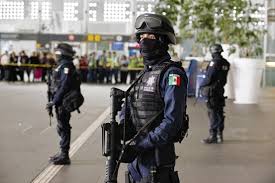
Los federales are national guard in México and are always armed.

Los federales are the national guard in México and are always armed.

Los federales (federal police) cruise around looking for vehicles to confiscate. High risk vehicles are newer cars and chocolates (vehicles that have U.S. plates because they were never legalized at the aduana (customs)) We had more problems when we had a newer truck, but now that we drive a Mexican national that we like to call Butch (Chevy circa 1980) they stop us less. When stopped, the feds ask for the paperwork for the vehicle issued by the aduana (customs). Know that only the registered owner or direct relative may drive a vehicle that has been imported into México. We have had to show our marriage certificate along with the other paperwork to prove that my husband is permitted to drive the truck since it was registered in my name to facilitate border crossing.

Los militares are the miltary police in México and are always armed.

Los militares are the military police in México and are always armed.

Then there are los militares (military police). This is a complete barrier stop for all vehicles. All motorists are subject to search and all vehicles are inspected, for guns or drugs. Civilians do not have the right to bear arms in México, but many have guns. It just isn’t prudent to carry them in your vehicle, even for personal safety. We carry a machete in our vehicle, which is not illegal, and can also be used to cut grass along the side of the road for our animals when the occasion presents itself.

The guns these guys tote are eye-popping big. You can determine whether it is a legitimate inspection or not by whether the police are wearing their cappuchis (masks) or not. A legitimate inspection is done by unmasked military and nothing is removed from your vehicle. Well, the other type, it’s best to just grin and bear it and not give too much information about yourself or risk being marked as a prospective kidnapping target. (See On Safety and Security).

Fortunately, only the transitos (traffic police) stopped us on that first trip. (See Getting Legal-Trip 1)

*************************


disclosure

6 Comments

Filed under Driving Hazards, Safety and Security

Driving Hazards–Gas and illumination

“It’s a dangerous business, Frodo, going out your door. You step onto the road, and if you don’t keep your feet, there’s no knowing where you might be swept off to.”–Bilbo Baggins

I’m an East coast girl and thus driving through major headache areas like D.C., Phili or NYC are old hat. However, nothing in my experience ever prepared me for driving in México.

Take, for instance, this last trip to San Miguel de Allende for my residency papers. (See Getting Legal-Trip 1)

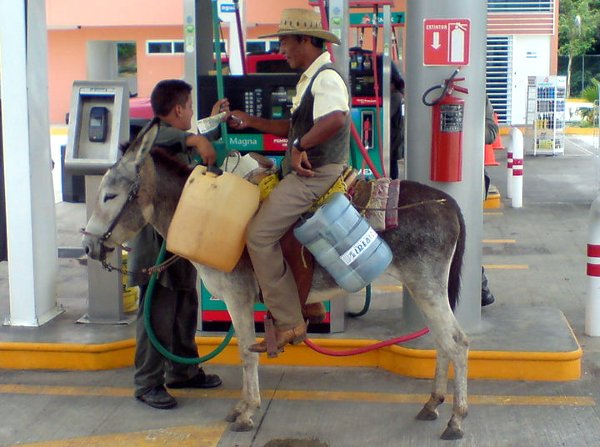
It is not uncommon to send a representative to get gas for rural communities that are not near a PenMexWe started out in the morning with a full tank of gas in the truck just in case. Gasolinera (gas stations) are not always where you think they should be. Residents in smaller towns sometimes have to go quite a distance to get gas. It’s not uncommon to send a representative to the gasolinera for several families. Various types of plastic containers are often reused as gas receptacles. I admit, one of our garafones (water jugs) has been converted to a gas container and we keep a second plastic jug (I believe it had windshield wiper fluid in it once upon a time) with a bit a gas behind the seat, just in case.

There have been occasions when we have run out of gas. (See Failing at your own business–Fruit truck) There is nothing to be done but hitch a ride to the nearest gas station and fill some sort of gas receptacle and hitch a ride back. No need to mention that this makes the trip much longer than anticipated.

Then we waited until it was nearly light to begin the trip. Driving at night is not advisable. Very few roads are lit. Cattle, horses, goats and other livestock may be tethered right next to the road for night feedings. This provides a sort of roadside maintenance as well. Bicyclists and walkers are nearly invisible as they head to work.

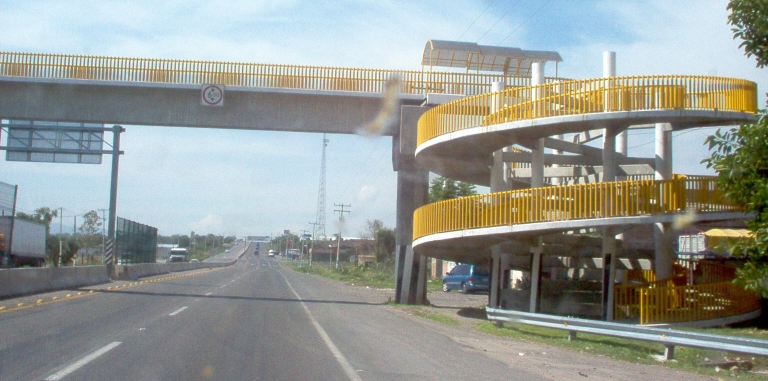
Puentes de peatones (pedestrian bridges) are not necessarily the shortest distance between two points.

Puentes de peatones (pedestrian bridges) are not necessarily the shortest distance between two points.

In the early morning, chickens, dogs and children may run wild across the road in desperate haste to get to the other side. There are puentes de peatones (pedestrian crosswalks) along high traffic areas, however, the shortest distance between two points is often not over the pedestrian bridge. So it is important to watch for those taking a “short cut” across the highway.

***********************


disclosure

2 Comments

Filed under Driving Hazards

Getting Legal–Trip 1

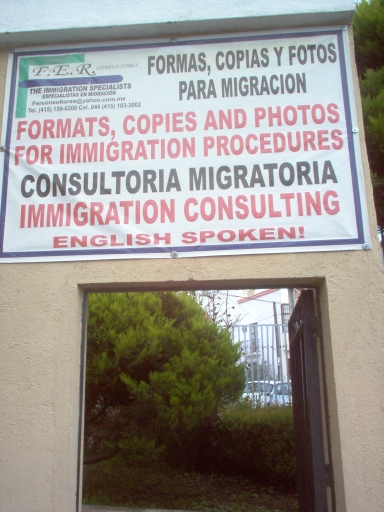
In order to avoid denial due to spelling or format errors, I trotted next door and had this office fill out my forms.

In order to avoid denial due to spelling or format errors, I trotted next door and had this office fill out my forms.

I have been living in México for 7 years and every year I go to San Miguel de Allende to the Mexican Immigration office to apply for permission to live here another year. When I entered México, I had a 6-month tourist visa. Then 6 months later, I had an FM-3. I had that for 3 years then moved up to an FM-2. I applied as a dependent familiar (family dependent) since the requirements were not so stringent. When I met the residency requirements, I started investigating what I would need to become a citizen and in order to give up these yearly trips and expenses as exciting as they may be.

First, the immigration office in San Miguel de Allende sent me to the Secretaria de Relaciones Exteriores in my hometown, Moroleón. There I was told that they didn’t do that sort of thing anymore and I would have to go to Morelia. So I went to Morelia and was told that since my legal address was in Guanajuato and Morelia was in Michoacan, I would need to go to León. So I went to León. And in León, I was told that because the name on my passport and Mexican identification was different from my name on my birth certificate, (my passport and ID had my married name) they would have to send my application on to Mexico City for approval. Well, I’m still waiting for that approval.

So thus defeated in my quest to become Mexican citizen last year, this year I went back to San Miguel de Allende to renew my Mexican identification and was told that because I had 4 years with the FM-3 classification I would not be able to get a renewal, unless I left the country and went to a Mexican consulate in the U.S. and started the process over again.

But wait, the law changed last November and I could qualify for permanent residency now. Yippee!! That meant I would no longer need to make the trip to immigration in San Miguel de Allende ever again! But of course, I wouldn’t be able to vote, own a foreign car, become alcalde (mayor) or own property, however, it would make my transition to naturalized citizen that much easier. So I said, sign me up!

Well, of course, it wasn’t that easy. I went the 25th of the month, but my identification didn’t expire until the 2nd of the following month, so my application couldn’t be processed until then. So I would have to come back on the 2nd when my papers could be accepted. Okie Dokie!

In order to not have wasted the trip, we headed next door to the lawyer’s office where we had the necessary paperwork drawn up. I could do it myself, however, I didn’t want my application to be denied on the basis of a spelling error. So the secretary completed my online application, wrote the letter asking for my change of status on the basis of being in the country 4 years and being the wife of a Mexican, took my picture (3 front facing, no earrings, no glasses, no bangs and one side facing, ears exposed), made copies of my Mexican ID, my U.S. passport, my Mexican marriage certificate, and my husband’s ID (IFE). When my husband handed over his ID, I took a quick look at it, and then had to look again. Dios mío! He looked like a serial killer in that picture. I can’t even begin to imagine what the approval committee said when they got a load of him as he looked there. Well, even serial killers have wives I guess.

The secretary gave me all the paperwork and the receipts that I needed to present at Banamex for payment, one for $1000 pesos and a second for $3812 pesos. The immigration office does not accept any sort of cash, all transactions have to be made at the bank. I expect that reduces the number of mordidas (bribes) offered and received. And so, the grand total for my paperwork was $720 pesos, which is about what I earn in a week. Then there were the mordidas in Celaya, (See Driving Hazards) gas, food and hair dye (I wasn’t about to have my application read :entre canas (gray-haired) which in all added another $1000 to that first trip. Cha-Ching!$$$ But I was on my way to permanent residency at long last.

****************************

disclosure

11 Comments

Filed under Getting Legal