
Tag Archives: living in rural Mexico

The Clucking of Chickens

One afternoon, not long after our tense encounter with the infamous Chicken Feather Guy, I got a call from a fellow colona, her voice full of excitement. She had just come from the presidencia, and was eager to share what she witnessed there with me.

Apparently, Chicken Feather Guy had stormed into the Urban Development office while she was there asking about escrituras for a different fraccionamiento where she owns lots. There, she had front row seats to quite a public spectacle. Chicken Feather Guy launched into a tirade, his voice rising with fury, accusing Super Prez of refusing to recognize his claim to a lot. You know the one. His allegations spiraled. He insisted la gabacha (which, of course, is me) had also bought her lot from Chuchi, the previous administrator, which was a flat-out lie, and added that Super Prez had 300 lots. Also untrue. And I fail to see the relevance of either of these statements to his particular complaint, but ok, whatever. 

He wasn’t done. He swore up and down that he’d had that lot for over 20 years, another fabrication, while pacing and gesturing wildly, saying he’d just sell the lot and be done with it. When he finally paused for breath, the colona warned him that trying to sell that certificate would be fraud. At that, he switched gears, declaring with exaggerated indignation that he would never do such a thing, right.

The Urban Development guy, clearly weary of the theatrics, finally cut in. “This isn’t our jurisdiction,” he said. “Talk to the asociación civil.” Meaning: talk to us, the mesa directiva. That should’ve ended it. But Chicken Feather Guy, undeterred, puffed up and stormed out, muttering that he’d take his complaints straight to the presidenta.

The circus didn’t stop there.

The following week, Huesos, the very man who had sold Chicken Feather Guy that dubious lot, booked an appointment during our Thursday office hours. He arrived fired up, brandishing a rolled-up plan like a sword. He was furious, he said, because we had claimed the lot didn’t exist, and he had the documents to prove otherwise.

Unfazed, Super Prez calmly laid down a legal document of his own, showing that the very lot in question had been transferred years ago to his father, with Chuchi’s signature sealing the deal.

As we examined the paperwork Huesos brought, a tangled web began to unravel. The chain of custody traced back to an architect who had once done work for Chuchi and had allegedly been paid with that lot, a lot Chuchi never had the right to give. That architect had then sold the land to none other than Fidel El Pancho Villa, the eccentric old man with the tricycle who famously built La Chuecha.

Huesos confessed that he had bought the lot from Pancho Villa’s son, also named Fidel, who assured him everything was in order, except, he warned, he might have to pay off some outstanding aportaciones. Ironically, Pancho Villa owed nothing, and that reason was a complete lie made to justify the low selling price.

I reminded Huesos, again, that both my husband and I had warned him about the questionable status of that lot before he sold it to Chicken Feather Guy. And then, I looked him straight in the eye and asked: Did Chicken Feather Guy send you here?

He hesitated, then nodded. Yes.

I didn’t hold back. “The issue was never whether the lot exists,” I said. “It’s that Chuchi never had legal authority to sell it. You saw the document.”

He mumbled that he’d confront Fidel Jr. the next time he saw him. I invited him to bring Fidel to speak with us directly. But instead, Huesos lowered his eyes and quietly slunk away.

****

So you have big dreams of buying a few acres in Mexico and living the good life? There’s more to living in Mexico than you might imagine. In a land where everybody’s finger is in the pie, it’s hard to find the proper channels to get basic services like water, sewage, and electricity installed. When one community has had enough, they staged a coup and launched La Yacata Revolution. Follow along with their attempts to restructure the Mexican political system in microcosm. Viva!
Leave a comment

Filed under La Yacata Revolution

My Stupendous Fall

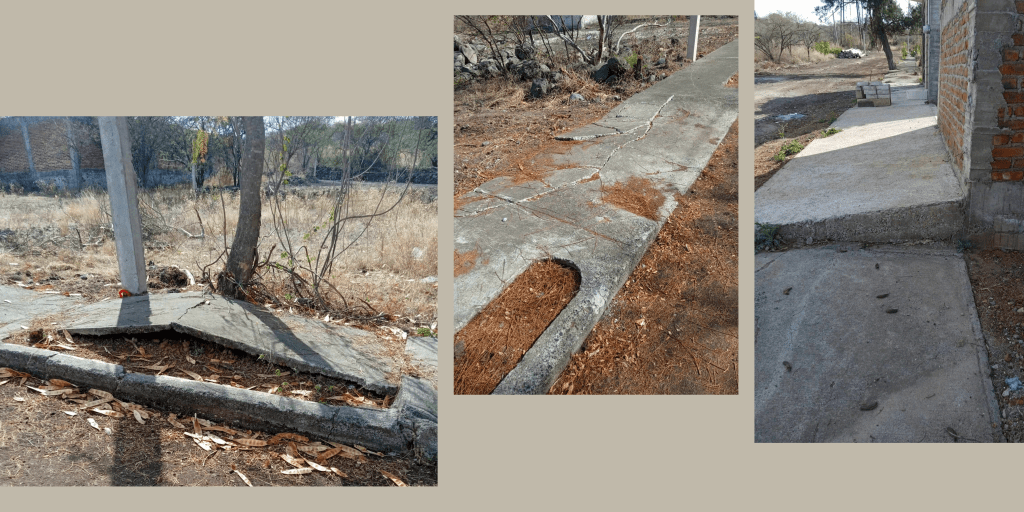
Walking around La Yacata has always been a bit of a treacherous endeavor. The roads are uneven and filled with what my son and I call “ravines” from the intense gullywashers during the rainy season. The sidewalks are about as safe as any sidewalk in Mexico, meaning not very. Ramps to garages make steep drop-offs. Sidewalks broken to lay water or drainage pipes and then reset are accidents waiting to happen. Tree roots push the cement nearly vertically, and so on. 

Well, that accident waiting to happen finally did. I was walking along with Cocoa, and I stubbed my foot on a piece of sidewalk that wasn’t level. I didn’t fall immediately. No, that would have been less spectacular. Instead, I stumbled along for another 10-15 feet, gaining momentum until I finally fell. My head hit a rock just off the edge of the sidewalk. I saw it clearly as a was hurtling through space and time towards it. 

I may have blacked out for a second, because I don’t remember sitting up. Or maybe I do. It’s a little hazy. It couldn’t have been for more than a second, though, because my head laceration hadn’t started to bleed yet. 

Super Prez and one of his workers were up the road doing some road measurement things when I fell. They approached while I sat there on the sidewalk, a bit stunned. Cocoa wouldn’t let them get very close. 

My Spanish flew out of my head and I started what must have seemed like babbling to them in English. My husband was working down at the corner and I knew Cocoa wouldn’t let anyone but him approach. With a conscious effort, I switched to Spanish and relayed this information to them. Then the blood started gushing from my head.

My glasses were missing a lens and I couldn’t see with the blood in my eyes anyway, so I just sat there until my husband arrived. He tried pulling me up, but that wouldn’t do. I got up myself. Then he took my arm to shuffle me to the house. Again, that wouldn’t do. I could walk fine; I just couldn’t see. I gave him Cocoa’s leash and put my hand on his shoulder to guide me. 

After the bleeding stopped, my husband left me with Cocoa and went back to work. My son didn’t get home until later in the afternoon, even though I tried calling him. He immediately cleaned and dressed my head, and I went back to bed. I contacted my teaching job and sent them a picture of my face to explain why I couldn’t teach that day. I had five classes that afternoon, so it was a financial disaster, but it just wasn’t going to happen.

I probably should have had stitches. The wound on my head took several days to scab up, and I’m pretty sure it will leave a scar. I used Árnica Mexicana (Heterotheca inuloides) and sábila (aloe vera) to treat my injuries, with some cola de caballo (Equisetum hyemale) wash for inflammation.

The following day, I let the people of La Yacata know I would be unavailable. While that didn’t completely stop them from bringing questions or documents, it did lessen the number of visitors. Not that I could see them anyway, as my eye had ballooned up quite a bit. I received a few kind messages wishing me a speedy recovery and telling me that I was “needed” by the community. It’s always nice to feel valued and essential.

I requested that I be allowed to teach without my camera on over the weekend because my eye was still so horrible. The company said I could as long as I started the class with it on and explained why I was turning it off to the students. The whole point was I didn’t want them grossed out, but I did what they outlined because I was just too tired to look for another job. 

The following Thursday, my shiner was still vividly purple, but the swelling had gone down enough to manage tasks and send out the message that I was back in business. There were so many Yacata things to get done and nobody but me to do them. 

3 Comments

Filed under Health, La Yacata Revolution

The Naming of the Roads

Would you believe 28+ years after the formation of La Yacata there were still no road names? Properties were identified by manzana (block) and lote number. Now for someone like myself, who takes endless walks around the fraccionamiento with Cocoa, identifying isn’t an issue. But as we were moving into the urbanization phase of our community growth, we now needed to buck up and choose some road names. 

I suggested that we use plants because, well, duh. I love plants. Super Prez was on board with that, so my husband and I made a list of plants that were found in La Yacata. Some, like cazahuate (Ipomoea arborescens) were immediately rejected as they are also insults. To call some a cazahuate in this area is to imply they are stubborn and unable to be reasoned with. 

I sent Super Prez a list of possibilities (with their botanical names because I’m a nerd). He sent a plan with about half of my list, the other half with extremely elevated names (in my opinion) like Maple and Cipres. I said as much and he sent a revised list with the names of more common trees. The road I lived on was to be called Tejocote, the Mexican crabapple. I had some problems pronouncing it, mixing up the j and the c, but it would do. 

The owner on the parallel road to me objected to Mesquite and requested Olivo. I thought Acebuche would be more apt as it is the native olive tree, but Olivo was added to the plan. Then, the lady down below didn’t like Frailes and requested Abedul, so that change was made. 

We could have saved ourselves the trouble because when we turned in the list to Desorrollo Urbano, they rejected all but two. Then gave us a list to choose from made up of plants and trees. Many of the names just didn’t roll off the tongue and we had gotten attached to the names we had chosen, so we were a bit put out. Not all of them were horrible. I liked Nopal and Copal and Tejocote was still on the list. 

Thus, Super Prez submitted yet another list, this time with plants rather than trees, and our road name changed to Trigo (wheat); the three other main roads became Maiz, Centeno, and Amaranto. The upper roads were aromatic and medicinal plants like Romero and Melisa. I have to admit that I was a little jealous. Trigo didn’t seem as pretty to me as some of the others, but as long as our road has a name, I’d find a way to deal with it.

However, the road name approval process seemed long and drawn out when it wasn’t an outright rejection. It could have been that the person we’d been dealing with in Desarrollo Urbano (Planning) was moved to another department because he’d had issues with the brother of the mayor or something. So this new guy was taking forever and a day for simple paperwork, perhaps at the behest of the powers that be. 

We went ahead and started using the names even if they weren’t official. However, at some point, we would need the official numbering and street names so we could have an official address for the electric bill. We got around the requirement with the initial 43 installations since the applications had been taken directly to the main CFE office in Guanajuato, and we didn’t have to go through the local office. 

Not having official numbers really set off the regional CFE office and prevented additional colonos from having electricity installed when they applied. It was also necessary for the neighbor’s store permit, and boy, did I want a store in La Yacata. 

The powers that be in the Presidencia said they couldn’t issue the official numbers until the cambio de uso de suelo (zoning change) was done. That paperwork had also been submitted months ago, and although several of the required departments had finished their studies, we were still waiting on the environmental impact study. 

Anyway, somewhere along the line, Desarollo Urbano suggested the Super Prez create the numbering system. After all, up until a few years ago, he had his own road paving company and knew the procedure, which involved measuring distances from the corner with a rolley measurer thing. So he did. 

***

Want to find out how it all began? Check out La Yacata Revolution: How NOT to Buy a Piece of Heaven in Mexico, available on Amazon.

2 Comments

Filed under Construction, Electricity issues, Getting Legal