Tag Archives: La Yacata

The first demanda Phase 8

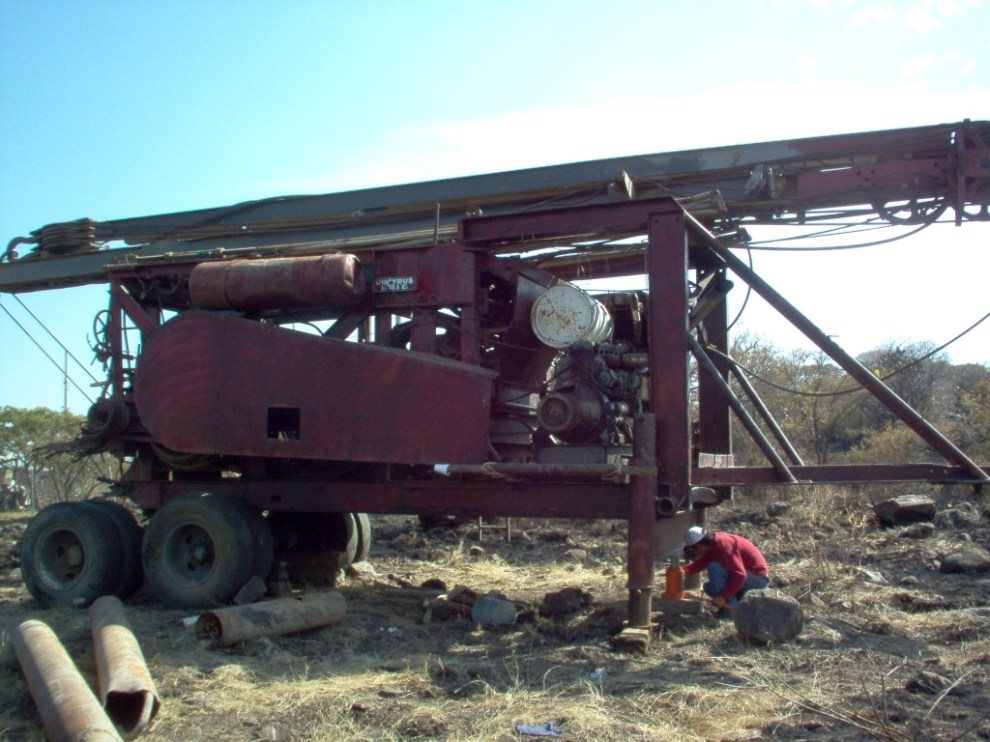
pozo digger

This is the machine that punched a hole in the water table.

So this brings up to early 2012. Our efforts to find out who we are and where we are had been coming along slowly, but steadily. Then came the first demanda (lawsuit).

We were presented the first copy of the demanda (lawsuit) during our routine meeting in January by someone unknown to us. He obviously had been sent by Chuchi to see that we get the paperwork. He was not forthcoming with how he obtained this, just that it had been given to him.

Super Prez read the papers and said he would look into it. The next day, the official notice was sent to his office. In this demanda (lawsuit) the perforador del pozo (the guy who drilled the hole that pretends to be a well) sued La Yacata and Super Prez for non-payment of work completed and nearly double in interest making the grand total about $500,000 pesos.

The lawsuit claimed that a contract had been signed in Super Prez’s office in 2007. Since Super Prez didn’t have an office in 2007 and was not the president of the community group La Yacata at the time, the well hole digger falsified the contract (with Chuchi’s help).

Well, the law works in mysterious ways here. Once a demanda (lawsuit) has been received, the accused party (in this case La Yacata and Super Prez) have 9 days to respond or it’s an automatic win to the presenter (the well digger). So since R’s brother, R2, was part of a legal team, a lawyer of sorts, he wrote a response to the lawsuit alleging falsification of the contract.

Now that a response had been made, the case proceeds to los juzgados (court). There, both sides present their cases to the judge who makes the final decision. It is a laborious and time-consuming process.

R2 decreed that he would accept no money until the case was won. It wasn’t a risk for him really, the charges were ludicrous. Lawyers are paid a percentage of the total claim. R2 said he would be content with a mere $100,000 pesos, after all, he was saving us $400,000 pesos by his efforts. We didn’t have any choice but to agree.

This first demanda (lawsuit) was open from January until September when the judge finally made his ruling in our favor. There was no contract between Super Prez or the people of La Yacata and the well hole digger. The contract was found to be between the well hole digger and Chuchi and therefore Chuchi was responsible for the balance of payment.

The next day R2 came for his first payment from the people of La Yacata. We put in a contra-demanda (counter demand) against the well hole digger in order to get back some of the money we have paid in our defense, but it won’t cover all the expenses. So each lot has a $250 peso cuota (charge) to pay the lawyers. It isn’t fair. We are being penalized for problems Chuchi has made. It doesn’t make the colonos (people) happy at all.

*****************

disclosure

14 Comments

Filed under La Yacata Revolution, Water issues

Water Woes

ajibe

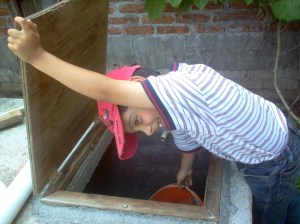
Using the ajibe (dry well)

As La Yacata does not have any water lines, nor sewer, nor electricity, daily living is challenging some days. Not having electricity requires that we make daily trips to town and buy just enough perishable foodstuff that we would eat in a day, and have the same thing for both lunch and dinner. Any organic scraps go to our animals. Nothing wasted. For lighting, we do what we can during the day and use a candle when it’s dark. For the most part, we rise and roost the same time as our chickens.

But not having water is much more difficult. We have an ajibe (dry well) that can hold about 3000 liters of water. Then we have a tinaco (water tank) on the roof that holds another 1500 liters. And recently we bought another water tank to hold the animals’ water. This amount of water will last us about 2 months.

tinaco

Our tinaco (water storage tank) on the roof of the house provides us with water for the kitchen sink, toilet, bathroom sink, and shower.

The rainy season begins in June and lasts until about the end of September. During the rainy season, there isn’t a shortage of water. We catch the rain in barricas (barrels), even been known to hang the blankets out for a little rain washing. The trick is then to get them dry.

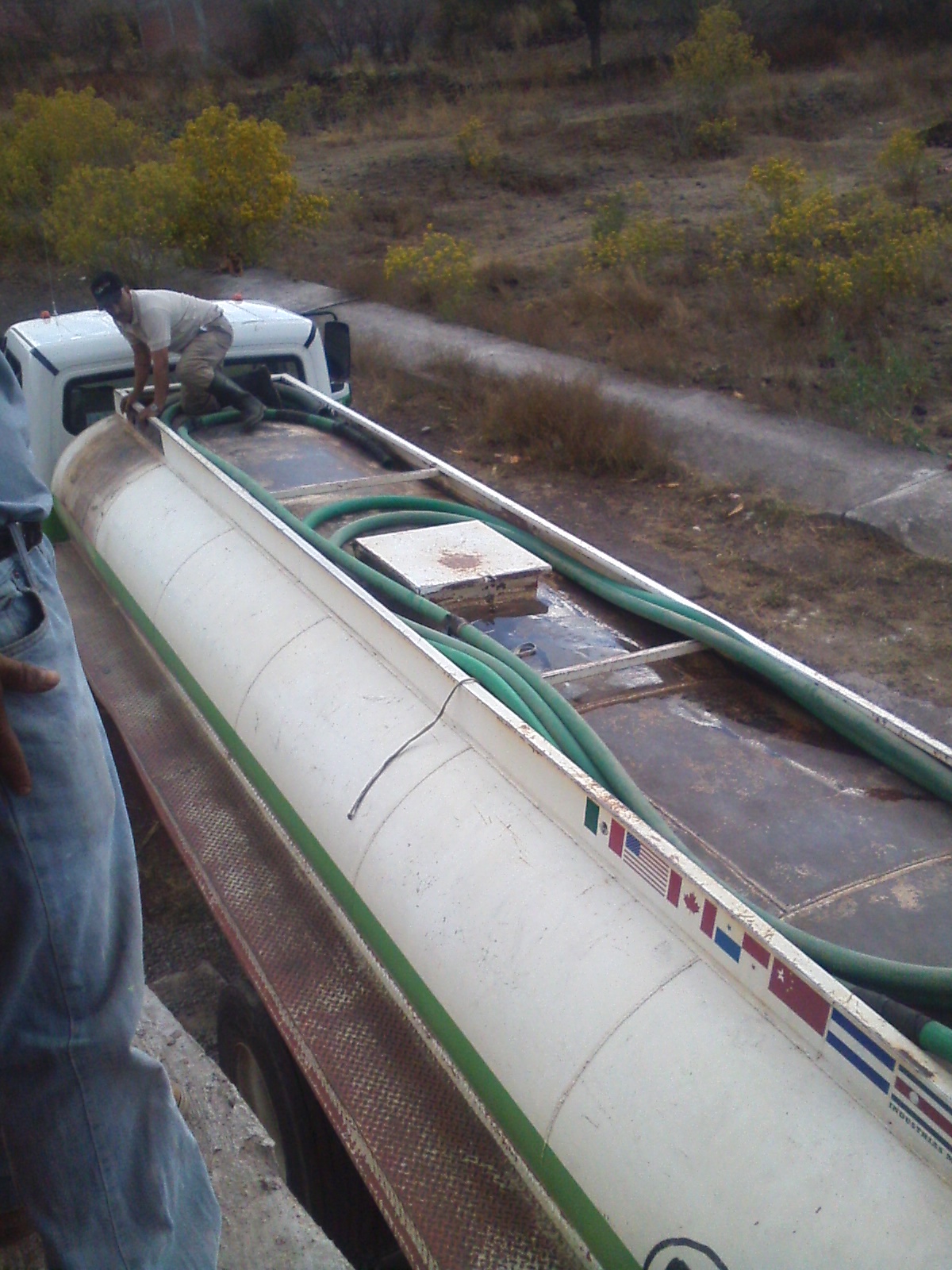
For about 400 pesos, we can have a tanker truck full of water delivered to our house.

For about 400 pesos, we can have a tanker truck full of water delivered to our house.

But during the dry season, water is a problem. During the last president of Moroleón’s term, the local pozo (well) at Los Areas Verdes refused to provide us with water saying that the well was drying up. However, the tanker trucks that arrived daily and left full told a different story. I’m sure they paid more than the poor people in La Yacata. For awhile, Los Areas Verdes was charging us 50 pesos per barrica (barrel). So we had to look for alternatives.

The truck pulls in front of our house and we run a house from the truck to the ajibe and tinacos.

The truck pulls in front of our house and we run a house from the truck to the ajibe and tinacos.

We ordered a tanker of water directly from the bomberos (fire company), however they charged us for 10,000 liters but only left 7,000.  When we pointed out the discrepancy we were blacklisted and now no delivery to La Yacata.

water filling

Filling the water storage container.

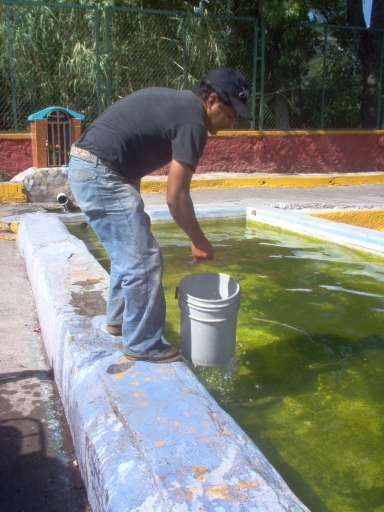
Another of our solutions was to go to a little community called Ojo de Agua de en Medio.  As its name implies, there is a natural spring in the center of town.  A section of the spring has been diverted into a public trough, used for water livestock and washing clothes.  The water then runs into a sewer canal.  So we loaded up the tank in the truck and off we went.

bucket bridgade

From trough to bucket

into the tank

From bucket to tank

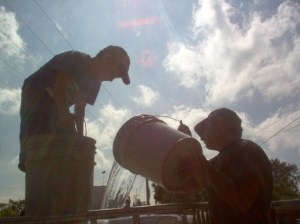
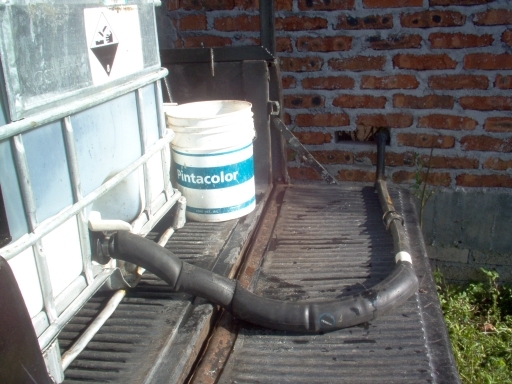
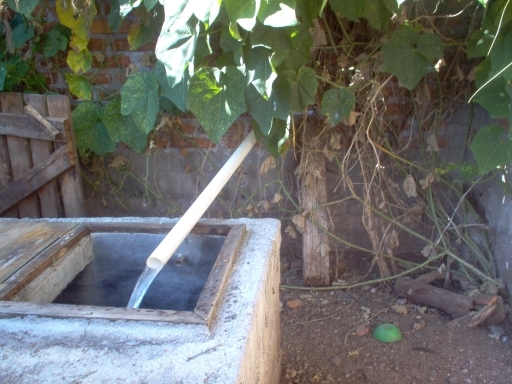
We used a bucket fire brigade line to fill the tinaco (water storage tank) and barricas (barrels) and headed back home. As our ajibe (dry well) is the rear of the house, we had to poke a hole in the wall to run the pipe in. My creative husband used an old bicycle inner tube to connect the tinaco (water storage tank) to the pipe and let gravity do the rest.

inner tube

From the back of the truck through the wall

into the ajibe

Through the wall into the ajibe (dry well)

As you can see, the process of getting water is not just a simple matter of turning on the faucet. Therefore, we respect each and every drop. This requires adapting how we used to do things.

For instance, in order to wash dishes, we employ what is called “drought washing.” Dirty dishes are stacked to the side. The sponge is soaped up. The dishes are soaped up. Then they are rinsed. No sink full of water for us.

My husband’s grandparents, being in their late 80s, have even more difficulty in obtaining water. So doing dishes at their house is more of bucket washing. Minimal water is used. The dirty water then goes to water the myriads of plants they grow. Not a drop wasted.

bucket washing at great-grandmas

The little guy helps great-grandma with her bucket washing

more bucket washing

Under the plants in the background is their ajibe (dry well). I’m pretty sure the same water has been there since the dawn of time.

Bathing uses quite a bit of water. We have a small gas boila (water heater) that provides the luxury of a nice hot shower. In order to both save gas and water, we schedule our showers so that we only have to light the water heater once. As one member finishes, the next jumps right in. When everyone is squeaky clean, we turn off the boila (water heater).

Our animals are also limited to the amount of water they use.  Each corral has a container for fresh water, but it the container is no bigger than the animals need.  For instance, the goats have a receptacle that will hold one bucket of water.  Since they won’t drink water that seems dirty to them (has grass bits in it) we reduced the amount of water wasted when we cleaned out their bowl.  The rabbits have an even smaller water dish, again with the idea to minimize waste.  So even though all our animals have fresh water daily, we try to keep the water waste low.  Additionally, the dirty water from the animals is used to water our fruit trees in the back.  Waste not, want not.

I could say that housecleaning too is diminished due to lack of water, but honestly, I didn’t do much of that even when we lived in the States.  Our house is clean, but not spotless.  I mop the entire house only once a week, then toss the water on the trees. I clean surfaces as they need it, not as a part of a daily ritual.  We’re good with that.

*************************************

disclosure

29 Comments

Filed under La Yacata Revolution, Water issues

Protecting our assets Phase 7

wires in the backyard

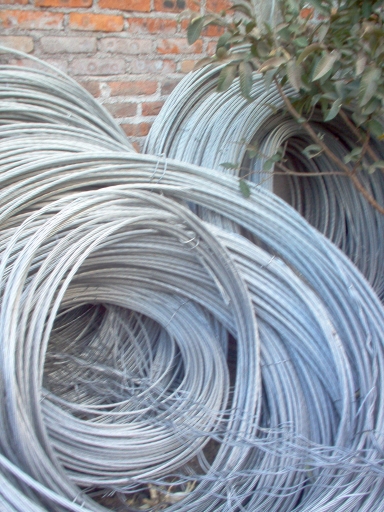
The power of electricity in my back yard.

About two months before, one of the electric posts that had been planted in the swamp, fell to the ground. No one seemed to be concerned about the long-term impact of downed wires and the strain on the remaining wires connecting Moroleón to La Yacata. About a month after that, someone cut and stole a large section of wire. This released the strain on the remaining wires, and they hung lower than ever over the highway. I mentioned my concern several times to our new president, but he didn’t have the time or the inclination to do anything about it. So finally, the wires over the highway were cut, possibly by a passing truck, which left the wires laying loose on either side of the road. So again, I told our new president that someone was going to steal them if we didn’t gather them up.

He called the electric company, who insisted there were no wires connecting Moroleón and La Yacata, but gave their permission in event that there were, he could gather them up. Then he hired a crew to remove and roll up the wires. My husband was the acting supervisor, making sure that those paid to collect didn’t steal any. Nearing the end of the first day, having collected from the crossroads to La Yacata, one of the albergue (rehab) people drove past. Then 10 minutes later, Chuchi drove past. Another 20 minutes later, the police came and demanded to see the workers permit. They didn’t have one, as the electric company said there were no wires. So the police hauled them to jail and left my husband to watch their truck. He called me and I called our new president to see if he could go out there and resolve the problem. He did and everything was hunky dory. The gathering of the wires went on.

It was a nice change to be able to call someone with the power and influence to solve these sorts of problems. As it always seemed us against them, I dubbed our new association president—tra-la-la the Super Prez!

The second day the workers started at the crossroads and went towards Moroleón. First el contratista showed up and told them they could not take the wire since La Yacata still owed him money. He named a debt of $70,000 pesos, a figure he refused to give us when he went to his office. The workers paid him no mind and he went off. Then Jesus showed up. He also said they did not have permission to remove the wires. This time the men got irate and told him he better be off or else. So he left, not one to risk life and limb.

So the wires, the future hope of La Yacata, was in large rolls stored in my backyard, where it still sits.

*****************

disclosure

Leave a comment

Filed under La Yacata Revolution