Tag Archives: homesteading

After ecstasy the laundry

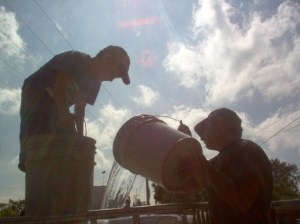
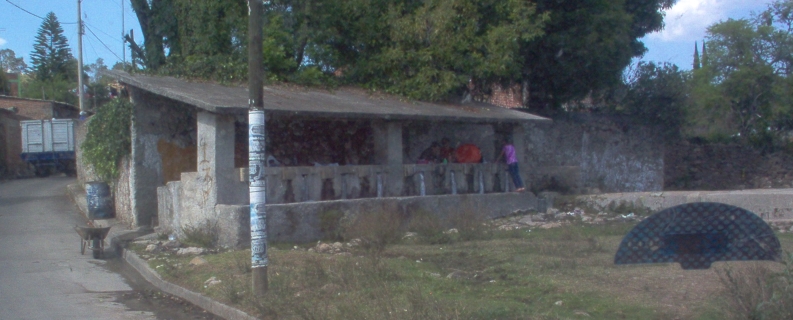
local laundrymat

A local laundry mat, although not the one we use.

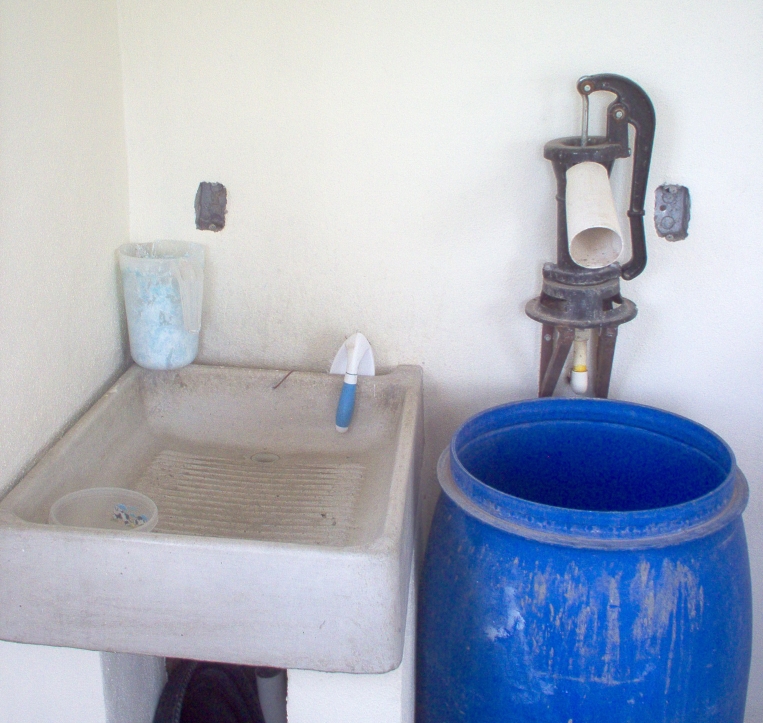
Laundry is another big water use.  We have a specially constructed laundry area on the second floor.  Instead of hauling buckets of water from the ajibe (dry well) we have a hand pump.  My mom sent it to us from the States as we were unable to find any sort of non-electric pump in the whole of México.  It’s wonderful!  My son’s job is to fill the barrica (barrel).  My job is to wash the clothes on the washboard using a Tupper ware container to scoop the water from the barrica (barrel).  My husband’s job is to wash the really heavy things, like blankets.  The wash water goes down another pipe into our garden and waters the plants.

laundry area

Our second-floor laundry area, complete with hand pump connected to the aljibe (dry well).

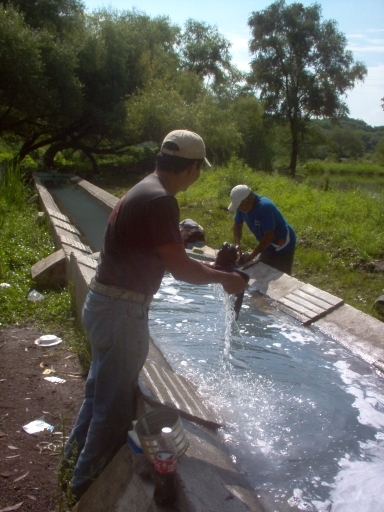
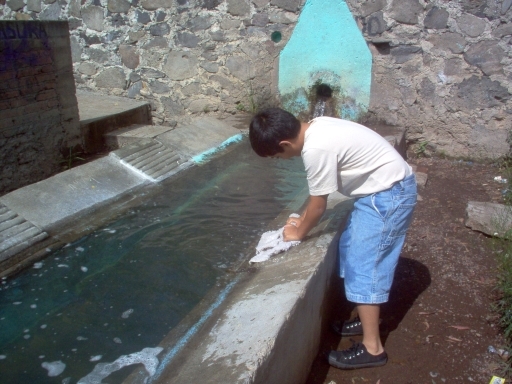
Sometimes, however, we are out of water at the house. This requires a trip to Quiahuyo. There is another natural spring there that has been divided into two area. One side feeds the lake, the other is diverted into a wash trough. The wash water goes to a swampy area near the lake and the plants filter the soap (which is typically biodegradable) from the water, which then runs into the lake.

Washing in the arroyo (stream) is not an easy task. Therefore, everyone has to pitch in and help. As it is uncommon to see men washing in the arroyo (stream) when my husband, son, and father-in-law come with me to wash, we are the object of mirth. The passers-by laugh, make comments about the gringa washing with the marimachos (men who are effeminate). Well, most of those comments come from the machismos (macho men) drinking their caguamas (beer) in the shade by the lake. The women who pass, however, say quietly in passing ‘que bueno’ referring both to my own industriousness and the fact that my men are assisting.

doing the laundry

My husband and father-in-law doing the wash.

everybody helps out

Everybody helps out.

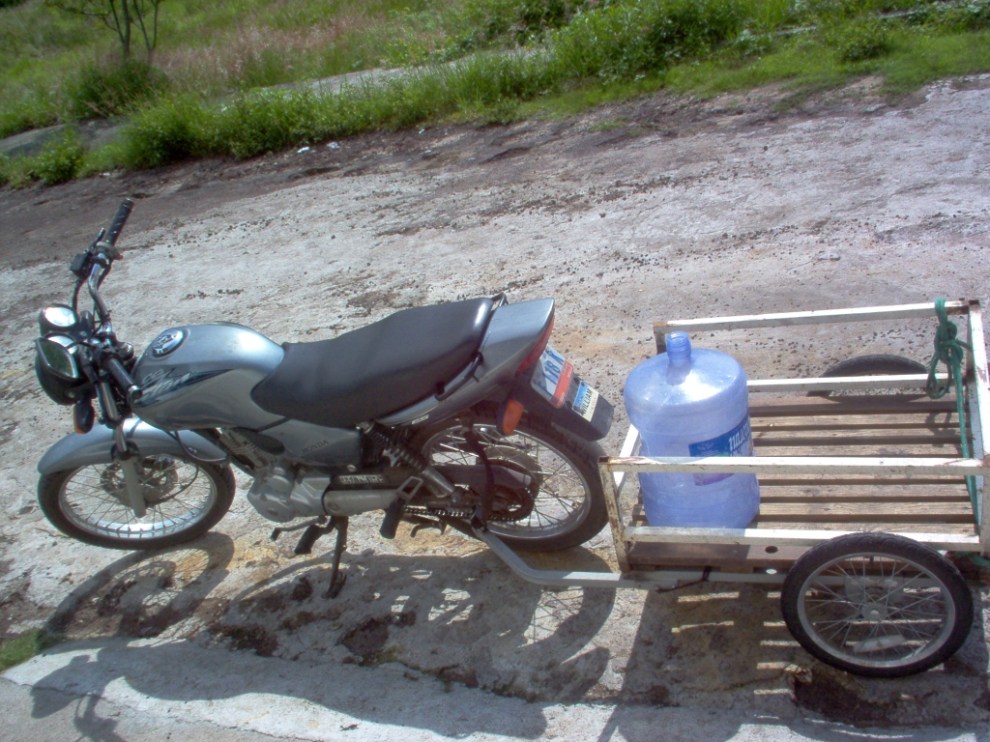
Then the wet clothing is loaded back in the truck (or in our moto cart) and hauled back to the house, up to the second floor, and hung out to dry. Besides the fact that we don’t have electricity to run a dryer, clothes dryers are rare, even among the wealthy. The sun is all a body needs to dry. However, make sure the clothes are hung inside out to reduce the amount of sun bleaching.

moto cart

My husband converted an old bicycle trailer into this nifty moto cart.

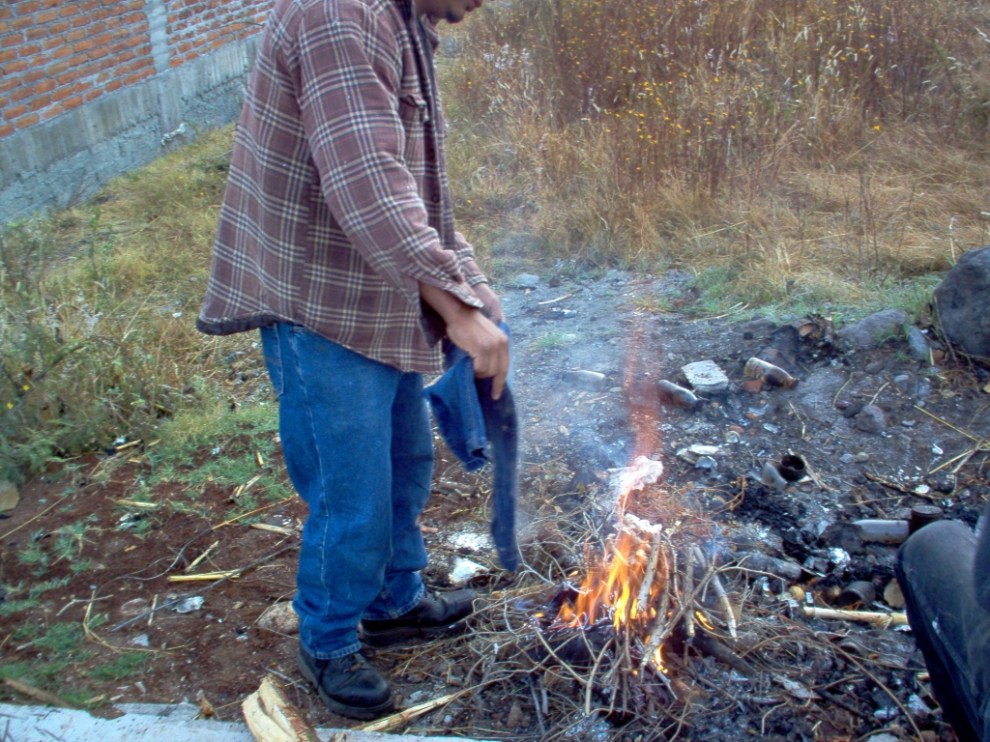
On occasion, an article of clothing is needed and the sun hasn’t been shining. So, we improvise. A little fire and a few minutes and its dry enough to wear in a pinch.

the emergency dryer

A bit of fire and instant dryer.

**************************************

disclosure

12 Comments

Filed under La Yacata Revolution, Water issues

Redefining Simplicity–Living within our needs


Welcome to the February edition of the Simply Living Blog Carnival – New Beginnings cohosted by Mandy at Living Peacefully with Children, Laura at Authentic Parenting, Jennifer at True Confessions of a Real Mommy, and Joella at Fine and Fair. This month’s topic, our writers consider where they are with their New Year’s Resolutions or new ventures of 2013. Please check out the links to posts by our other participants at the end of this post.

***

beauty-life

Today, while using the washboard and brush to scrub the towels, I thought of how our lives have changed since moving to México. Not only our lives, but our needs had become pared down from our middle-income suburban past.

Immigration reform deprived my family of a life in the U.S. and so 6 years ago, we came to México to start a new life. Many of the things we painstakingly packed and brought were essentially useless and we have divested ourselves of most of the excess baggage along the way. Don’t think it has been easy. Possessions have a way of feeling important even if they are not used. The washer and dryer set just took up space in a house that had no running water or electricity, but I was loathed to part with it for quite some time.

Living without electricity has also eliminated a refrigerator. We buy fresh food daily and only what we will eat in a day. Anything in excess of our daily bread goes to waste. We enjoy fresh organic goat’s milk and eggs, sometimes in quantities that we have difficulty in finishing in a day, but hey, who’s complaining?

We have a stove, however, there are days when we can’t afford the gas to cook with, so we gather up sticks and build an impromptu stacked brick oven outside. Flame-cooked beans have a flavor all their own.

We’ve divested ourselves of the TV, lamps, electric piano, blender, toaster, radio and crock pot. We use a rechargeable flashlight, cell phone, portable DVD player, laptop, and solar lights. When these items could no longer be recharged we replaced them or not depending on if we felt the cost worth it. For instance, we use candles now, no flashlights or solar lights. They work just as well and are more easily obtainable.

My wardrobe has also changed. In the life we lived prior to this one, I had a full closet, multiple pairs of shoes for every outfit and occasion, and coats and jackets that truthfully saw the light of day two or 3 times a year. I used to have beautiful silk dresses and angora sweaters, but they just aren’t practical wear for minding the goats. Now I have 2 pairs of pants, a handful of shirts and sweaters, one jacket, one pair of sneakers, one pair of sandals, and one pair of boots. Don’t think that sometimes I don’t look back longingly, like Lot’s wife, but my needs have changed, and I have to change along with them.

We have also changed our spending habits. Not having electricity or running water means we have been unable to establish credit. And without credit, no credit cards or buying on credit. So for us, it’s cash on the barrel, or it doesn’t get bought. This has meant that materials for our house are carefully budgeted items, not something we can run to Home Depot and buy now to pay later. We are moving towards a finished house, but haven’t arrived there yet.

We have found that we need less to be content than we thought we did. Our preconceived priorities have been altered. Yes, we still need food, shelter, water, and clothing, but not what we thought we needed.

I have had one heck of an education, moving from a first-world country to a third-world country on what a person needs to be happy. Safe in our middle-income suburban life, I might have said that the conglomerate of things we had amassed was essential to living. And I would have been mistaken.

I have found that difficult though some days may be, there is a sense of freedom in our new life, a sense of purpose in what we do every day, that has nothing to do with what we own. As if all the extra frivolousness has been stripped away, leaving only the basics and a sense of gratitude.

***


disclosure
***
Thank you for visiting the Simply Living Blog Carnival cohosted by Mandy at Living Peacefully with Children, Laura at Authentic Parenting, Jennifer at True Confessions of a Real Mommy, and Joella at Fine and Fair. Read about how others are incorporating simple living into their lives via new beginnings. We hope you will join us next month, as the Simply Living Blog Carnival focuses on Clearing the Clutter!
  • Using Special Time to Simply Connect – Amber at Heart Wanderings begins to focus on simply connecting with each of her children for a few minutes of Special Time each day. A deeper connection and sense of joy, softening of emotional outbursts, and less sibling rivalry have resulted from this practice.
  • Redefining Simplicity – Living within our needs – Survivor from Surviving Mexico talks about how moving from a first-world country to a third world country has changed her family’s perception of simplicity. Adapting to this new life has not been easy, but can be done with an attitude of gratitude.
  • Changes – Sustainable mom writes about how she is bringing back a beat to a rhythm that has been falling apart.
  • Listening to my Kids – Christy at Eco Journey In The Burbs is seeking peace and freedom after over-scheduling her daughters.
  • Thankful to Begin Again – Mercedes @ Project Procastinot learns a lesson from her twins.
  • Changes for a New Year – Mandy at Living Peacefully with Children is concentrating on making small changes this year in an effort to make better habits.
  • Parenting Two: A Fresh Start – Joella at Fine and Fair embraces the transition as her family grows as a new beginning by being gentle with herself and realistic with her expectations.
  • Finding Balance – At Authentic Parenting, Laura looks at where she’s gotten fighting depression and aspiring to a more harmonious life.

6 Comments

Filed under Carnival posts, La Yacata Revolution, Water issues

Water Woes

ajibe

Using the ajibe (dry well)

As La Yacata does not have any water lines, nor sewer, nor electricity, daily living is challenging some days. Not having electricity requires that we make daily trips to town and buy just enough perishable foodstuff that we would eat in a day, and have the same thing for both lunch and dinner. Any organic scraps go to our animals. Nothing wasted. For lighting, we do what we can during the day and use a candle when it’s dark. For the most part, we rise and roost the same time as our chickens.

But not having water is much more difficult. We have an ajibe (dry well) that can hold about 3000 liters of water. Then we have a tinaco (water tank) on the roof that holds another 1500 liters. And recently we bought another water tank to hold the animals’ water. This amount of water will last us about 2 months.
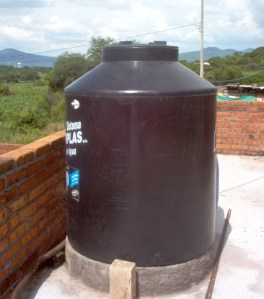
tinaco

Our tinaco (water storage tank) on the roof of the house provides us with water for the kitchen sink, toilet, bathroom sink, and shower.

The rainy season begins in June and lasts until about the end of September. During the rainy season, there isn’t a shortage of water. We catch the rain in barricas (barrels), even been known to hang the blankets out for a little rain washing. The trick is then to get them dry.

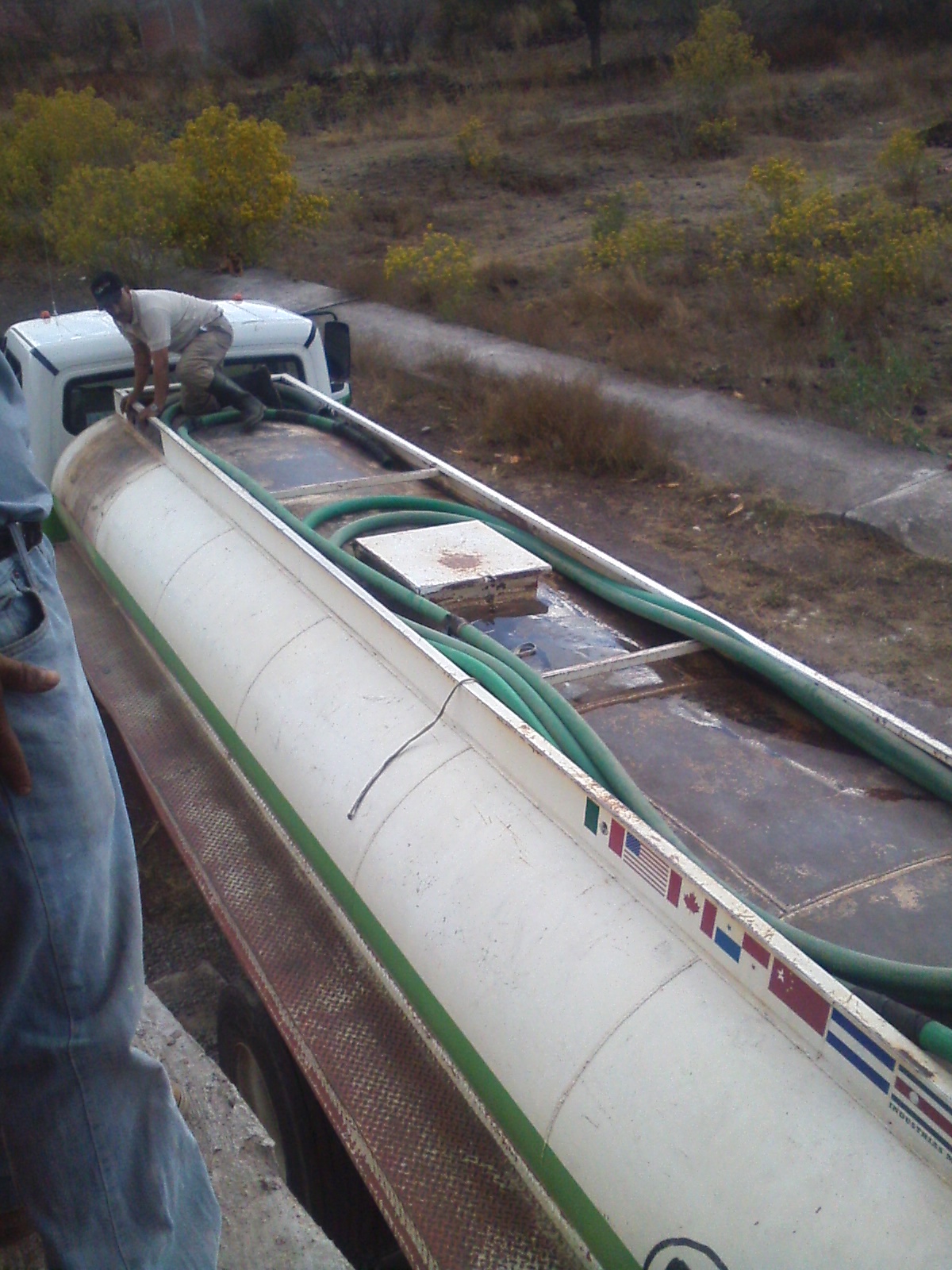
For about 400 pesos, we can have a tanker truck full of water delivered to our house.

For about 400 pesos, we can have a tanker truck full of water delivered to our house.

But during the dry season, water is a problem. During the last president of Moroleón’s term, the local pozo (well) at Los Areas Verdes refused to provide us with water saying that the well was drying up. However, the tanker trucks that arrived daily and left full told a different story. I’m sure they paid more than the poor people in La Yacata. For awhile, Los Areas Verdes was charging us 50 pesos per barrica (barrel). So we had to look for alternatives.
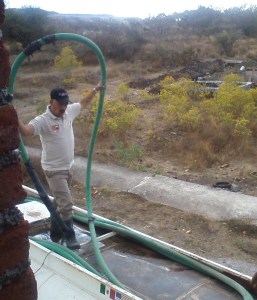
The truck pulls in front of our house and we run a house from the truck to the ajibe and tinacos.

The truck pulls in front of our house and we run a house from the truck to the ajibe and tinacos.

We ordered a tanker of water directly from the bomberos (fire company), however they charged us for 10,000 liters but only left 7,000.  When we pointed out the discrepancy we were blacklisted and now no delivery to La Yacata.

water filling

Filling the water storage container.

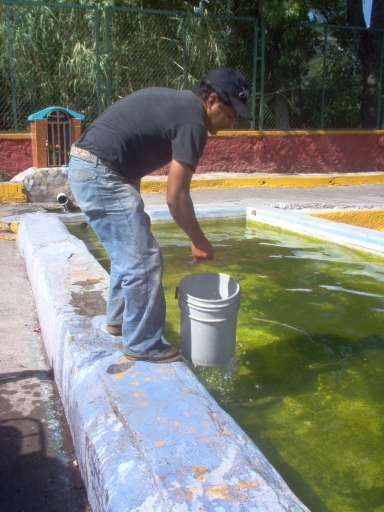
Another of our solutions was to go to a little community called Ojo de Agua de en Medio.  As its name implies, there is a natural spring in the center of town.  A section of the spring has been diverted into a public trough, used for water livestock and washing clothes.  The water then runs into a sewer canal.  So we loaded up the tank in the truck and off we went.
bucket bridgade

From trough to bucket

into the tank

From bucket to tank

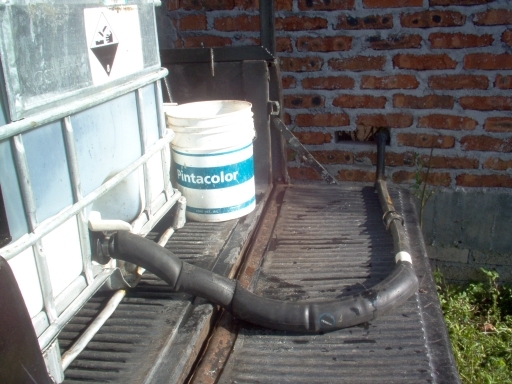
We used a bucket fire brigade line to fill the tinaco (water storage tank) and barricas (barrels) and headed back home. As our ajibe (dry well) is the rear of the house, we had to poke a hole in the wall to run the pipe in. My creative husband used an old bicycle inner tube to connect the tinaco (water storage tank) to the pipe and let gravity do the rest.

inner tube

From the back of the truck through the wall

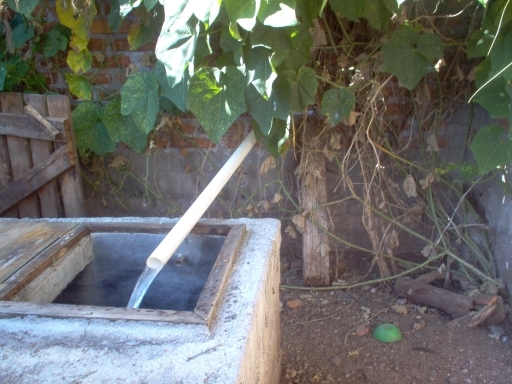
into the ajibe

Through the wall into the ajibe (dry well)

As you can see, the process of getting water is not just a simple matter of turning on the faucet. Therefore, we respect each and every drop. This requires adapting how we used to do things.

For instance, in order to wash dishes, we employ what is called “drought washing.” Dirty dishes are stacked to the side. The sponge is soaped up. The dishes are soaped up. Then they are rinsed. No sink full of water for us.

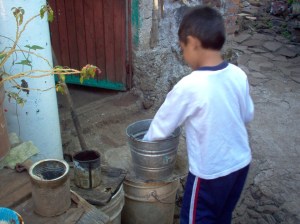
My husband’s grandparents, being in their late 80s, have even more difficulty in obtaining water. So doing dishes at their house is more of bucket washing. Minimal water is used. The dirty water then goes to water the myriads of plants they grow. Not a drop wasted.
bucket washing at great-grandmas

The little guy helps great-grandma with her bucket washing

more bucket washing

Under the plants in the background is their ajibe (dry well). I’m pretty sure the same water has been there since the dawn of time.

Bathing uses quite a bit of water. We have a small gas boila (water heater) that provides the luxury of a nice hot shower. In order to both save gas and water, we schedule our showers so that we only have to light the water heater once. As one member finishes, the next jumps right in. When everyone is squeaky clean, we turn off the boila (water heater).

Our animals are also limited to the amount of water they use.  Each corral has a container for fresh water, but it the container is no bigger than the animals need.  For instance, the goats have a receptacle that will hold one bucket of water.  Since they won’t drink water that seems dirty to them (has grass bits in it) we reduced the amount of water wasted when we cleaned out their bowl.  The rabbits have an even smaller water dish, again with the idea to minimize waste.  So even though all our animals have fresh water daily, we try to keep the water waste low.  Additionally, the dirty water from the animals is used to water our fruit trees in the back.  Waste not, want not.

I could say that housecleaning too is diminished due to lack of water, but honestly, I didn’t do much of that even when we lived in the States.  Our house is clean, but not spotless.  I mop the entire house only once a week, then toss the water on the trees. I clean surfaces as they need it, not as a part of a daily ritual.  We’re good with that.

*************************************

disclosure

29 Comments

Filed under La Yacata Revolution, Water issues