Tag Archives: Driving hazards in Mexico

Driving Hazards–Rules of the road

A slow moving vehicle often straddles the solid line to permit other vehicles to pass.

A slow-moving vehicle often straddles the solid line to permit other vehicles to pass.

When driving in México, be aware that a 2 lane road is really a 3 lane road. Larger and slower vehicles straddle the solid yellow or white line on the side in order to allow smaller and faster vehicles to pass in the middle. A left turn signal from a vehicle straddling the yellow line normally is an indication from the driver of said vehicle that it is safe to pass. However, sometimes it means the driver is going to take a really wide left turn, so proceed with caution. Pass straddling vehicles at your own discretion. Remember often oncoming traffic uses the same 3, uh 2, lanes you do.

If an oncoming vehicle flashes its lights at you, it typically means there is an obstruction in the road ahead, like a disabled vehicle, a slow-moving tractor, or a herd of goats. Slow down.

This sign does not indicate a steep incline, but a speed bump.

This sign does not indicate a steep incline, but a speed bump.

This sign indicates speed bumps, however they may not be the helmet variety as advertised.boya sign

When you see a sign with three turtle-like bumps or a car at an incline, immediately slow down. It’s an indication of topes or boyos (speed bumps) ahead and you can put your suspension system in mortal danger if you pass over them too quickly. Topes (See also The Deeper Meaning of Mexico’s Giant Speed bumps) vary in size and shape and there is no telling how big the next one will be. There are round helmet type topes, small thin line type topes, giant boulder size mountain topes and everything in between. Often the topes are not marked or the paint indicating a tope has long since worn away, so drive cautiously, especially in residential or commercial areas.

These topes are attached to the road with names, so proceed cautiously or risk a flat.

These topes are attached to the road with nails, so proceed cautiously or risk a flat.

This is my favorite type of tope. Taken at just the right speed on my moto, I can get considerable air time.

This is my favorite type of tope. Taken at just the right speed on my moto, I can get considerable air time.

Most topes (speed bumps) are like this and nearly invisible until you get right up on them.

There are some roads so peppered with crosses that mark where someone has died after an accident that it is like driving through a cemetery. A large number of crosses indicates a tricky navigation area. Proceed with caution.

Crosses such as this one are constructed by the side of the road at the place where someone has been killed in an accident. Fresh flowers are often brought on the anniversary of the death and el día de los muertos (The day of the dead) in November.

Crosses such as this one are constructed by the side of the road at the place where someone has been killed in an accident. Fresh flowers are often brought on the anniversary of the death and el día de los muertos (The day of the dead) in November.

Cuota (toll) roads are available and take some of the risk out of driving, however, they cost quite a bit and are not necessarily shorter than the libre (freeway or what pretends to be a freeway). So most travel is along roads that once might have been goat paths, twisting and turning over hill and dale.
How's this hair pin turn for some hair raising driving?

How’s this hair pin turn for some hair-raising driving?

*******************


disclosure

1 Comment

Filed under Driving Hazards

Driving Hazards–Gas and illumination

“It’s a dangerous business, Frodo, going out your door. You step onto the road, and if you don’t keep your feet, there’s no knowing where you might be swept off to.”–Bilbo Baggins

I’m an East coast girl and thus driving through major headache areas like D.C., Phili or NYC are old hat. However, nothing in my experience ever prepared me for driving in México.

Take, for instance, this last trip to San Miguel de Allende for my residency papers. (See Getting Legal-Trip 1)

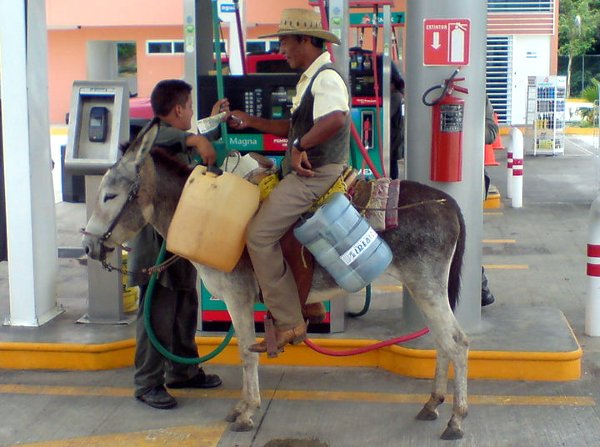
It is not uncommon to send a representative to get gas for rural communities that are not near a PenMexWe started out in the morning with a full tank of gas in the truck just in case. Gasolinera (gas stations) are not always where you think they should be. Residents in smaller towns sometimes have to go quite a distance to get gas. It’s not uncommon to send a representative to the gasolinera for several families. Various types of plastic containers are often reused as gas receptacles. I admit, one of our garafones (water jugs) has been converted to a gas container and we keep a second plastic jug (I believe it had windshield wiper fluid in it once upon a time) with a bit a gas behind the seat, just in case.

There have been occasions when we have run out of gas. (See Failing at your own business–Fruit truck) There is nothing to be done but hitch a ride to the nearest gas station and fill some sort of gas receptacle and hitch a ride back. No need to mention that this makes the trip much longer than anticipated.

Then we waited until it was nearly light to begin the trip. Driving at night is not advisable. Very few roads are lit. Cattle, horses, goats and other livestock may be tethered right next to the road for night feedings. This provides a sort of roadside maintenance as well. Bicyclists and walkers are nearly invisible as they head to work.

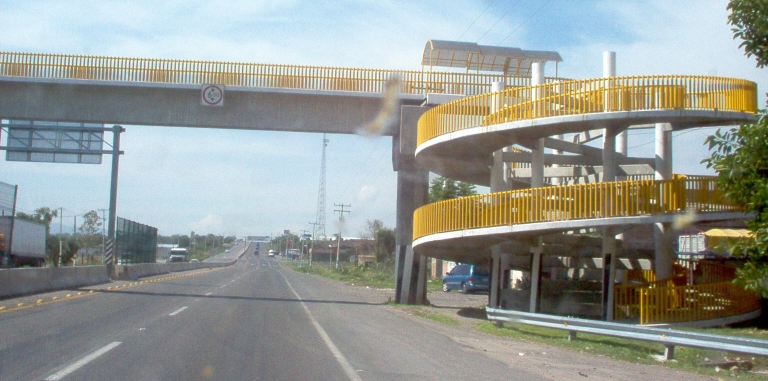
Puentes de peatones (pedestrian bridges) are not necessarily the shortest distance between two points.

Puentes de peatones (pedestrian bridges) are not necessarily the shortest distance between two points.

In the early morning, chickens, dogs and children may run wild across the road in desperate haste to get to the other side. There are puentes de peatones (pedestrian crosswalks) along high traffic areas, however, the shortest distance between two points is often not over the pedestrian bridge. So it is important to watch for those taking a “short cut” across the highway.

***********************


disclosure

2 Comments

Filed under Driving Hazards