Tag Archives: community living in Mexico

Escrituras! Escrituras! Wherefore art thou, Escrituras?

In June, Super Prez was called unexpectedly to the presidencia and informed that if we were interested in proceeding with escrituras (individual deeds) for the community, we could do so,  under certain conditions. Typically, escrituras are granted when at least 80% of the infrastructure for an area is complete, including sewer, water, electricity, and roads. If you’ve been following our story, you’ll know that we aren’t anywhere near 80%. However, not to look a gift horse in the mouth, we presented the opportunity to the colonos at the next junta.

The first question was how much it would cost. Because of our rural classification, most colonos were thinking about $5000 per lot. As that didn’t seem to be the amount that the presidencia was hinting at, we’d need to investigate further. 

Unbeknownst to us, the presidencia went ahead and called a meeting in the cabildo municipal via Facebook. I heard about it the day before and told Super Prez he should be in attendance. I couldn’t go because I had classes. He was busy with electricity estimates and said he wasn’t going to be able to make it. Another colono attended and sent him a message shortly after the meeting started, saying his presence was urgently needed. Super Prez wasn’t too far away, swooped in to an illegal parking spot in front of the presidencia, and party crashed what had become a Yacata bashing session. 

The colono who sent out the SOS said that upon Super Prez’s arrival, the tone of the meeting changed. No one DARED to badmouth La Yacata or the mesa directiva to Super Prez’s face. The meeting broke up shortly after that. Super Prez requested another meeting in the cabildo, with advance notice this time, so that we could get some details on the escrituracion process. 

La mesa directiva, including myself, and a handful of colonos were present at the second meeting. We had specific questions that I divided among the colonos, including who would be the notario that would be in charge of the process, how much would it cost, and were there other restrictions that we needed to be aware of. The notario would be from another city, the cost would be $24,000, and the conditions of the escrituras meant that we would remain a colonia and could not petition the municipio for any basic services (water, electricity, sewer) that normally would be provided as part of the predial (yearly taxes) collected each year. 

These conditions were not exactly favorable, but in our current condition, this would be the only opportunity we would have for escrituras until all the services were completed, which could take another 5 years. Feeling like we had received our answers that we could take back to the asamblea, Super Prez excused himself to attend to other matters. 

The second he left the room, the criticism of La Yacata started up again, and it was fierce. Certain colonos in the room started in how the mesa directiva was corrupt and untrustworthy, that there was no progress, that we were dipping into community funds for our own benefit. I saw RED. After all the time and effort we had devoted to making La Yacata a more dignified place to live? This was the thanks we got?

The presidencia representative said that based on the complaints, he could take over community direction for the “good of the community”. I was livid. I literally stood up at that point and directly refuted some of the blatant lies spoken by the agitators in attendance. Of course, my righteous indignation did not help the fluidity of my Spanish, so I stumbled a few times. I also had to leave because I had classes, and this meeting had already gone on for 3 hours. So, in parting, I addressed the remaining colonos and told them I was leaving the defense of our community and mesa directiva in their hands and marched out dramatically, although probably not elegantly as flustered as I was.

Later, a colona who remained at the meeting said the first thing the representative of the presidencia said when I left was that all members of the mesa directiva should be able to express themselves well in Spanish or be replaced, a direct jab at my second-language abilities. 

After that fiasco, we invited the enlace (representative) for the notario to the next community meeting so he could explain the process to the colonos. He sent a message right before the Sunday meeting saying that he would not be able to attend. We had the meeting anyway. 

On Tuesday, we took a group of colonos to the presidencia to meet with the powers that be to see why the enlace was “unable” to attend. We got the run around, nobody was able to meet with us, blah blah blah, until we made it clear that we would remain there, in the lobby, until we were attended to. Not 30 minutes later, we were ushered into the cabildo. The enlace was called in to explain himself. He gave the excuse that he was afraid to come to La Yacata, which puzzled us greatly until we pieced together that he thought we were “Las Yacatas”, another community in the next municipality, near where 6 men were executed the previous Friday, all known to the enlace. 

We confirmed the cost and that colonos would be able to pay for the escrituras in two installments, and the meeting ended.

Naturally, the colonos were flabbergasted at the cost, and it took some doing to explain that the escrituras were completely optional. Those who wanted to go through the process now could, and those who did not, were not obligated to do so. Either way, escrituras or not, all property owners would remain part of the colonia and have obligations towards community advancement and upkeep. 

A mad rush of those who had not paid any aportaciones indicated their interest in escrituracion. People with certificates issued by the previous encargado (person in charge) appeared out of nowhere. Some of the lots they had certificates for were owned by others, so it was quite a time making sense of the ownership trail. Others were certain they could get their escrituras from another notario for cheaper and, therefore, bypass the process completely.

Ownership needed to be proven by an official document. At the last minute, parents wanted to gift their lot to their children, and married colonos wanted to add their current significant other. The property certificate then had to be reissued since the escrituras and the certificate needed to match exactly. 

Then there was a subgroup of individuals who were no longer in possession of their property certificate for whatever reason. They believed that they could recover possession of said property via escrituras. Unfortunately for them, the original property certificate (not a copy) had to be turned over for the orden de escrituracion (deed order). Their applications for escrituras remained dead in the water at that point.

Then there were the names. Ma., Maria, M., Ma. de, and Jose, J., J. Gpe. Abbreviations or full names needed to match the INE (voter registration cards). Documents had to be reprinted and refiled. 

It was absolute chaos for a time.

Anyway, the first step was the application for the permiso de division (subdivision permit). It’s a technical form, and not just anyone would be able to fill it out. Super Prez offered his services as an engineer for a mere $200 compared to the going rate of $1800 or more. There were complaints about that.

The permit itself was $382. Originally, this was to be paid in the presidencia, but they didn’t want to bother with the individual payments and wanted a lump sum, so when we had a group ready, Super Prez took the cash himself, only to be told that the official number registration fee would also need to be paid at the same time. This meant calling everyone back to bring the cash for that transaction.

There was so much paperwork. So many messages to colonos asking for documents, or information, or payments. So much hassle. I was in charge of trying to keep the paperwork in order, while Super Prez was in charge of the more technical aspects and meetings with the enlace and presidencia. 

The first subdivision permits came back from the presidencia with errors and had to be resubmitted. The official numbers were issued using fractions of the colonia rather than the road and number. Fractions are not accepted by any agency (CFE, water, etc), so those were set aside to be given later, even though they needed to be paid for first, according to the presidencia. 

The fiscal year ends on December 15. Although the process of escrituracion can be done next year (or even the year after that), the price goes up every fiscal year. So we have been working overtime to try and get these packets of papers turned over to the enlace (representative) before the deadline for those who wish to get their escrituras right now. And this is a negative cost-benefit for the community. The 50 or so colonos, most of whom owe aportaciones (community fees), will have their escrituras, but we still won’t have enough money to pay the electricity contractor.

***

Curious how it all started? La Yacata Revolution: How NOT to Buy a Piece of Heaven in Mexico
6 Comments

Filed under La Yacata Revolution

Second CFE Billing Cycle

After the dispapaye (chaos) of the last billing cycle, we were determined to get our ducks in a row before the next. We started with the list of 8 meters which were not in the system or entered incorrectly and the incorrect numbering (lots instead of official numbers). Super Prez created a list requesting the lot numbers be changed to the official numbers, and every colono with electricity signed it. As I mentioned before, the municipio had granted Super Prez the authority to generate the official numbers and he had a letter to that effect from the presidencia (town hall). However, when he presented the list to the local CFE office, they called the regional CFE office, which said that it wouldn’t do. 

Meanwhile, the restructuring at the CFE main offices was going on. If you recall, CFE begged off from attending our convivio (community gathering) in November because several higher-ups, including the local representative, had been fired for corruption. In the free-for-all that followed, the CFE supervisor who oversaw the electricity installation in La Yacata was promoted to fill one of the vacancies. While that might be perceived as good, as he was aware of our situation, it didn’t seem to matter any. He came on a site inspection with one of the more senior supervisors who threw a fit, saying we committed fraud as we certainly didn’t qualify for this federal program. 

Super Prez was summoned to the regional office to account for our sins or some other such nonsense. The gathered CFE overseers accused him (and us) of misrepresenting La Yacata so we could receive this federal grant. Super Prez explained that the grant was a complete surprise to us. He then turned it around and told them to check their records to see who had approved the project. He waited while they dug around. They came back chagrinned. The application had one signature, a colono, not even on the mesa directiva (board of directors). None of the information about the status of La Yacata had been filled out, because, not surprisingly, the colono didn’t know any of it. 

So what we believe happened is that at some point a year or so ago, a CFE grant scouting party stopped by and came across the colono sitting in front of his house. Instead of sending them to me up the road, this colono took it upon himself to become the community representative, and the grant scouting party accepted that. Since the grant money had to be spent and we obviously needed electricity, the scouting party submitted the application, which somebody approved. We first heard of the grant when CFE showed up with a plan and start date. We certainly weren’t going to look a gift horse in the mouth and gladly accepted. 

Anyway, with some grumbling, the issue was dropped. However, it took several more trips to the regional and local CFE offices for the official numbers generated by Super Prez with full municipal authority to be accepted. 

When that happened, Super Prez also got the go-ahead to connect the 39 muretes (posts) and fincas (buildings) that had not been included in the initial project. I worked with each colono to gather the required photos and documentation. (See Downed Lines and New Connections

When the first additional solicitud (application) was finally ready, I handed the folder of items off and told the colono to go at 9 am Monday to the CFE office. He did, and on Tuesday, CFE zoomed into La Yacata, found me walking Cocoa, and asked for directions to the house. The electricity was installed that very day. 

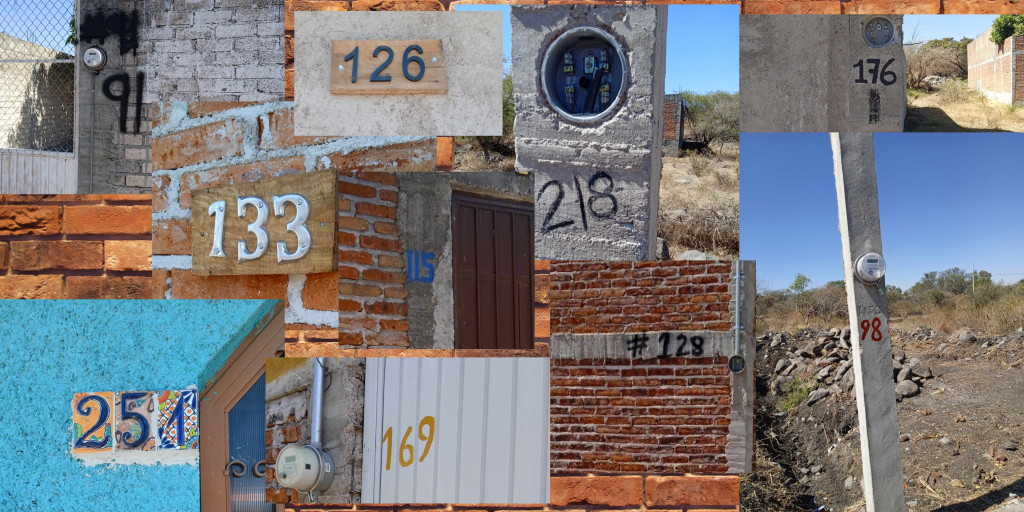
Now that we had official numbers, we needed to put them up on the walls. I bugged and bugged, sending messages and calling colonos so that they would put those numbers up before the next CFE bills arrived. We still didn’t have the street signs up, but the numbers started popping up. It made my heart glad! Things were beginning to feel like a community instead of a wasteland. 

Turns out, all that effort wasn’t needed. When the CFE delivery guy came, he encountered the same colono who had made himself the official representative for the grant. He handed over the entire stack of recibos. The colono didn’t want to be responsible for all those bills, so he brought them to my door. I sent the word out that I had them for everyone to come and pick up. There were still four missing bills and two others that I wasn’t sure were correct. Well, I suppose we have to take what we get. I sent the two I thought were incorrect to the CFE office with pictures of their meters and the bill and told the other four that we’d wait for another billing cycle and see what happened.

****

Want to read about the first failed attempt at modernization in La Yacata? Check out La Yacata Revolution: How NOT to Buy a Piece of Heaven in Mexico available on Amazon.

Leave a comment

Filed under Electricity issues, Homesteading, La Yacata Revolution

The Naming of the Roads

Would you believe 28+ years after the formation of La Yacata there were still no road names? Properties were identified by manzana (block) and lote number. Now for someone like myself, who takes endless walks around the fraccionamiento with Cocoa, identifying isn’t an issue. But as we were moving into the urbanization phase of our community growth, we now needed to buck up and choose some road names. 

I suggested that we use plants because, well, duh. I love plants. Super Prez was on board with that, so my husband and I made a list of plants that were found in La Yacata. Some, like cazahuate (Ipomoea arborescens) were immediately rejected as they are also insults. To call some a cazahuate in this area is to imply they are stubborn and unable to be reasoned with. 

I sent Super Prez a list of possibilities (with their botanical names because I’m a nerd). He sent a plan with about half of my list, the other half with extremely elevated names (in my opinion) like Maple and Cipres. I said as much and he sent a revised list with the names of more common trees. The road I lived on was to be called Tejocote, the Mexican crabapple. I had some problems pronouncing it, mixing up the j and the c, but it would do. 

The owner on the parallel road to me objected to Mesquite and requested Olivo. I thought Acebuche would be more apt as it is the native olive tree, but Olivo was added to the plan. Then, the lady down below didn’t like Frailes and requested Abedul, so that change was made. 

We could have saved ourselves the trouble because when we turned in the list to Desorrollo Urbano, they rejected all but two. Then gave us a list to choose from made up of plants and trees. Many of the names just didn’t roll off the tongue and we had gotten attached to the names we had chosen, so we were a bit put out. Not all of them were horrible. I liked Nopal and Copal and Tejocote was still on the list. 

Thus, Super Prez submitted yet another list, this time with plants rather than trees, and our road name changed to Trigo (wheat); the three other main roads became Maiz, Centeno, and Amaranto. The upper roads were aromatic and medicinal plants like Romero and Melisa. I have to admit that I was a little jealous. Trigo didn’t seem as pretty to me as some of the others, but as long as our road has a name, I’d find a way to deal with it.

However, the road name approval process seemed long and drawn out when it wasn’t an outright rejection. It could have been that the person we’d been dealing with in Desarrollo Urbano (Planning) was moved to another department because he’d had issues with the brother of the mayor or something. So this new guy was taking forever and a day for simple paperwork, perhaps at the behest of the powers that be. 

We went ahead and started using the names even if they weren’t official. However, at some point, we would need the official numbering and street names so we could have an official address for the electric bill. We got around the requirement with the initial 43 installations since the applications had been taken directly to the main CFE office in Guanajuato, and we didn’t have to go through the local office. 

Not having official numbers really set off the regional CFE office and prevented additional colonos from having electricity installed when they applied. It was also necessary for the neighbor’s store permit, and boy, did I want a store in La Yacata. 

The powers that be in the Presidencia said they couldn’t issue the official numbers until the cambio de uso de suelo (zoning change) was done. That paperwork had also been submitted months ago, and although several of the required departments had finished their studies, we were still waiting on the environmental impact study. 

Anyway, somewhere along the line, Desarollo Urbano suggested the Super Prez create the numbering system. After all, up until a few years ago, he had his own road paving company and knew the procedure, which involved measuring distances from the corner with a rolley measurer thing. So he did. 

***

Want to find out how it all began? Check out La Yacata Revolution: How NOT to Buy a Piece of Heaven in Mexico, available on Amazon.

2 Comments

Filed under Construction, Electricity issues, Getting Legal