Category Archives: Parenting Challenges and Cultural Norms

Why we chose to send our child to elementary school in Mexico

first grade

Then there was the decision to send our son to elementary school. We live in an isolated rural area so small that it doesn’t even qualify as a village. Although there are inhabitants in La Yacata despite the difficult living conditions, there were not any children our son’s age. He is also an only child, so socialization was one reason we opted to travel the 20 minutes to town every day.

A secondary reason, although somewhat related to the first, was the fact that we felt that schooling would help him learn what was necessary for successful interactions in the community. Although my husband is Mexican, he is not from this area, and his difference in speech and custom is often remarked negatively upon. I am not Mexican and would therefore not have been the best teacher in this regard for my son.

Registration for Primaria (Elementary school) takes place in February before students finish preschool. There are often long lines of parents waiting to register since there are always more students than cupo (available seats). In most public schools, there are two turnos (sessions), matutino (in the morning) and vespertino (in the afternoon.) Everyone seems to want the morning classes insisting the students learn better and the teachers are more qualified than the afternoon classes. However, the morning teachers are just as likely to be the same as the afternoon teachers since many teachers teach 2 turnos (sessions), teacher pay being what it is in Mexico. Furthermore, studies have shown that students actually perform better and retain more in the early afternoon than in the morning.  The morning class typically begins between 7:50 and 8:10 am and ends at 12:30 pm. The afternoon session begins between 2 pm and 2:10 pm and may end at 6:30 pm or as late as 7:30 pm depending on the school. Private schools have somewhat extended hours and only one turno (session) which runs typically from 7:50 am to 2:30 pm.

We opted to send our son to the afternoon session. Why waste the best part of the day cooped up in a stuffy classroom? Therefore, while I went to work at a private elementary school teaching English, in the mornings, for 6 years, my son stayed with his dad, taking care of the animals, working on the house, or just riding his bike. Then when the day became too hot for outdoor activities, (this is Mexico after all), he went to school. He spent 4 1/2 hours in the classroom with perhaps 15 minutes of homework each day.

Primaria (Elementary) begins when about half of the students are just 5 years old since the same age requirements apply as preschool. Half enter reading Spanish, and half are still learning their letters. The pressure for reading and general learning eases off in primaria (elementary) since teachers are not allowed to fail students unless they make a personal appeal to the school board in Guanajuato. This educational reform has only been in practice 3 or 4 years. It is now just fine for students to finish second grade without being able to read, write their names or do simple mathematics. It seems that the shame in failing a grade outweighs any educational rationale although the debate still wages as to whether failing a grade does more harm than good.  Perhaps if there were more resources and support available for teachers in Mexico, more children would be better educated. But then again, maybe the government isn’t interested in having well-educated citizens.

Schools are required to teach Spanish, Mathematics, History, Exploración de la Naturaleza (Earth Science), Formación Cívica y Etica (moral values), art, music, physical education, English, and Computer Literacy. Yes, English is now a required course even in the public schools. However, there is a decided lack of qualified teachers. Many teachers have been certificated as English teachers on the basis of being able to pass the TOEFL exam. (See Getting Legal–Working Papers) Unfortunately, there is a world of difference in knowing a language and being able to teach it effectively.  But fortunately for my son, I am a licensed English teacher, so no problem there!

elementary school

Grading is done on a scale of 10, 10 being the highest grade and 6 being the lowest passing grade. A 5 indicates the student has not passed, although, with the ban on failing students, it is rare that any student receives a 5 anymore. Each classroom has anywhere from 24 to 40 students, making it a challenge to meet every child’s learning needs.

Up until 2014, students were required to take a standardized end-of-year exam called ENLACE. The current president, Peña Nieto, has disbanded the ENLACE exam. However, his educational reforms have been clearly modeled on the current U.S. standards, and now teachers can be dismissed on the basis of their students’ grades. I think that there will be another exam issued nationally to take the place of the ENLACE in the very near future despite fervent protests and marches by the teachers’ union.

The extended school year is interspersed with random vacation days. Every month, teachers are required to attend a meeting, and school is canceled. 2014 marked the first year that these required work days were tacked onto the student calendar, which meant summer vacation didn’t start until July 15, well into the rainy season in our area. As the 2014-2015 school year began on August 18, that left less than 5 weeks of summer break. The academic year currently runs 200 days.
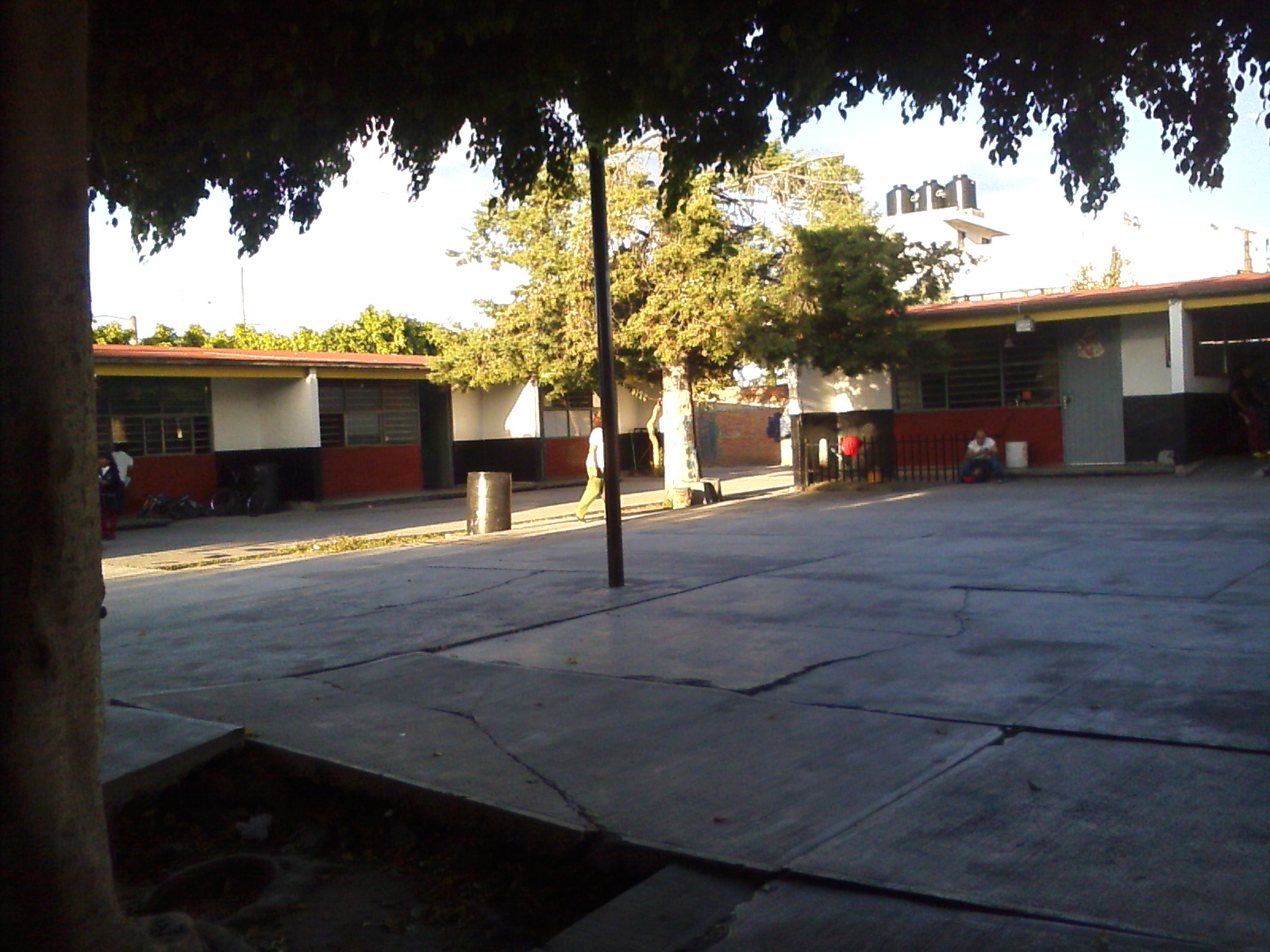
elementary school inside

There is an extensive Christmas vacation in December, that begins December 19 or 20, but since Las Posadas begins on the 16th, the vacation isn’t nearly long enough. School starts back up typically on January 7th, just one day after Los Reyes Magos deliver gifts. Seems a bit unfair that the kiddies only get one day to enjoy their gifts after having waited the entire vacation period, but, hey I didn’t make the rules. Semana Santa is also a long vacation and actually lasts 2 weeks in March or April. May is the most tiresome month to get through as a teacher, but fantastic for the students. Not only is it the hottest month in our area, but there are a number of special days commemorated. Beginning with April 30 there is El Día de Los Niños. (See Cultural Apathy) Then May 1 is El Día del Trabajo (Labour Day), May 5 is the commemoration of La Batalla de Puebla (The Battle in Puebla day), May 10 is El Día de la Madre (Mother’s Day), and May 15 is El Día del Maestro (Teacher’s Day).

Exams are administered bi-monthly and are usually taken over the period of a week. Early on in this segment of schooling, we discovered some issues. My son’s lowest grades and highest frustration levels were in Formación Cívica y Etica, which is something along the lines of Mexican Moral values. Even the kids that weren’t passing any other subject were getting 8s and 9s in this subject, so why not my son? Upon examining the exams, I discovered that many questions had to do with Mexican dichos (sayings). For instance:

Lo que empieza con gran coraje termina

1) con gran orgullo

2) con gran vergüenza

3) con gran ventaja

The answer is 2, but I wouldn’t have known it, not being a Mexican and all. My husband had no formal schooling to speak of, so wasn’t much help in exam preparation either.

How about this one?

In Mexico la muerte nos…..

The answer is …pela los dientes.

Come again?

So it stands to reason that Formacion civica etica was a trial for my son throughout his elementary years.

Since this sort of schooling was not enough for a well-rounded education, we augmented part-time unschooling. (See Homeschool variation) There were and continue to be so many opportunities for learning in our area, or perhaps we just look for the possibilities. My son also often accompanied me to my private English classes, sometimes as an additional student to the class, other times with his own activity book. After all, he may decide that this place we call home is not for him and set off on his own adventures one day, English might be beneficial when that time comes.
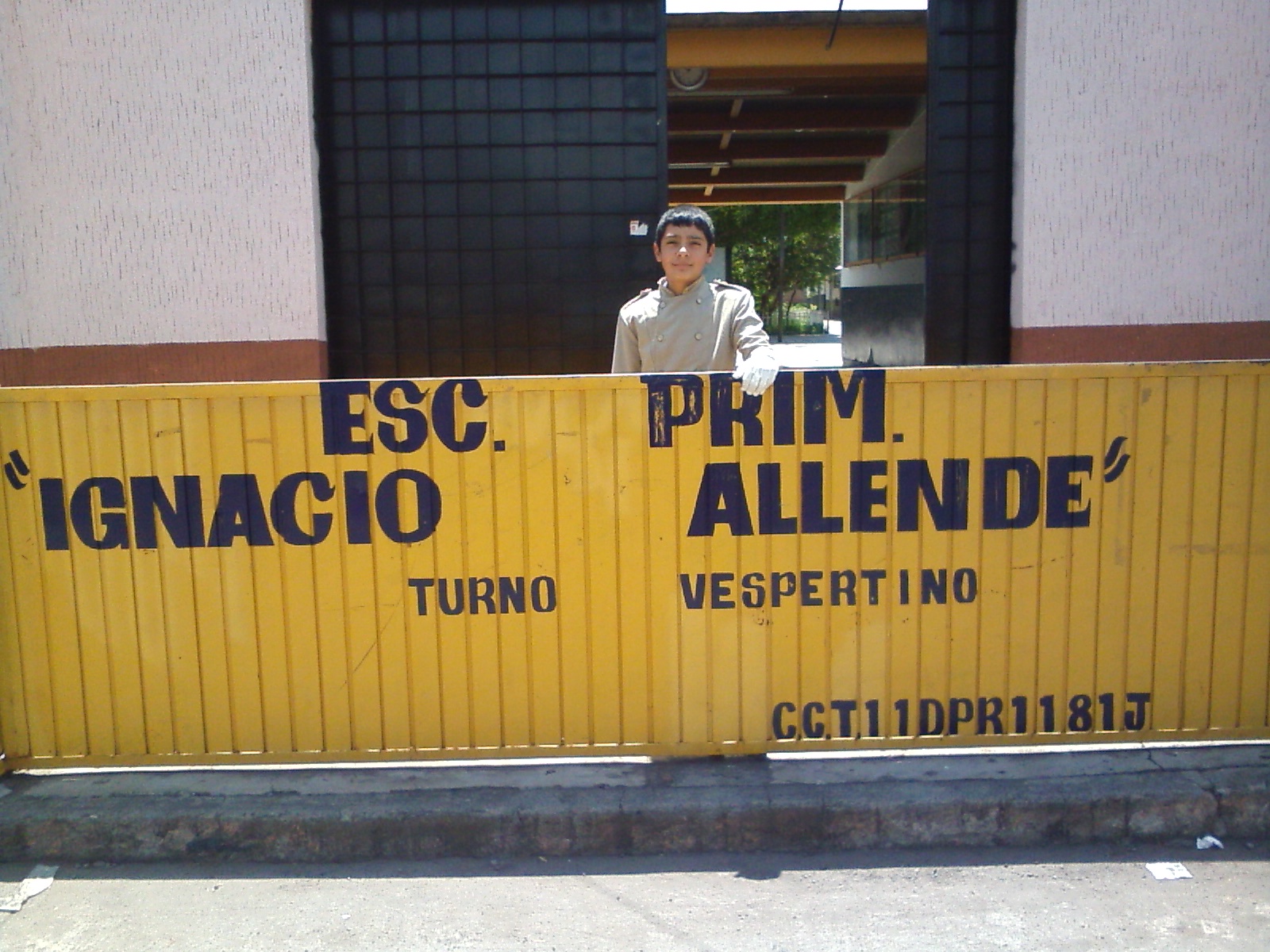
school days

My son did well in the traditional classroom and besides being in the honor roll all 6 years was part of the escolta (honor guard) in sixth grade. As only the best and brightest are chosen, (See Independence day) it was quite an honor. He was also selected by his teachers to read a despidida (farewell) poem during the graduation ceremony. His high achievement led to his being recommended into the better of two secondary schools in the area, and a shot at the matutino (in the morning) session.

*************************************************************


disclosure

10 Comments

Filed under Education, Parenting Challenges and Cultural Norms

Why we chose to send our child to preschool in Mexico

parade marching

Marching in the Kinder parade for Independence Day.

Before you get all up in arms, our choice in formal education was made with the idea of finding what was best for our son. We live in rural Mexico, and the educational system is a bit different here. Not better, just different. Our ultimate goal has been and continues to be adequate life-learning for our son, and that has included sending him to school.

In Mexico, kinder (preschool) starts at 2, yes 2. The little tots typically attend school from 9 am to 1:30 pm Monday thru Friday, with no nap time. Children must be the minimum age for a grade the December of the year they begin school. This means that children born on January 1 are more than 12 months older than their classmates born December 31. Talk about classroom diversity!

We arrived in Mexico when my son was 4 years old, which was just as well because starting school at 2 was not in my plans. I kept him at home with me until August, so he actually was 5 when he began school. We opted for a private, bilingual kinder, mostly because I was able to get a position there and teach my son half a day, along with 20 other 4 and 5-year-old Mexican children. Overall, it was a good experience for him (though not so much for me). (Learning and Teaching Year 1) It allowed him to improved his Mexican Spanish in both formal and informal situations and keep up his confidence in the process since he was the top English student.

Kinders (preschools) typically offer music, art, some sort of physical education, math and reading. Students are given homework daily in the hopes that it will instill a sense of responsibility in them. It seldom does. There is an almost unholy quest for students to be able to read before they finish kinder. Fortunately, Spanish is a bit less complicated than English in regards to reading (The Easiest Language to Learn) and most children are able to master basic Spanish language reading skills.

kinder parade

Marching in the kinder parade!

Quite a lot of time is spent on events, Grandparent’s Day, Christmas, Day of the Dead, Children’s Day, Father’s Day, Mother’s Day, Carnival, Independence Day, etc.. Most of these events require the little ones to learn some sort of dance and memorize some poem or song. There are several parade marchings as well. The kids usually ride in floats, but it’s hard on the teachers and parents marching alongside.

tree planting

Planting a tree on Father’s Day.

There were some worthwhile activities as well. For Father’s day, dads and kids went to Los Areas Verdes and planted a tree together. For Children’s Day, several parents and teachers took a collection of toys to the remote villages of Los Amoles and Santa Gertrudis, then a clothing donation to La Ciudad de Los Niños (a local orphanage) and another children’s shelter in Uriangato. As the trees were donated, the toys were used, and we volunteered to drive, it really wasn’t much of a sacrifice on the part of the well-to-do parents whose children attended this kinder, but hey, something is better than nothing.

graduation

Kinder graduation

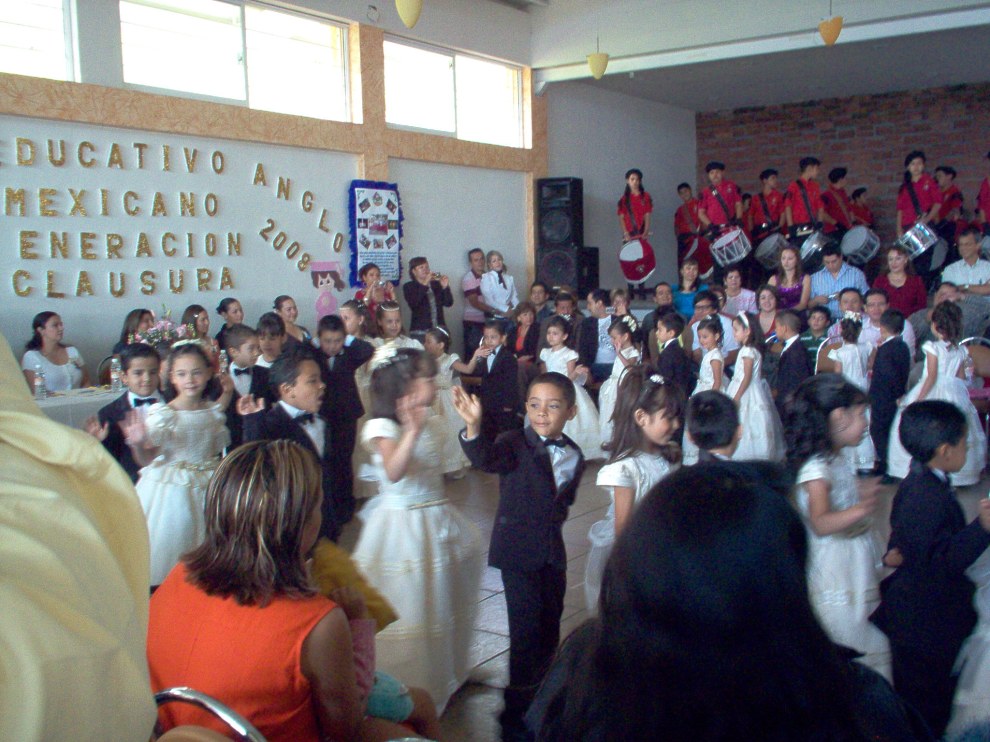
When the 5 and 6-year-olds are ready to leave the kinder, there is a graduation ceremony. At the private school we attended, the boys wore a little tux and girls wore mini-prom gowns to perform a bas (formal dance). They received diplomas and shook hands with the mesa directiva (school board). It seems quite excessive unless you take into consideration the comparable hoopla for first communion ceremonies.

despidida

Saying goodbye to the Kinder.

During this school year, we found a little bit of land to purchase, and my husband began working on our home. My son and I would head to school in the morning, then out to the construction site in the afternoons. Saturdays he and I would make the private English class rounds on the moto. He had his own “English” activity book and was an incredible incentive to students just starting out. It was an exciting, but exhausting, period in our lives with all the planning and building and just getting adjusted to the way things go here in Mexico.

********************************************

disclosure

7 Comments

Filed under Education, Parenting Challenges and Cultural Norms

More thoughts on Safety and Security

Last week my husband’s nephew L. was kidnapped and tortured. He was taken from the street along with his mother’s moto and held just a few blocks from his aunt’s house. He was stabbed twice in the back and had his ear nearly cut off with a machete. He escaped after 3 days of torture, naked and handcuffed. He was picked up and taken to the hospital where he was stitched up. Three of the four sequestradores (kidnappers) were arrested according to police. His mother sent L. into hiding.  He has just turned 20.

Is this boy evil enough to be tortured?

Is this boy evil enough to be tortured?

Being the mother of a son, this incident awoke a deep-seated fear in me, albeit my son is only 12 and a good boy. But you see, when I met L.,he himself he was 12 and a good boy too. So as parents, my husband and I began rationalizing away our fears. L. must have done something to deserve this treatment. Therefore, it was karma, justice, etc. And as our son hasn’t done anything so bad that he would be kidnapped and tortured, he would be ok.

We had some rationale for our thoughts.  This isn’t the first time L. has been involved in a violent attack. A few years back, his liver was damaged during the 13-second initiation beating rite of Sur 13. (See On Safety and Security) Then his mother’s boyfriend did a stint in jail for possession not so very long ago. (See Failing at your own business–Taxi Service) Part of his gang membership obligations included selling pot. He also used pot to cope with the constant pain he still has from his injuries. Is that enough to deserve torture? It hardly seems so.

If it wasn’t hedid, perhaps it was who he was involved with. As a street pot distributor, he would know who brought the drugs into town. Three days after L. escaped, two suspected drug distributors were murdered in Moroleón, one of them a transito (traffic cop).

You won’t find much of this information in the local newspaper, although other newspapers in Guanajuato have picked up on some of the assassinations and have reported on them or rather reported the gory details after the bodies have been found. But as Moroleón is a small town, no matter how much it wants to believe it is a city, the information spreads, although in whispers now.

The story being told is that someone turned traitor against those who previously were in “charge” of Moroleón and have been given permission by los estados (State Police) to eliminate those still remaining with the understanding that future control will be given to this person. These bodies that are “found” are executions. No one is ever arrested. No one is brought to justice.

Aliada al cártel de Sinaloa, La Familia domina Guanajuato

Ejecutan a 5 personas en Moroleón

Una menor de 16 años entre los ejecutados en Moroleón

Balacera en Moroleón; al parecer hay cuatro muertos November

Lo ejecutan amarrado de pies y manos

Ejecución múltiple; hallan a cinco sin vida

Ejecutan a hombre en Moroleón

The body count has become so high, that the powers prohibited the local radio station to announce “fallecidos” for a time, which is how most friends and family members learn the day and time for the funeral and novena. (See La novena)  I expect their reasoning is, see no evil, speak no evil, and hear no evil.

So as parents of a pre-teen boy, we hope that the executions end soon. We increase our vigilance over our son, although he resents the restrictions. We look for talismans to hold out as wards against evil. Be home before dark. Come straight to where your dad is working from school. Don’t visit L. Bring your friends to our house rather than going to their houses. Will it be enough?

students

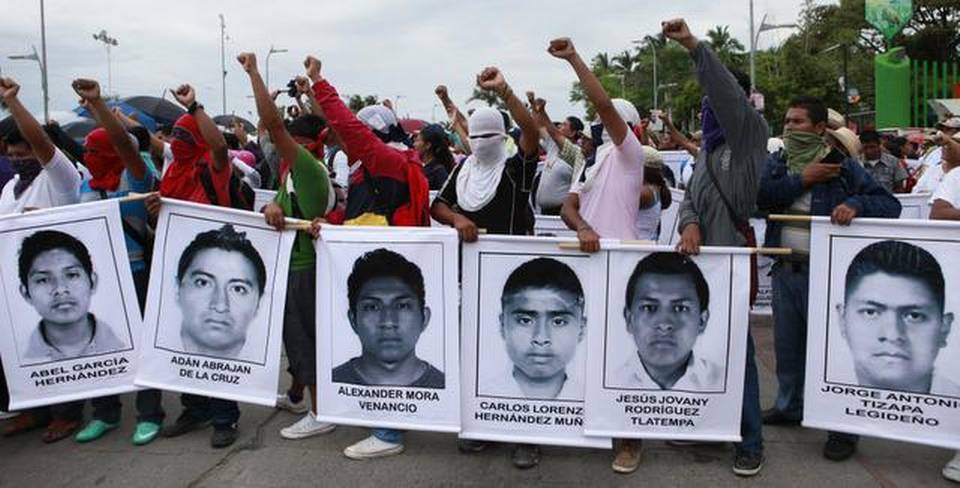
My son is not involved in gangs or drugs, but that wasn’t protection enough for the students in Iguala. And we already know that there is no justice to be found in México. (See On Life and Liberty) (See Justice for All) What more can we do?

Así fueron los últimos momentos de los estudiantes desaparecidos en México

***********************

disclosure


4 Comments

Filed under Parenting Challenges and Cultural Norms, Safety and Security