Category Archives: Getting Legal

Modern Day Marias–Nicole the liberator

There is so much about Maria that we will never know. The snippets that were recorded leave out nearly everything important. However, we know something about her from how her children turned out. After all, a mother is a child’s first teacher. Maria’s firstborn son, the day he was elevated to manhood, chose the verse recorded at Luke 4:18 (The Spirit of the Lord [is] upon me, because he hath anointed me to preach the gospel to the poor; he hath sent me to heal the brokenhearted, to preach deliverance to the captives, and recovering of sight to the blind, to set at liberty them that are bruised) as his personal creed. Maria must have been like the virtuous woman of Proverbs 31:20 “She stretcheth out her hand to the poor; yea, she reacheth forth her hands to the needy” just as today’s Modern Day Maria, Nicole, is.

I’m Nicole. I am originally from the northeast, lived in the deep south for six years where I worked as a federal public defender, and now I live in Baja California Norte near the U.S. border. I’m a human rights lawyer working with asylum seekers and deported persons who are trauma survivors. All of my cases are either low bono (meaning low fee) or pro bono (meaning free). I do contract work for other attorneys in the U.S. writing expert reports or serving as a mitigation consultant in federal criminal and immigration cases. Basically working one job to fund my non-paying dream job.

I’m still working on a website. Here is the Facebook page: Law Office of Nicole Ramos

Living in Mexico has changed me. I no longer take people or things for granted. I appreciate every little thing that I have because financially I have struggled here as I’ve been working to get my human rights project off the ground. I have spent many a night eating beans and tortilla, and have not bought a stitch of clothes in over a year until recently when I finally reached a point where I could buy two shirts. Yay. I am happy every day of my life, whereas I used to be sad most days before. Even when I get angry on some days, I am still incredibly happy over all. People’s compassion and resilience inspire me. Listening to live classical music or watching live dance inspires me, CBP angers me. A lot.

That's me with a child client who was seeking asylum and traveled throughout Mexico with other migrants by herself.

That’s me with a child client who was seeking asylum and traveled throughout Mexico with other migrants by herself.

Here I’ve also realized how precious family and relationships with friends and neighbors can be. Working with asylum seekers who have had to flee their homes, leaving behind all the people in their lives whom they love, I realize how lucky I am to live in a place where I can grow my personal relationships in safety, and not be forced to run and leave people behind. I cherish people in a way that I never imagined.

My belief system has not changed, but it has become stronger, even more of what it has been at its core for so long. Mexico has given me the chance to test how far I am willing to go and how much I will personally sacrifice for my beliefs — that the most vulnerable among us deserve justice and the quality of that justice should not be measured by a person’s ability to pay, even if that means that I must go without material things and creature comforts. Thus, I have become even more passionate, and more aggressive in righting wrongs for people whose rights have been violated. Because the border is a militarized zone and in order to protect my clients’ rights, I have to be as aggressive as the government agents who would seek to disregard those rights.

I had to learn Spanish. I was not raised speaking Spanish, and only spent 8 months living in Argentina following law school. My Spanish coming to Mexico was rudimentary. It was very overwhelming at first, and my Spanish will never be perfect but I work hard at it and have improved more than I thought possible. My single motivator is that in order to help my clients, they have to feel like I speak their language on some level, and not only speak through my translator and that I think unfettered communication is important enough to work hard to learn their language.

I have also learned how to use a comal (Mexican cast iron griddle), how to roast chiles on an open flame and do other cool things with food, and how to drive aggressively but safely. There are still so many things I have to learn but I’d really like to learn how to make candles and how to garden.

I struggle with the fact that I am trying to do the work of an organization as a solo practitioner. So I struggle with the fact that there are only 24 hours in a day, and that my body needs sleep and food. I receive a never-ending stream of phone calls and emails and have no time that is my own from the moment I wake up to the moment I go to bed.

I also struggle with the fact that I do not have a formal source of funding yet. This project unfolded organically, but very quickly over the last 10 months. So I have had to take contract work from other attorneys, writing expert reports and doing consulting work, in order to make money to pay the bills, while at the same time, working a second unpaid job of sorts with my pro bono asylum cases.

That's me and my partner. my biggest supporter.

That’s me and my partner. my biggest supporter.

Coffee and the unconditional support of my partner keep me going. My partner is with me every step of the way, helping to interview clients, to comfort them, to help me make sure I remember to sleep and eat, and never says no to me when it comes to helping people and sacrificing comforts in our own lives.

It isn’t a professional achievement per se, but I am most proud of losing my fear. I used to have really incredible anxiety. I would worry myself into a state of sadness. But since my move to Mexico, I can say I do not have fear anymore the way that I once did. I feel braver, even the moments when I am still a little afraid. I think my clients have given me this courage. They have been the bravest people I have ever met in my life, setting out through uncertain and hostile territories to get their families to safety. They have survived unimaginable horrors. But they keep going, refusing to be killed, refusing to lose their resilience. They make me want to be brave.

I miss my family. I miss being able to hug my mom more than the amount of hugs that I can get in during one visit a year. I miss some of the foods, like arroz y gandules and tostones. I miss the art museums in Philadelphia and New York, and the big leafy green parks. I miss walking through the woods in the Wissahickon Park.

I used to have a killer designer wardrobe. Even though I was a federal public defender, I was still well compensated for a non-profit sector attorney so I could afford to shop big. And while I still appreciate fashion, I’m just never going to be able to afford it again and that’s okay. I have no free time. I would love to have just a week of laying on a beach reading books and sleeping. In another life, I enjoyed museums, live music, dancing all night in clubs, and weird performance art.

I would say that the defining moment in my life here in Mexico was when my cat was killed by people who broke into my home (albeit likely accidentally but it still sucked). She was a kitten, not more than 18 months, and she was my favorite. She sat on my lap all day while I worked. I cried for a week. I did not shower. My hair got so matted I looked like I was in the early stage of dreadlocks. I couldn’t eat. I’m fairly certain I smelled bad. But I got to the point where I realized I could not sit around in my own pain all day because even though I had lost someone very special to me in a violent way, others had lost so much more and that I had to get off the couch and stop behaving like my pain was so special and tragic.
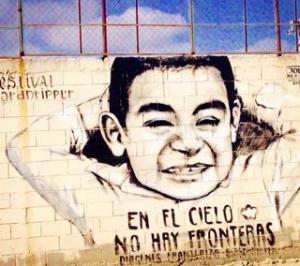
That's part of the U.S.-Mexico border wall.

That’s part of the U.S.-Mexico border wall. It reads “In heaven, there are no borders.”

My current goal is to incorporate my now unfunded project, The Border Rights Clinic, into a formal nonprofit. This will require me to register in both the U.S. and Mexico. I need funds for start-up costs such as registering an organization and other associated costs, i.e. notary costs, as well as funds for things like paper and toner. People can donate to the Border Rights Clinic at borderrightsclinic@paypal.com. The clinic is based in Baja California Norte and represents individuals seeking asylum in the United States. All proceeds go toward funding the project’s monthly legal clinics which it is hosts in partnership with other community organizations in Tijuana, and also funds the pro bono legal representation of low-income asylum seekers from the moment they try to present themselves to CBP through their subsequent detention and the process of applying for asylum in the U.S., including their representation in court.

I am also always in need of qualified volunteer interpreters and document translation. I also need help building the website. If you can volunteer in any way or know of someone who would benefit from services that I can offer, please contact me through my Facebook page.

*************************

disclosure

6 Comments

Filed under Getting Legal, Guest Blogger Adventures, Safety and Security

Failing at your own business–online teaching

determined woman

Out of the blue in April, I received a response from an online teaching company that I had applied to in January. Well, HOT DOG! They paid in US dollars which is a whole lot more than more than measly pesos and averaged 10 to 15 USD per hour. Sign me up! 42 emails and 3 months later, I’m about to start.

So what happened? Well, I started with the screening test. It had a variety of grammar, vocabulary, and idiomatic expression questions. No problem. Then there was the voice recording attachment. That took me a little bit to figure out, but I did it. I apparently did well on the test and my voice was acceptable (not too much of an accent) and since I highlighted that I have experience working with Spanish speakers on my resume, I received the official job offer letter and I was invited to fill in the HR paperwork.

The first round of paperwork came with instructions on how to fill it out. I was to sign and return the job offer letter, the confidentiality waiver, the employee handbook, the pre-employment background check release form, and the handbook acknowledgment form. So I did.

It was the second round where I had some issues. The paperwork involved included a direct deposit form, an I-9 form verifying that I was legally allowed to work in the US, employee information sheet, W-4 and the optional payroll card enrollment form. Not one was correct the first time I turned it in. The easiest to fix were the employee information sheet and W-4. The company required a US address, so I gave them one. (See Trade Route Established)

The I-9 should have been a piece a cake. I’m a US citizen, right? Well, I am, but that isn’t good enough. I had to get someone to verify that I was. As I haven’t been in the US in some time, my driver’s license has expired, but my passport was still current. (See Renewing our passports in Mexico). As I would be a remote employee (not in the same state as the company) I would need to go to a notary and have my passport verified as authentic. Easier said than done. The nearest US notary was in San Miguel de Allende and I didn’t have the time nor the money for the trip. So I asked another person who also worked for this company and she said that she had gone to the local presidencia (town hall) and had them stamp the form. So I went and asked and they said no. I had to go to an official notario (notary) and they charged the big bucks. I took my Mexican driver’s license(Getting legal–license to drive), my US passport and my Mexican permanent residency card. (See Residency at last).

The notary requested the company letter requesting the verification to be translated, which I went and did. When I returned, he wrote the official identity verification letter for his files, which I proofed. He signed and stamped the company letter and charged me 1,100 pesos. Yikes!

The notary verification wasn’t enough for the company. A company employee needed to verify the notary verification and the passport. However, as I was still a remote employee, I was told to pick someone to sign the paper for me acting as a company representative. I requested a little more information on this and was told that it could be anyone, as long as I trusted them. Ok. So I had one of the kindergarten teachers sign off on it.

After all this, I scanned and sent the forms along with a copy of my identification to HR. Rejected! It turns out I had never signed my passport in the four years that I had it, so it was not valid. Ooops! I signed it and scanned everything again and sent it all along, again.

Then my direct deposit form was rejected. Apparently, foreign banks are not acceptable. So I would have to apply for the payroll card. So I did. Only I couldn’t figure out how to submit it. The fax number on the application form was incorrect. When I tried to get more information from the website, I was redirected. After repeated emails to the company, they responded that I could email the payroll card application which was nowhere to be found on the application. The company representative was so kind as to include it in her clarification email. So I emailed it. Then I had to wait for confirmation from the payroll card company. Once I got that I emailed it to the online teaching company. The card was sent to my US address. It took 10 days for me to get the card number since my trade partner was on vacation, but finally, I got it. I set up the virtual bank account.

The next step was to resubmit the direct deposit form with the virtual bank account connected to the payroll card. I was to submit it with supporting documentation. Unfortunately, now my printer was giving me fits. It would only print in black and white. Then quit printing altogether. It took two days to get it working again. Then it only printed in blue. Well, it would have to do.

But when I sent my direct deposit form, it was REJECTED. I couldn’t believe it. I sent an email asking what more they needed since I’d submitted every bit of documentation requested. The only thing I could figure was that the bank watermark wasn’t visible because I could only print in blue.

So I begged the school secretary to print it out for me in color. I then rescanned everything and sent it again. ACCEPTED!

Next, I received an email that they urgently needed my state tax form. However, the state that I listed does not have a state withholding requirement, so there was no form to submit. I emailed that information to the company. Jeez! A lesser woman would have given up by now. But not me!

disclosure

11 Comments

Filed under Education, Employment, Getting Legal, Teaching

Selling Myrtle Baja y Alta

1424459043912

It is with a heavy heart that I set about finding a buyer for Myrtle, our VW bug. We had racked up some expenses and with the price of gas still high, it was the logical vehicle to sell. We use our motorcycles every day and the truck serves as our water and animal transportation, so Myrtle had to go.

The secretary at the school was deperately in need of a vehicle and soon a deal was struck. The next step in selling a vehicle is dar de baja (I have no idea how to translate this expression). This means turning in the tarjeta de circulacion (permission to circulate) and las placas (license plates) so that the vehicle can be registered in someone else’s name.

oficina de recaudadoraAs Myrtle was registered in my name (See Placando Myrtle), it would be up to me to make sure it was done in a timely manner, within 10 days. Both license plates and the permit must be returned to the Oficina Recaudadora where the vehicle was registered. In Myrtle’s case, this was in Moroleon, even though the new owner would be registering it in Uriangato.

If one of the license plates happened to be missing, there would be a fine up to 392 pesos and if both were missing, a fine of 736 pesos. Why would license plates be missing? Well, they could have been stolen, fallen off, or removed by el transito (traffic cop) for a parking violation. In the event of missing plates, in order to complete the baja transaction, the owner must present a letter from los Transitos saying that a fine is not outstanding, however a fine would still be paid at the time of the baja. (See El tramite de alta y baja vehicular paso a paso)

In the event that that the tarjeta de circulacion permit went missing, it would be a fine of 106 pesos. Any outstanding money owed to the government, like parking tickets and the like, must be paid before the transaction is finalized.

The owner also must show a photo id, driver’s license, passport or IFE (voter’s registration card) and bring a copy of it. The actual cost of the proeedure is 79 pesos.

I finally managed to get to the office to complete the transaction sandwiched between making a lab appointment and the actual appointment (See blood draw) on yet another teacher meeting day (See Political wrangling). There was some delay as the secretary hadn’t yet removed Myrtle’s placas (plates) for me to turn in. We couldn’t find a screwdriver at the school, so she zooped around the block to have a mechanic do it for her as her incredibly pregnant stomach didn’t allow for much bending over.

That done, we headed to the office and took a number. It was only about a 45 minute wait, so that’s like lighting speed here in Mexico. I was happy about this especially since I had spent 3 hours waiting for the lab appointment set up that morning and would spend another 2 hours standing in line at the caja (register) to get my lab paper stamped authorizing the actual blood draw, which took less than a minute.

I handed my driver’s license and copy, the license plates and my tarjeta de circulacion to the lady behind the glass and she entered the information in the computer. I clarified that I was turning everything in as I had sold the vehicle.

The secretary’s mother mentioned that her son has recently sold his motorcycle and hadn’t done this transaction. I explained (as my husband explained to me) that many buyers do not turn in the license plates and keep using them. This would be a risk to the seller as the vehicle would still be registered to him or her and in the event of an accident or traffic infringement where the vehicle was impounded, the previous owner would be liable. Thus, my concern that the transaction we were doing was completed in a timely manner.

Myrtle's new owner

Myrtle’s new owner

I received a receipt which I gave to the secretary, Myrtle’s new owner, so that she would be able to dar de alta (register the vehicle, receive license plates and circulation permit) in Uriangato. My part was done. I patted Myrtle on the hood and said goodbye.

Just in case you want to know, in order to dar de alta, the new owner must present the original title of the vehicle with cedo los derechos a (name of new owner), ceding the rights to said vehicle to the new owner and the signature of the seller, proof of residence of the new owner and the receipt of la baja being paid by the previous owner. If the new owner is foreigner, proof that the buyer is legally in the country, like the permanent residency card.

Just to be clear, these are the general procedures for the state of Guanajuato.  Other states may have other requirements and procedures in place.

*********************


disclosure

3 Comments

Filed under Driving Hazards, Getting Legal