Category Archives: Safety and Security

And Justice for All?

There was no justice to be had for this man in Moroleón.

There was no justice to be had for this man in Moroleón.

The court proceedings concerning the moto accident between my in-laws and the police finally occurred a year and a half after my mother-in-law’s death (See on Life and Liberty). During the month of September, my father-in-law reported to court an average of 2-3 times per week.

So 2-3 times per week, my father-in-law rode his bicycle from La Yacata to the courthouse or the lawyer’s office.

This legal process was exasperated when the police officer involved or his lawyer or the witnesses did not appear in court and my father-in-law spent hours cooling his heels in the outer office.

We thought that perhaps that the no-shows would be in my father-in-law’s favor. Little did we realize that their absence was a mark of how trivial they felt these proceedings to be since they already knew what the outcome would be.

Decisions of guilt or innocence are not determined by a jury of your peers in México, but by the sole discretion of the judge. In Moroleón, all penal cases are determined by La Juez, whose children I had been teaching for several years. I had come to respect her over the years and appreciated her advice during the difficult week when my mother-in-law died and Chuchi slapped me with a demanda (See The First Demanda and La Novena). However, mitigating this esteem was the fact that her husband was the forensic specialist for the police in Moroleón. And him I was never too impressed with. The forensic evidence submitted by the police included a film of an accident that wasn’t with my in-laws and a dent in the driver’s side door which was used as conclusive “proof” that the moto hit the truck and, therefore, the fault of my father-in-law, completely discounting the conflicting evidence of the injuries sustained by my in-laws.

Forensics here is proclaimed the new messiah and unlike CSI, there is no attempt to find logical connections between the evidence and the action. For instance, if your fingerprints are on your own wallet that was stolen, the judge might determine that you yourself gave the wallet to the thief since there were no other fingerprints on it. Whatever!

With such logic, a dent in the door must mean that the moto hit the truck and caused the accident, not that the force of the impact caused the moto to spin from the front of the truck around to the opposite side and hit the door after throwing the passengers into the air–or so it would seem.

Despite witness testimony, despite testimony from my father-in-law, despite the injuries sustained by my in-laws all charges against the police officer were dropped and instead the charges were laid at my father-in-law’s feet for him to disprove. He awaits sentencing at the end of the month.

An appeal has been submitted to the district court in Celaya, but no court date has been set.

************************

disclosure

15 Comments

Filed under Safety and Security

Driving Hazards–Police and Military stops

Transitos are the traffic cops in México and are not armed.

Transitos are the traffic cops in México and are not armed.

Then there are police checkpoints to contend with. Arriving in Celaya, on our trip from Moroleón to San Miguel de Allende (See Getting Legal–Trip 1) we were stopped by the transito (traffic police) because our truck didn’t have a current verficación (inspection) sticker. I put my head down and pretended to be invisible while my husband negotiated the mordida (bribe). On the way back, we were stopped yet again by the same group of transitos (traffic police). Being tired and cranky, my husband made the mistake of complaining that we had already paid our dues in the morning. The transit cop had him get out of the vehicle and then gave him a dressing down for being chismoso (a tattletale) before sending us on our way with his mordida (bribe) of course.

Bribery is called mordida (bite) as in a bite of an apple.

Bribery is called mordida (bite) as in a bite of an apple.

To bribe or not to bribe, that is the question to consider.

Transitos are open to bribery. However, whether you offer a bribe or not depends on who you are. If you are female, typically no bribe is offered and no ticket is given, you may not even be stopped. Unless, of course, you are an aggressive female, then you are treated like any male in this machismo power play. (See Driving Hazards–Crossing the Border) If you are a non-Mexican male, you must understand this an alpha male thing and if the phrase “se puede reglar esto” (this can be resolved) is used by the transito (traffic police), discretely hand over $200 pesos. Transitos (traffic police) will stop you for missing inspection stickers, missing or out of state plates, for the driver not wearing a seatbelt, for anything that might be not working on your vehicle, like a tail light or just because. They will ask you for your license and tarjeta de circular (permission to use the vehicle in the country), so it pays to have both current. A transito (traffic police) can take either card or your placas (license plates) and hold them for ransom until you go and pay the fine.

Los estados are the state police in México and are always armed.

Los estados are the state police in México and are always armed.

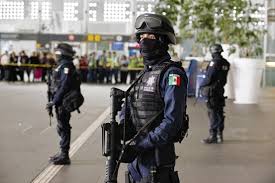
The next level up is the random inspection typically done by the state police. These officers wear large pistols, and are sometimes masked, so are not to be confused with the transitos (traffic police), who do not wear guns and never wear masks. Los del estado (state police) may stop you for having out of state plates, for vehicle identification number (VIN) verification to see if you are driving a stolen vehicle, for a license or tarjeta de circular (permission to drive in the country) check, for driving a nice vehicle, or whatever other reason occurs to them. The mordida (bribe) is much higher and trickier to negotiate. They may take your vehicle or any other items that aren’t permanently attached as part of the “inspection.” It doesn’t to any good to go and file a complaint. (See On Safety and Security).

Los federales are national guard in México and are always armed.

Los federales are the national guard in México and are always armed.

Los federales (federal police) cruise around looking for vehicles to confiscate. High risk vehicles are newer cars and chocolates (vehicles that have U.S. plates because they were never legalized at the aduana (customs)) We had more problems when we had a newer truck, but now that we drive a Mexican national that we like to call Butch (Chevy circa 1980) they stop us less. When stopped, the feds ask for the paperwork for the vehicle issued by the aduana (customs). Know that only the registered owner or direct relative may drive a vehicle that has been imported into México. We have had to show our marriage certificate along with the other paperwork to prove that my husband is permitted to drive the truck since it was registered in my name to facilitate border crossing.

Los militares are the miltary police in México and are always armed.

Los militares are the military police in México and are always armed.

Then there are los militares (military police). This is a complete barrier stop for all vehicles. All motorists are subject to search and all vehicles are inspected, for guns or drugs. Civilians do not have the right to bear arms in México, but many have guns. It just isn’t prudent to carry them in your vehicle, even for personal safety. We carry a machete in our vehicle, which is not illegal, and can also be used to cut grass along the side of the road for our animals when the occasion presents itself.

The guns these guys tote are eye-popping big. You can determine whether it is a legitimate inspection or not by whether the police are wearing their cappuchis (masks) or not. A legitimate inspection is done by unmasked military and nothing is removed from your vehicle. Well, the other type, it’s best to just grin and bear it and not give too much information about yourself or risk being marked as a prospective kidnapping target. (See On Safety and Security).

Fortunately, only the transitos (traffic police) stopped us on that first trip. (See Getting Legal-Trip 1)

*************************


disclosure

6 Comments

Filed under Driving Hazards, Safety and Security

Independence vs. Safety

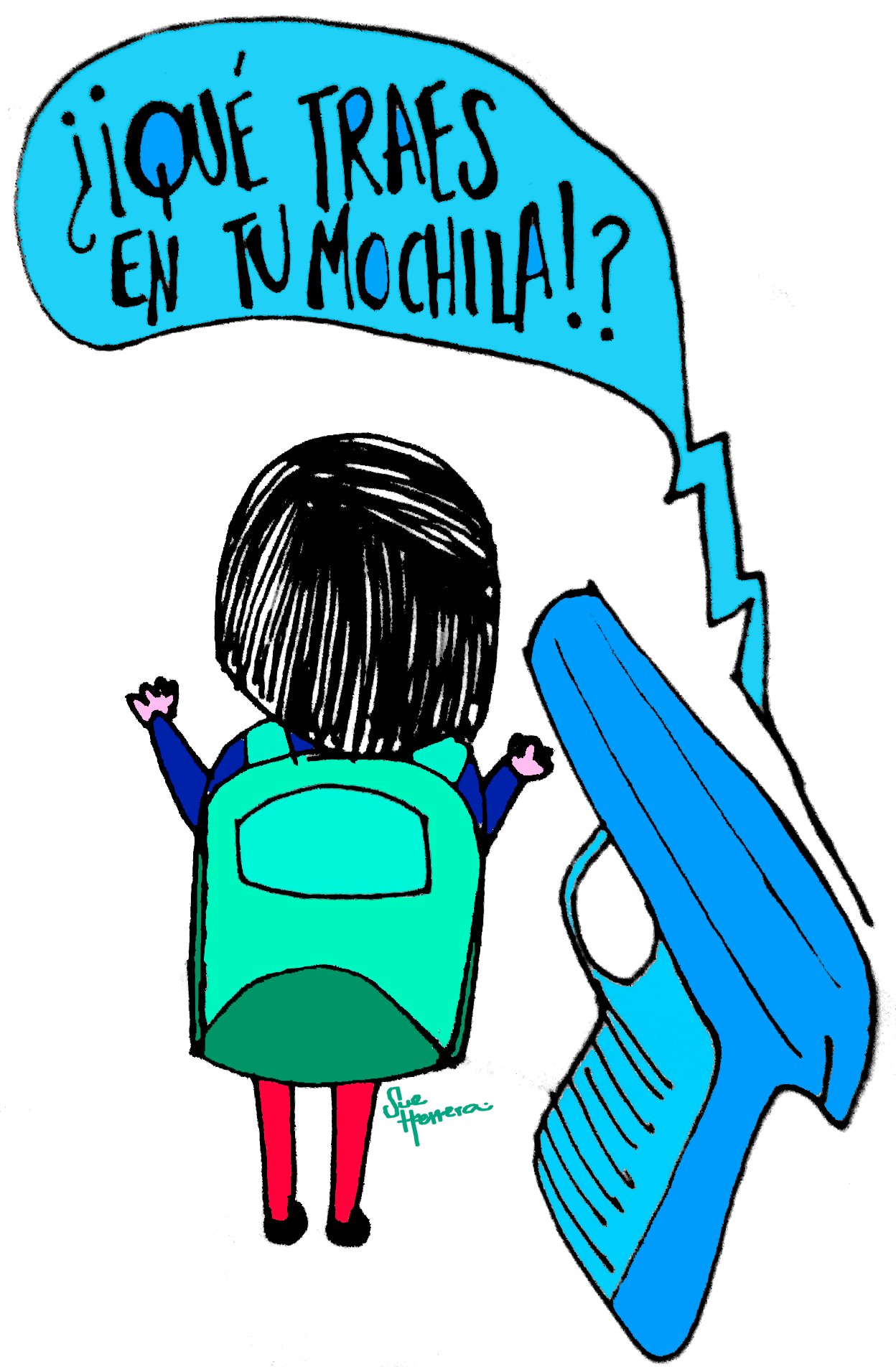
whats in the backpack

My little guy has grown into a big guy. At 10 going on 11, there are new challenges in parenting. Our most recent being, how to let him have more independence while still keeping him safe.

As you may have noticed, safety is a serious issue where we live. Those in charge of law enforcement, often can not be trusted. Then with the proximately of the Michoacan-Guanajuato border, there are the Michoacan bad guys that make raids in our area then skip back to their own territories. It’s hard to say who the bad guys are sometimes.

Up until this point, we drove our son to his class at 2 pm and picked him up at 6:30 pm on the moto. However, wishing to be more independent, he has decided that he would walk to school and back home. As he arrives after dark, I wait anxiously at the window until I see him trot around the corner. I worry about bullies or careless drivers. However, there are more worrisome things than these here. My son has been subjected to random backpack searches by Los Federales, (Federal police) on the way home from school. It makes me nervous, to say the least, not that he might be carrying weapons or drugs, but that a frustrated Federal might take out his aggression on my little boy.

Gangs are also problematic, although I expect not as bad as say, Los Angeles, California, USA. Here we have Sur 13, Los Zetas (Z) and La Familia (the mafia). Most of Moroleón is controlled by Sur 13. For the most part, they are in the employ of Los Zetas or La Familia, in a sort of a dog-guard capacity. They don’t start trouble but stand guard on the corners one of these groups wishes to have monitored. Periodically, they are sent as decoys for the Federales (Federal police) to come and hassle and pick up for petty drug-possession, while a bigger transaction occurs on the other side of town. Typically, they are compensated for their time in el bote (jail) and out on their corner watch the next day.

Being initiated into Sur 13 is as bad as you might see on TV. My husband’s nephew L was inducted about 2 years ago, and it nearly cost him his life. The 13-second beating by gang members that he was subjected to damaged a good portion of his liver. A week or so later, after eating some particularly greasy chicharrones (fried pig skin), his liver stopped functioning. He was taken to the Regional Hospital, where he was basically given up for dead. Only one doctor thought he could be saved because of his youth, just 17. The doctor had him transferred immediately to León, a state-of-the-art hospital facility. L survived, however, he has permanent liver damage.

Right now, my son is too young to be considered for gang membership. However, there are sort of junior gangs that hang about other corners, watching and learning from a distance. Obviously, in our family, this hanging about business is discouraged with liberal doses of study and work. Perhaps he might remember what happened to his cousin and if the time comes when he has such a decision to make, hopefully, he chooses a wiser course.

The next level up in the gang hierarchy are Los Zetas. They are found mostly across the border in Michoacan but have their representation here. They are known for telephone extortion scams. They have contacts within the community, typically at banks and money-wiring places like Western Union. They use the information from these sources to make phone calls to those who recently received money from the US. They may say that one of the victim’s family members has been kidnapped, usually a daughter. Then they might have a female voice screaming or asking for her mommy in the background to prove that she has been kidnapped. If X amount of money is not deposited to X account by X time, then the family will not see her again. The fear occasioned has led to the defrauding of countless families.

Another ploy is that the person who answers the phone is the intended target. The caller may say that the victim is being watched, that their location and the location of their loved ones are known, and then begin asking leading questions in the hopes the victim may give away his or her present location. Again, the fear and intimidation are incredible leveraging tools, and the victim is not only defrauded, but their sense of security shattered.

Phone safety has repeatedly been stressed at our home. My son is NOT to answer any unknown caller. His newly acquired phone is NOT to be shown even to his friends but hidden away in the secret compartment of his backpack. He is NOT to spend all his saldo (pre-paid phone money) in case he needs to call one of us in an emergency. I hope it’s enough.

La Familia is the mafia and has branches wherever you might go in México. They are not the law, they are their own law. They have wealth and power and prestige. Reportedly, La Familia was the authority that had the traffic camera deactivated at the corner where my mother-in-law was killed. Her death was not mafia related. However, this inactive traffic camera contributed to the subsequent cover-up by the police.

My husband’s youngest brother C is a gang member wanna-be. But if he really wanted to be, I expect he could go through the initiation just like the regular members, so maybe he is happy with his wanna-be status. He gets himself Sur 13 tattoos and talks big. This has caused him trouble. Once, while intoxicated, he threatened a member of Los Zetas with the wrath of La Familia. The Zeta backed down and left. Two days later, he was back. He ran C down with his truck, destroyed his moto, and put him in the hospital. Word on the street was he had investigated C’s boast, found that he was unknown to La Familia and decided he needed to be taught a lesson. C has since recovered but doesn’t leave the house these days.

My husband’s sister’s young boyfriend has also been involved in gang activity. He isn’t so smart either and seems he had broken in and stolen items (most likely drugs) from a house owned by La Familia. He fled Moroleón and tried to cross the border to the US to avoid retribution, and my husband’s sister went with him. They stayed away nearly a year. I’m not sure what deal was made, but eventually, G was permitted to come back, tail tucked between his legs, and L came trotting along behind him.

Apparently, he didn’t learn so well the first time, because recently he has been warned again, this time with the removal of several of those ‘sticky’ fingers. He again tried fleeing but was unsuccessful in escaping to the US.

Where I grew up, we didn’t have any sort of gangs, so really I haven’t a clue how to help my son make good choices with regard to gang membership and dealings. I have to trust that these examples his extended family has provided, and some perhaps his own classmates might yet provide, will keep him safe from harm. But things are just so uncertain, and I worry.

********************************

disclosure

2 Comments

Filed under Parenting Challenges and Cultural Norms, Safety and Security