
Rateros–really?

field

So after a hiatus of 6 months, we finally scheduled a community meeting in October. In case you think it’s an easy matter, it took the usual week to deliver the volantes (flyers) and there weren’t enough funds in the Yacata account to pay for our time or to put a “spot” on the radio.

Our main points were: 1–Request payments from those colonos (associates) who have not picked up their certificates ($100 pesos) or paid the $250 pesos for the lawyers. As tesorera (treasurer) I had the honor of reading la lista de verguenza (the list of shame), naming names and pointing fingers at colonos who have yet to pay their dues.

2–La Yacata is not a basurera (trash dump) and each person is accountable for his or her responsible trash or animal feces disposal (See Good Fences make Good Neighbors)

3–Explain the encuesta (interview form) that we would be requesting from each colono (associate) as to whether we could proceed with projects for los servicios (water, sewer and electric) beginning in January 2014. The approximate cost for all the services including pavement was $50,000 pesos per lot. That amount brought gasps of shock. The proposal would be that by December of 2014, all of the aforementioned items would be in place and serviceable. Theoretically of course. Things in México always take longer than anticipated.

4–Mention that there still were no resolutions for the second two demandas (lawsuits) against la colonia (neighborhood) (See Demanda 1, Demanda 2, Demanda 3) but all signs pointed to jail time for the perforador del pozo (well hole digger) and Chuchi. (See Negotiating for La Yacata) although that didn’t mean we would get back any of money stolen by said litigants.

5–Remind the colonos (community members) that is was a crime to cut trees without a permit. We were lucky enough to have someone from the Dept. of Ecologia at the junta (meeting) and were able to put into place a plan for the next time the motosierra (chainsaw) was let loose in La Yacata. (See Good Fences make good neighbors).

6–Ask that the colonos (community members) not lump the current mesa directiva (community leaders) with Chuchi and call us rateros (thieves). These types of comments particularly irritate me. As treasurer, I am responsible for giving an accounting of what money comes in and goes out, which I do every meeting. One colono said that he heard comments to the effect that there was some doubt as to where the money is spent. I about spit fire at that. I said that that simply wasn’t true. I have receipts for all expenditures and that anyone who was interested could come and check my books if they liked. With that, I gave the accounting for the current month. When I said that there was not a single cent left after delivering volantes (flyers) another lady–who had never come to a junta before and had never put a single solitary cent from her own pocket into the community fund–said that it wasn’t possible that it cost $600 pesos for flyers. I clarified that it wasn’t the copies that cost $600 pesos but the delivery. It takes nearly a full week for my husband, my son and I, to write up, organize and deliver the flyers. I snippily asked if there were any volunteers at the meeting that would do this work for free. I think I must have had lightening shooting from my eyes because everybody took a step back and remained perfectly silent. I went on to say that my interest was in the advancement of La Yacata, since I lived here, not the little bit of money that comes in. I think I impressed them with that point because another colono pointed out that we aren’t asking for money, only that those that owe, pay what they owe. The same lady then wanted to know why we didn’t take legal action to get these deadbeats to pay up. I retorted by pointing out that it would cost more to demandarlos (sue) them than we would get. With these cheery points, we ended the meeting and attempted to distribute encuestas (survey sheets).

The irritating lady was still there and wanted to be shown where “her” lots were. I pointed them out on the plan but didn’t have the inclination to walk with her to see them. She went to view “her” kingdom and straight away said she wanted to sell the lot that was up the hill. She turned to me and asked if I would be interested in buying it. I nearly blurted out “sure, with the money that I steal from La Yacata you *$&#)” but restrained myself. I say “her” lots because once upon a time her mother bought these 2 lots. When her mother died, her mother’s husband came and laid claim to them. He paid for the new registration and the $250 per lot for legal defenses. The lots, therefore, are in her step-father’s name and unless he authorizes it, she won’t be able to sell either lot.

My high hopes that perhaps we could advance into the 20th century have been dashed. So few encuestas (surveys) have been turned in that we will have to personally invite all 500+ colonos to come to Super Prez’s office and fill out the form. Of course, this will mean a further tax on my limited time and even more limited resources since La Yacata fund has nothing in it because of point #1–see above. A veces, es muy pesado ser parte de La Yacata. (At times, it’s a heavy load to be part of La Yacata).

*******************

disclosure


3 Comments

Filed under La Yacata Revolution

Getting Legal–License to Drive

driver

Most people here drive without bothering to get a license, it’s only a $200 peso fine if you are stopped by the transitos (traffic police) and you don’t have a license. I don’t have a license, although my moto has current placas (plates) and a permiso de circular (permit to drive) and is current in impuestos (taxes) y el refran (a yearly charge instituted to pay for the 1980’s Olympic games that up until 2012 was mandatory for all vehicles).

However, for some who enjoy a challenge, it is possible to get a driver’s license in México.

Here’s my husband’s experience. First, he had to make sure he had an official copy of his Mexican birth certificate, obtained from the civil office in his hometown of Cerano. We actually went to Cerano and applied for a new copy since the copy he had had been issued some 30 years before and was “different” than the newer versions or so they said.

Next, my husband had to obtain his credencial de votar (IFE) which is a voter’s registration card and believe it or not–free. This was obtained at the voter registration area (IFE office). He had to bring proof of residency, like a water bill or rent receipt. At the time, his parents were still living in Moroleón, so we borrowed a water bill from them. He presented his proof of residency along with two testigos (witnesses) who already had IFE cards from Moroleón to sign for him. We had only brought his mother, so she asked the next person in line to sign for him, a relative stranger. No one cared. The card came in about 20 days later and he went back with his receipt to pick it up.

Then my husband had a blood test at a lab to determine what sort of blood he is (o positive). This is listed on the driver’s license, I suppose in the event of an accident.

After that, he had to go to the community center for a physical of some sort. I’m not sure what this was for. His physical condition isn’t listed on the license, but maybe to determine if he was fit enough to drive.

When he had all these documents plus another proof of residency, like the electric bill we again borrowed from his parents, he took the originals and a copy of each to the transito (transit) office. In the office, he was given a few pages of the driving manual, not the entire manual, told to read it and take the test afterward. The first time he missed 7 (you can only miss 5 to pass). So he went back the next day, took the same test and missed 12, the same questions that were right the day before. The third day, he took the same test and didn’t pass again. So he asked what he needed to do to pass and slipped the $200 mordida (bribe) into his folded exam paper. He didn’t need to retake the test, nor take the driving section, nor take the eye exam, although he wears glasses to drive.

He waited around in the office for some other papers, the authorization I believe, which he took to another building, the oficina de recauado (payment office) about 2 miles away and paid there the $515 for a 5-year car driver’s license.

Note: The type of license is very specific. If you are stopped by a transito (traffic police) and have a license to drive a car but are driving a truck, you will get a fine. If you have a license for a moto but are stopped when driving a car, you will be fined. Etc.

Then with the papers marked paid, returned to the first building to receive his license. I haven’t attempted this process yet. I’m sure it will be even more tedious for me and I will need to present even more documentation. I can’t wait to tackle it.

******************************


disclosure

4 Comments

Filed under Driving Hazards, Getting Legal

Good Fences make Good Neighbors–unless your neighbors steal them

fence
La Yacata is not yet a full-fledged village, but it does have residents. And having residents besides us, we have neighbors.

So let me introduce you to my neighbors.

First, our oldest neighbor is Don A. He has been planting corn in this area for over 40 years, so feels like he owns the place. He and my husband have an ongoing “turf” war over planting and grazing areas in La Yacata. One particular quirk he has is that if Don A planted a terreno (lot) before, even if the property has changed hands, he continues to plant there. When the new owner tells him directly, usually with some sort of implicit threat, that he may not plant there, Don A sprays chemicals and kills not only his own crop but also poisons the grass that our animals eat surrounding it. No amount of talking to him about the harm of chemical pesticides has done any good. Recently, he himself was envenenado (poisoned) by his own sprayer and even after spending nearly two weeks near death, he was back at it as soon as he could walk, spraying gleefully about La Yacata.
poison
He also is a big believer in veneno (poison) for stray dogs in the area (See 101 Perritos) and his decapitated poisoned chickens have killed numerous of our pets both cats and dogs.
flood
We recently experienced hurricane aftermath storms in La Yacata and as a result had higher than normal rainfall in a very short period of time. Our backyard flooded, a good section of our crops on the hillside were knocked over and two chickens drowned in these rains. We counted ourselves lucky and went about cleaning up.

But not Don A. His most recent offense was destroying the banqueta (sidewalk) at the bottom of the hill to make an arroyo (gully) to try and divert the water runoff away from his house. Seriously, I can’t imagine how he thinks this will work. The sidewalk is about 4 feet higher than the land it surrounds and thus, with the exception of hurricane rains, acts as a dam to keep most of the water contained. Now that the floodgates have been hammered open, I expect he will have even more water in his house.

Don A has also started a business making charcoal.  He cuts down trees and makes this sort of enclosed mud and rock structure to convert the raw tree to charcoal.  He then totes it back to town on his tricycle for sale.

This structure contains the fire which converts the wood to charcoal.

This structure contains the fire which converts the wood to charcoal.

sheep farmer
Next, I’d like you to meet Bull Terrier, the neighbor opposite us on the next road. He started out with a herd of 20-30 borregas (sheep). Every day, he would follow them around as they rampaged fledgling trees, flowers, and crops in their quest for food. He had the gall to tell anyone that complained that our measly flock of 5 goats were causing all this damage, which just simply wasn’t the case.

Bull Terrier soon found that borregas (sheep) required too much maintenance (See Separating the Sheep and the Goats) and traded them for pigs. Pigs don’t have to be taken out to graze. Of course, pig poop is terribly smelly, but that doesn’t seem to faze him. The odor from his house is horrible.
trash
Bull Terrier does like a tidy house though and every day takes out the trash. The only thing is, the trash tractor does not come to La Yacata for pick up. So what does he do with his trash? He throws it on the roof of the vacant house across the street.
pig farmer
Then there are the Pig guys. (See Miss Piggy didn’t bring home the bacon) After we ousted them from our backyard, they moved up the street to dirty someone else’s backyard. They continue to feed chicken intestines to their pigs, which makes pig poop the most lethal chemical gas in la Yacata, and throw chicken feathers wherever they have a mind. Piles of moldy chicken feathers smell to high heaven, just in case you never had the pleasure, and take longer than a plastic bag to disappear.

One of several piles of rotting chicken feathers in La Yacata.

One of several piles of rotting chicken feathers in La Yacata.

The pig guys have begun cutting down the mesquite trees with a chainsaw in La Yacata (on lots not belonging to them of course)–with the intention of selling it in town. Mesquite leña (wood) burns slowly and has a pleasant aroma making it ideal for cooking. Now, as La Yacata is a semi-arid region and no other trees grow here and the mesquite grows so slowly, this deforestation is likely to become a problem in the very near future. I am currently on a quest to see if I can get a picture of them at it to report it to the Departmento de Ecologia (Dept. of Ecology).

This guy just cruised right into La Yacata and started hacking away with his machete. He said it was because the trees looked

This guy just cruised right into La Yacata and started hacking away with his machete. He said it was because the trees looked “muy fea.”

Another neighbor up the hill and his truck loaded with green cut mesquite.

Another neighbor up the hill and his truck loaded with green cut mesquite.

The pig guys are also very confrontational. On more than one occasion, they have stumbled to our door to demand restitution for some plant or other than they claim our goats had trampled or eaten. The thing is, if it were our animals, we would take responsibility for these actions, however, it isn’t and being accused unjustly is enough to make anyone’s blood pressure go up.
robber
Moving up the hill, there is the horse guy. He began his list of sins by obtaining a property certificate under false pretenses. As I am in charge of verifying ownership before certificates are printed for La Yacata, this was a problem left at my door. Even after repeated requests, he has not returned the certificate, although a new one has been given to the lawful owner. He also “owns” at least 3 other lots that he has not registered. Since it is also my job to maintain a current padron (owner list registry) this irks me.  (See Who owns What?)

One morning, we were awakened by some banging and went up to the roof to investigate. There was the horse guy, prying off laminas (corrugated sheet metal) off a structure we call la chueca (crooked) for obvious reasons. My husband hollered and he scurried away. Later when we went to tie up our animals to graze, we could see that 6 or 7 sheets had been removed. The owner of la chueca is over 80 years old and not able to get out to La Yacata much to keep an eye on his investment. But you better believe that once we see him again, we will report it.

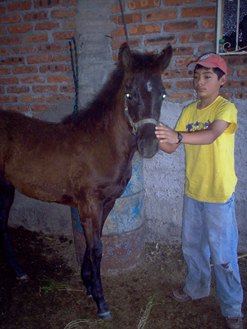
The horse guy was also seen removing bricks by the wheelbarrow from a recent construction site, tying his horse in cornfields not his own and making off with grava (gravel) and sand. After all this, my husband still went to him when he wanted maquila (stud service) for Beauty. (See Beauty’s Babies) The horse guy had 3 good looking stallions that he had reportedly “bought” and my husband paid $1000 pesos for an hour’s rental. I objected because nothing the horse guy does is on the level, but my husband went ahead with the deal. A week after this transaction, the previous owners came to claim the horses for non-payment. The rumor is that the stallions had been “vaccinated” to temporarily not produce sperm. As the horse guy provided the maquila (stud service) for at least a half dozen yeguas (mares) in the area, the joke is on the owners now believing their mares to be pregnant, like us. (See Immunocontraception)

Our new next door neighbor is a relative of the pig guys and yep, you guessed it, plans to put pigs in his newly built structure. You can’t imagine how delighted I am about that! During construction, my husband lent him our portable tinaco (water storage tank) and allowed him to leave his cement on our lot under a roof—again against my advice. He did this with the hopes that the owner would give him the construction job, but he didn’t. The workers he did bring in were not the most savory sort, but I expect they came cheap. They left their tortilla bags and soda bottles littered about the place. So every evening, I would gather it all up and throw it in the owner’s lot. And every morning, he would give me a dirty look, but I persisted until he told his workers to pick up the trash. That will teach ’em!

Lest you think all friendly feel is lost in La Yacata, we have some good neighbors. El plomero, although not as reliable as one might like due to his drinking, has always been ready to help out when needed. J. Gpe. of the Lpz clan also has been a good neighbor. He is the owner of the lotes prestados (borrowed lots we share-crop) and offers pleasant conversation, advice, seed corn and a handshake when he visits. The borrega guy and the cow barn guy on the street behind us, aren’t as friendly, but we have never had occasion to complain about their actions. And of course, my suegro (father-in-law) lives up the hill, so we often meet up under one of the few remaining mesquite trees for a Sunday afternoon cookout.

Recently, a new family has moved into the house that was el profe’s. It’s too soon to say what sort of neighbors they will be, but I hope that our fence is deeply entrenched enough to make good neighbors.

**********************

disclosure

16 Comments

Filed under La Yacata Revolution